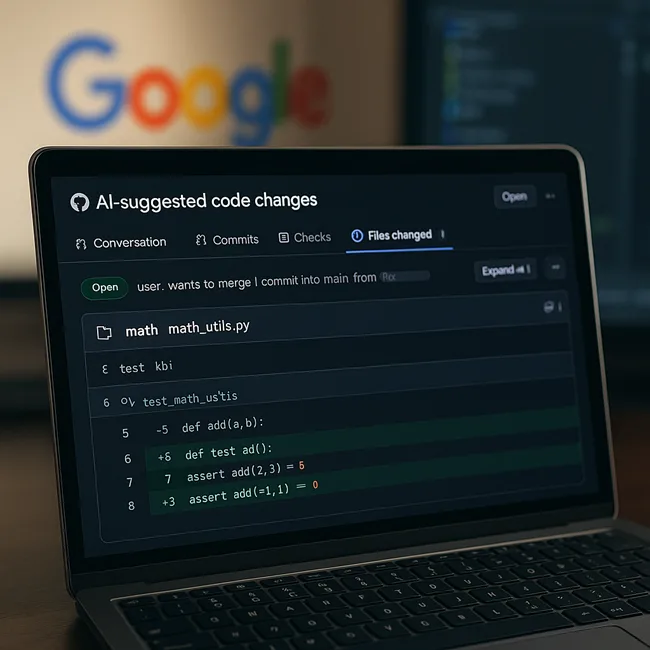
During its annual developer conference, Google I/O 2025, Google announced the public beta release of Jules—its AI-powered asynchronous coding agent designed to automate routine software development tasks. The unveiling follows a broader corporate push to embed generative AI into core developer tools, positioning Jules as a direct competitor to existing AI assistants such as GitHub Copilot and Amazon CodeWhisperer.
Jules is engineered to write unit tests, fix bugs, develop features, and update dependencies autonomously within GitHub repositories. Integrated with Google’s Gemini model and cloud infrastructure, the agent executes tasks in a secure, sandboxed environment by cloning the user’s codebase, analyzing it, and then offering suggested changes through a pull request-style diff. The agent is now publicly accessible through the Gemini API and can be used within Android Studio as well as GitHub.
How does Jules function as a standalone AI agent in real-world development workflows?
Unlike conventional code completion tools, Jules is designed to function autonomously. It reads a project’s structure, interprets developer instructions, and initiates multi-step code modifications. Once it clones a GitHub repository to a secure environment, it performs the required task—such as refactoring functions, writing test cases, or resolving compilation issues—before submitting the proposed changes for manual review.
Developers maintain full control over the integration process, with Jules offering transparency through detailed documentation of each code change. This review-first approach reflects Google’s aim to build developer trust and avoid the kind of “black box” concerns that have plagued other generative AI tools. The fact that the tool can scale across both front-end and back-end codebases, and align with broader CI/CD pipelines, gives it potential utility for teams dealing with large legacy code or complex multi-module architectures.
What are the key differences between Google’s Jules and other AI coding assistants like Copilot?
The competitive landscape for AI-assisted software development has quickly grown crowded, with GitHub Copilot and Amazon CodeWhisperer emerging as early leaders. Both tools rely heavily on autocomplete and context-sensitive suggestions that assist developers as they type. However, Jules differentiates itself as a coding agent, not just a coding assistant.
This shift in architecture means that instead of being reactive, Jules can proactively initiate and complete entire development tasks. According to the Fifty One Degrees report that first detailed the beta launch, Jules has shown early signs of being able to automate cross-project dependency updates, streamline repetitive workflows, and intelligently refactor redundant logic without constant prompting.
The underlying engine is powered by Gemini, Google’s multimodal large language model, giving Jules a reasoning layer that may enable broader autonomy compared to code-prediction-based models. However, some developers in early access programs have reported mixed outcomes. While Jules can speed up mundane tasks, its current limitations in handling complex business logic or unusual codebases still require manual oversight.
What could Google’s AI coding agent mean for developers, enterprises and the future of work?
For individual developers, Jules promises a productivity boost. It minimizes the mental load of repetitive coding chores—such as writing boilerplate test cases or squashing simple bugs—allowing human developers to prioritize creative problem-solving and architectural design.
From a business perspective, the implications are significant. Companies that integrate tools like Jules could shorten their development timelines, reduce QA costs, and improve release velocity. In fast-moving sectors like fintech or healthtech, where every week of saved time matters, such tools can offer competitive advantage.
However, these gains come with cautionary notes. There are longstanding concerns around reliance on AI-generated code—especially when it comes to maintainability, debugging, and accountability. If Jules makes a subtle error that goes undetected during review, it could introduce downstream bugs with costly implications.
Privacy is another concern. Google has stated that all code processed by Jules remains private and encrypted in isolated environments, but some enterprises—especially those operating under regulatory constraints—may hesitate to upload proprietary code to any third-party platform, regardless of assurances.
How has the software development community reacted to the Jules public beta launch?
Initial sentiment within developer forums and social media communities has been cautiously optimistic. On platforms like Reddit and Hacker News, users have praised the potential time savings while raising questions about the AI’s reliability in nuanced scenarios.
Investors and analysts, meanwhile, interpret the launch of Jules as further evidence of Google’s AI-first enterprise strategy. Since the introduction of the Gemini model, Google has accelerated AI deployments across consumer, cloud, and productivity platforms. Jules represents a clear attempt to secure ground in the developer tooling space, an area where Microsoft has enjoyed a first-mover advantage through GitHub Copilot and Azure integrations.
On Twitter and LinkedIn, the hashtags #GoogleJules and #AICoding have sparked discussions on whether AI agents will shift the role of software engineers from “writers of code” to “reviewers of AI outputs.” Some see this as an evolution, not a threat, while others warn of creeping deskilling and an overreliance on machines for critical software functions.
What are the expert views on autonomous AI coding tools like Jules and their future in enterprise development?
AI in software development is moving from a co-pilot phase to an autonomous agent phase—and Jules is among the first visible examples of this evolution. Industry experts view the transition as inevitable but urge teams to adopt such tools incrementally.
While the allure of faster delivery and fewer bugs is strong, over-automation can create blind spots. Developers must still understand the code, ensure it aligns with architectural standards, and catch errors AI might miss. Additionally, Jules and similar agents will force organizations to revisit coding guidelines, review processes, and risk management frameworks.
More broadly, autonomous coding agents may alter team dynamics. Junior developers, who traditionally cut their teeth on repetitive tasks, might now start with higher-level work—raising both opportunity and training challenges. Jules is unlikely to eliminate jobs, but it could significantly reshape how engineering teams are structured, what roles are prioritized, and how productivity is measured.
Will Jules redefine how modern software gets written—or just raise the bar for developer tools?
Jules is not just another productivity tool—it is Google’s strategic bet on the future of AI-led software development. By enabling codebase-wide changes, planning task flows, and pushing commits autonomously, it points toward a new paradigm where agents become active participants in development workflows.
Still, the success of Jules will depend on how well it balances autonomy with developer trust. If it delivers on accuracy, security, and value without adding complexity or opacity, Jules could become a foundational layer in next-gen DevOps. For now, it’s a glimpse of a future where humans and machines write better software—together.
Discover more from Business-News-Today.com
Subscribe to get the latest posts sent to your email.