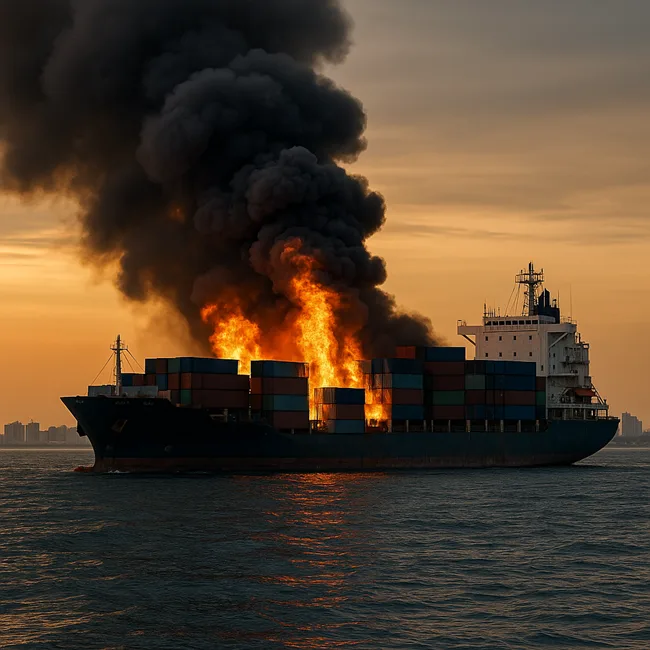
Why is the MV Wan Hai 503 container ship fire near Kerala posing an environmental crisis?
A major maritime emergency continues to unfold off the coast of Kerala after the Singapore-flagged container vessel MV Wan Hai 503 caught fire on June 9 while sailing nearly 70 nautical miles west of Kozhikode. Following an explosion beneath its deck, the ship has remained unmanned and adrift, emitting thick smoke for days. As of June 14, firefighting and towing operations were ongoing, with maritime authorities warning of the grave environmental risks posed by the vessel’s hazardous cargo and onboard fuel reserves.
According to the Indian Coast Guard (ICG), seven of its ships are engaged in round-the-clock firefighting, supported by Indian Navy and Indian Air Force assets. A total of 4,000 kilograms of Dry Chemical Powder (DCP) have been air-dropped by the IAF to contain metal fires aboard the vessel, which carries approximately 2,000 tonnes of fuel oil and 240 tonnes of diesel located dangerously close to the fire zone.
The ship’s manifest also lists over 1,750 containers, at least 143 of which contain hazardous substances including flammable liquids, spontaneously combustible solids, and marine pollutants like trichlorobenzene and hydroquinone. A number of containers were dislodged by the initial explosion and have since been observed drifting toward the Kerala coast.
How are Indian Navy and Coast Guard teams trying to tow MV Wan Hai 503 away from Kerala’s coast?
By June 12, Coast Guard officials confirmed that approximately 40 percent of the fire—mainly in the forward section—had been contained. Operations were significantly hindered by strong westerly winds and choppy sea conditions, which prevented firefighting vessels from approaching too closely. However, on June 14, Indian Navy commandos from INS Garuda were airlifted onto the ship via Seaking helicopter and successfully attached a towline to Tug Offshore Warrior. The goal is to move the ship further out to sea and away from environmentally sensitive coastal zones.
The rescue team was later evacuated safely following structural assessments. Simultaneously, boundary cooling continues as hot spots persist beneath the deck. The vessel is reported to be listing 10 to 15 degrees to port, a development that complicates towing and raises the risk of structural failure or sinking.
What are the risks to marine life and coastal fisheries from drifting hazardous containers?
The Indian National Centre for Ocean Information Services (INCOIS) issued an advisory predicting a 60 percent chance that debris and containers could beach along the coast between Thalassery and Kochi within the next 4–6 days. INCOIS has also flagged the possibility of some containers sinking, which could lead to hazardous chemical discharge into the seabed and water column, endangering marine ecosystems.
In response, the Central Marine Fisheries Research Institute (CMFRI) and the Central Institute of Fisheries Technology (CIFT) have begun testing water and fish samples for signs of contamination. Preliminary results indicated no traces of oil in sampled fish, but further biochemical analysis is underway. Coastal communities have expressed concern over the possible impact on seafood safety and livelihoods, prompting the Kerala Fisheries Department to coordinate increased surveillance and advisory issuance.
Why is the Kerala High Court monitoring legal accountability in the MV Wan Hai 503 incident?
Amid the unfolding environmental risk, legal and institutional responses have gained pace. The Directorate General of Shipping (DGS) has warned the ship’s operator, Wan Hai Lines, and its appointed salvor, T&T Salvage, over their failure to ensure adequate safety systems, firefighting equipment, and crisis response. The DGS has stated it will not rule out criminal prosecution under Indian maritime laws if negligence is established.
The Kerala High Court, acting on a public interest litigation, has also intervened. The court observed that any pollution within India’s Exclusive Economic Zone (EEZ) could constitute economic injury to the coastal fishing sector and ruled that state funds should not be used for salvage operations. It ordered that all costs be recovered from the vessel owner, and appointed an amicus curiae to oversee case developments. The matter has been posted for further hearing on June 19.
How are diplomatic reactions and public sentiment shaping response to the ship fire near Kozhikode?
Diplomatic responses have also followed. The governments of China and Taiwan expressed gratitude to Indian forces for rescuing crew members aboard the vessel during the initial stages of the emergency. These acknowledgments were shared by the Indian Navy and ICG in public statements.
Meanwhile, Kerala’s fishing community has reported a steep decline in local seafood sales amid contamination fears. Matsyafed, the state’s fisheries cooperative, has appealed for urgent scientific testing of marine life to restore consumer confidence. Public discourse on social media and regional news platforms has grown more critical of maritime safety enforcement and preparedness mechanisms.
What does the MV Wan Hai 503 fire reveal about India’s maritime emergency preparedness?
This incident follows close on the heels of the May 25 sinking of the MSC Elsa 3 near Alappuzha, another cargo vessel whose case also sparked scrutiny under India’s Admiralty Act, 2017. Observers note that back-to-back maritime incidents raise questions about the readiness of India’s coastal infrastructure to handle emergencies involving hazardous material transport.
MV Wan Hai 503, launched in the early 2010s and operated by Wan Hai Lines, has been a frequent carrier in Asia-Middle East shipping lanes. The current fire exposes the dangers of outdated onboard suppression systems and the complexities of monitoring hazardous cargo in open seas.
What are the expert views on the next steps and environmental risks from MV Wan Hai 503?
With monsoon winds expected to strengthen between June 14 and 16, the safe towing of the vessel has become a time-critical operation. Salvage experts have warned that any further delay in stabilizing the ship increases the chances of a structural breach, which would release thousands of litres of fuel and toxic cargo into the Arabian Sea.
Experts have underscored the need for India to strengthen coastal firefighting capabilities, including pre-positioned foam-equipped response tugs and faster access to hazardous material experts. Public accountability, ecosystem rehabilitation measures, and legal recoveries from the shipowner will likely dominate the post-incident discourse.
As of June 14, firefighting and cooling operations continue. The vessel remains 65 nautical miles off the Kerala coast, with authorities cautiously optimistic about completing towage to safer waters.
Discover more from Business-News-Today.com
Subscribe to get the latest posts sent to your email.