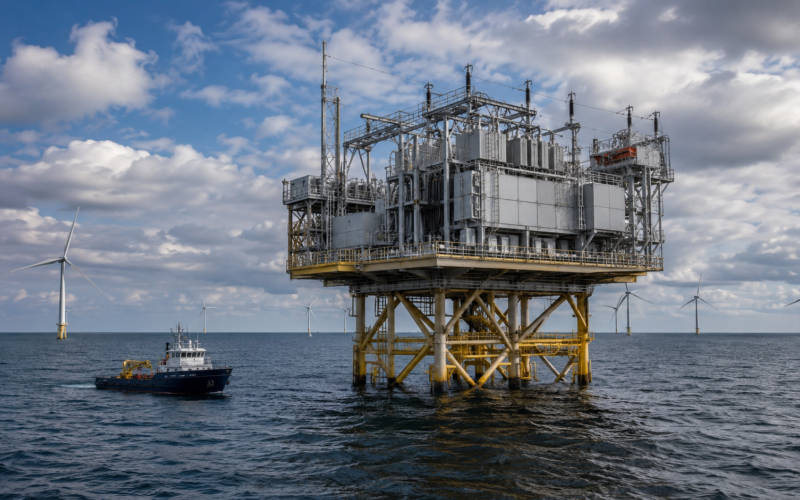
Siemens Energy AG (Xetra: ENR) and Neptun Smulders Offshore Renewables have secured a major contract from 50Hertz Transmission GmbH to deliver the 2 GW North Sea Connector 2 offshore grid connection system in Germany. The turnkey project includes an offshore converter platform in the North Sea, an onshore converter station near Schwerin and the electrical infrastructure required to transmit wind power over long distances using high-voltage direct-current technology. Key sections of the platform will be manufactured at Rostock-Warnemünde, marking the first time Germany will produce an offshore converter platform built predominantly around the new 2 GW standard. Commissioning is planned by the end of 2034, while discussions are continuing for a second platform that could lift the combined contract value for the Neptun Smulders Offshore Renewables scope to approximately €2.5 billion. The award strengthens Siemens Energy’s already substantial grid-technology backlog while testing whether Germany can expand domestic industrial capacity quickly enough to support its offshore wind ambitions.
Why is the North Sea Connector 2 contract strategically larger than a conventional offshore wind award?
North Sea Connector 2 is not a contract to supply wind turbines or construct a single offshore wind farm. It is the transmission infrastructure that will allow electricity generated at future wind sites in the German North Sea to reach the mainland grid. Without this connection, the associated offshore generating capacity would have no commercially viable route to electricity customers.
The system combines the LanWin6 offshore grid connection with the DC32 direct-current link as part of the broader NordOstLink transmission corridor. It is designed to move as much as 2 GW of electricity, roughly equivalent to the output of two large conventional power stations operating at full capacity. The planned offshore wind sites N-12.4 and N-12.5 will connect to the offshore platform, where alternating-current electricity will be converted into direct current for transportation to shore.
That conversion is necessary because the platform will be located approximately 200 kilometres west of the island of Sylt. Alternating-current transmission becomes less efficient and more technically difficult over long subsea distances. High-voltage direct-current technology reduces losses and allows the grid operator to manage large power flows with greater control.
At the onshore station near Mühlenbeck, outside Schwerin, the electricity will be converted back into alternating current before entering Germany’s transmission system. This creates a continuous infrastructure chain from the offshore wind zones to electricity consumers in eastern Germany, Berlin, Hamburg and connected European markets.
The contract therefore addresses the less glamorous but commercially decisive side of offshore wind. Installing turbines attracts attention because the structures are visible, but transmission determines whether their output can be sold. Offshore generation without converter platforms, cables and inland grid capacity is simply expensive equipment surrounded by seawater.

How will Siemens Energy divide the offshore converter work with Neptun Smulders Offshore Renewables?
The consortium has accepted responsibility for the complete implementation and turnkey delivery of the converter system. The scope includes engineering, procurement, component manufacturing, construction, offshore and onshore installation, testing and commissioning. This structure gives 50Hertz one integrated delivery group rather than requiring the transmission operator to manage separate technology and fabrication contracts.
Siemens Energy will supply the principal electrical systems, including converters, transformers and switchgear. The equipment will convert offshore wind electricity from alternating current into direct current at sea and reverse the process at the onshore converter station. Siemens Energy has also secured a long-term service agreement covering maintenance, information technology support and on-call services.
Neptun Smulders Offshore Renewables will be responsible for the large steel platform structures. The company is an equal joint venture between Neptun Werft, part of Meyer Werft Group, and Belgian steel construction specialist Smulders, a subsidiary of Eiffage.
Neptun Werft will manufacture the platform topside at Rostock-Warnemünde. The topside functions as the main offshore building and will house the converters, transformers, switchgear, control rooms and supporting equipment. Siemens Energy will then install and integrate its transmission technology within the structure.
Smulders will manufacture the jacket foundation at Vlissingen in the Netherlands. The jacket will be fixed to the seabed and support the platform topside in the North Sea. Dividing fabrication between Rostock and Vlissingen allows the consortium to combine German shipyard capacity with Smulders’ experience in offshore foundations and heavy steel structures.
The commercial challenge will be coordinating these parallel workstreams. The topside, foundation, electrical equipment, cables and onshore station must all reach compatible levels of completion before offshore installation begins. A delay in one package can leave specialised vessels, fabrication halls or engineering teams waiting, which can quickly add cost to a project of this scale.
Why does manufacturing 95% of Siemens Energy’s scope in Germany matter for the investment case?
Siemens Energy expects approximately 95% of its North Sea Connector 2 scope to be delivered from Germany. Transformers and converter equipment will come from Nuremberg, while sulfur hexafluoride-free gas-insulated switchgear will be supplied from Berlin. The company is investing several hundred million euros in expanding these production locations to address rising demand for grid equipment.
This domestic manufacturing concentration reduces some exposure to global shipping disruption and creates closer coordination between engineering teams and the shipyard assembling the platform. It also supports the political argument that energy-transition spending can generate industrial activity inside Germany rather than flowing mainly to overseas suppliers.
The project is expected to create more than 500 long-term jobs across Mecklenburg-Western Pomerania, the participating companies and their suppliers. These roles are likely to span fabrication, welding, electrical integration, project engineering, logistics, commissioning and long-term technical support.
The award also gives Meyer Werft Group an opportunity to diversify beyond cruise-ship construction. European shipyards have faced volatile ordering cycles, cost pressure and the need to fill large fabrication facilities with alternative work. Offshore energy platforms can provide multiyear industrial programmes that use many of the same heavy-engineering, steelwork and project-management capabilities.
However, domestic production is not automatically the lowest-cost option. German labour, energy and regulatory expenses can be higher than those in competing manufacturing locations. The consortium must therefore prove that shorter supply chains, technical coordination and skilled labour can offset the cost disadvantages.
This is why the tender result has broader industrial significance. 50Hertz indicated that the consortium succeeded on both technology and price, suggesting that domestic fabrication was not selected merely as an industrial-policy gesture. Replicating that competitiveness across future platforms will determine whether Germany develops a lasting converter-platform sector or completes only a small number of politically prominent projects.
Could a second North Sea Connector platform turn the award into a €2.5 billion industrial programme?
The initial award covers North Sea Connector 2, including one offshore platform and one onshore converter station. 50Hertz has also begun negotiations with Neptun Smulders Offshore Renewables for North Sea Connector 1, another grid system using the same 2 GW platform scale.
North Sea Connector 1 includes the LanWin3 offshore connection and the DC31 link within NordOstLink. Its onshore converter station would also be located at the new connection point near Mühlenbeck. Siemens Energy had already secured the high-voltage technology package for this project in 2024.
If the second structural contract is completed, the combined order volume for Neptun Smulders Offshore Renewables could reach approximately €2.5 billion. This figure relates to the joint venture’s production and service scope rather than the entire cost of both transmission systems or Siemens Energy’s undisclosed contract value.
The second project would materially improve factory economics. Shipyards and component plants must invest in buildings, cranes, equipment and specialist staff before they can produce large converter platforms. One platform may not provide sufficient volume to justify that investment. Two platforms create a longer workload and allow engineering lessons from the first unit to be applied to the second.
Standardisation should also reduce execution risk. The consortium can reuse design approaches, manufacturing processes, supplier relationships and installation procedures. Workers trained on North Sea Connector 2 can move into the next project without rebuilding the workforce from scratch.
The risk is that any design or production problem can also be repeated. Fleet-style construction is valuable when the underlying design performs well, but common defects can affect multiple platforms. The consortium must therefore maintain strict quality control before accelerating production.
For 50Hertz, negotiating a second platform with the same industrial group can provide greater schedule certainty and reduce repeated procurement work. It also concentrates supplier exposure. A serious delay at Rostock or within Siemens Energy’s component factories could affect more than one critical grid connection.
Why is the end-2034 commissioning target both distant and commercially demanding?
North Sea Connector 2 is scheduled to enter service by the end of 2034, with earlier tender documentation identifying trial-operation readiness during 2034. The long timeline reflects the scale of engineering, manufacturing, cable installation, permitting and offshore construction required for a 2 GW grid link.
A distant commissioning date does not mean the project can proceed slowly. Long-lead components such as transformers, converter valves, switchgear and subsea cables must be ordered years in advance. Factory expansions, engineering approvals and platform fabrication require tightly sequenced decisions.
Offshore installation introduces weather and vessel risk. The jacket foundation, topside and cables can only be installed during suitable marine conditions. Specialised heavy-lift and cable-laying vessels are in high demand across the European offshore wind market, creating potential competition between projects.
The onshore programme must progress at the same time. Delays at the Mühlenbeck converter station or along NordOstLink could leave the offshore platform technically complete but unable to transmit electricity into the German grid.
The project must also remain aligned with the development schedules of the wind farms using the connection. A grid link completed too late can strand generating assets. A connection completed too early can remain underutilised while the transmission operator carries financing and operating costs.
Cost inflation is another long-duration risk. Labour rates, steel prices, electrical-component costs and financing expenses may shift substantially before 2034. Contractual escalation mechanisms and risk allocation between 50Hertz and the consortium will influence whether higher costs are absorbed by suppliers, transferred to the grid operator or shared.
The timeline therefore provides construction runway but not comfort. Nine years can disappear surprisingly quickly when the equipment weighs thousands of tonnes and every installation window depends on weather, vessels and regulators agreeing at roughly the same time.
What does the offshore converter award mean for Siemens Energy’s Grid Technologies business?
The award reinforces Grid Technologies as one of Siemens Energy’s strongest growth businesses. The segment supplies high-voltage direct-current systems, transformers, switchgear, grid automation and related services at a time when electricity networks are becoming a central infrastructure constraint.
Siemens Energy reported record group orders of €17.7 billion in its second fiscal quarter of 2026, taking its total backlog to €154 billion. Stronger-than-expected demand within Grid Technologies contributed to the company raising its full-year outlook. Siemens Energy now expects comparable revenue growth of 14% to 16%, a profit margin before special items of 10% to 12%, net income of around €4 billion and free cash flow before tax of approximately €8 billion.
Grid Technologies is expected to deliver comparable revenue growth of 25% to 27% in fiscal 2026, with a profit margin before special items between 18% and 20%. Those targets underline why the market is increasingly valuing Siemens Energy as a grid and power-infrastructure supplier rather than viewing it mainly through the problems previously associated with Siemens Gamesa.
North Sea Connector 2 offers equipment revenue during manufacturing and installation, followed by recurring service income after commissioning. Long-term service work can improve revenue quality because it extends the relationship beyond the original project-delivery period.
The contract value attributable to Siemens Energy has not been disclosed, and the company expects to book the order in the fiscal year beginning October 1, 2026. Investors should therefore avoid assuming that the full potential €2.5 billion programme belongs to Siemens Energy. That figure applies to the Neptun Smulders Offshore Renewables scope if both platforms are awarded.
Even without a disclosed value, the project supports Siemens Energy’s strategic positioning. Few suppliers can deliver the converters, transformers, switchgear, controls and system integration required for 2 GW offshore links. This limited supplier base gives capable manufacturers pricing power, but it also leaves them responsible for increasingly large and complex contracts.
How should investors interpret Siemens Energy’s share performance around the contract award?
Siemens Energy shares closed at approximately €168.92 on June 19, 2026. The stock had gained about 9.4% from its June 12 close and roughly 1% from its May 19 close, while trading within a 52-week range of approximately €82.97 to €191.66.
The strong five-day movement cannot reasonably be attributed only to North Sea Connector 2. Siemens Energy’s valuation is being supported by broader investor enthusiasm around electricity demand, data-cententre expansion, gas turbines, grid investment and the company’s rising earnings expectations.
The contract nevertheless fits the market’s preferred narrative. Grid Technologies is experiencing strong orders, expanding margins and customer advance payments. North Sea Connector 2 demonstrates that Siemens Energy is converting sector demand into specific projects backed by major European transmission operators.
The stock remained around 12% below its 52-week high, leaving some distance from the peak but little room for major execution disappointments. Siemens Energy’s market capitalisation has expanded rapidly, increasing the importance of delivering backlog at acceptable margins rather than simply announcing more orders.
Investors should watch how the company manages working capital and project guarantees as its order book grows. Customer advances can support cash flow during early stages, but large contracts also create exposure to engineering changes, supplier costs and delay penalties.
The most constructive interpretation is that the award strengthens an already improving Grid Technologies outlook. The cautious interpretation is that Siemens Energy now carries an enormous multiyear backlog whose profitability will depend on disciplined project selection and execution.
What does North Sea Connector 2 mean for Elia Group and 50Hertz’s capital programme?
50Hertz operates the high-voltage transmission network across northern and eastern Germany and is owned 80% by Elia Group SA/NV (Euronext Brussels: ELI), with Germany’s KfW Group holding the remaining 20%. Its network extends across more than 10,000 kilometres and supplies a region containing approximately 18 million people.
Elia Group expects its German operations to invest approximately €5.1 billion during 2026, reflecting the scale of substations, offshore connections and inland transmission infrastructure required by the energy transition. The group has forecast adjusted German net profit of between €585 million and €625 million for the year, although the investment programme remains exposed to permitting, supply-chain and execution risks.
Elia Group shares closed at €132.30 on June 19. The stock was approximately 1.7% below its June 12 level and broadly flat compared with its May 19 price, while remaining within a 52-week range of €92.35 to €143.10.
That relatively stable performance reflects the different investment profile of a regulated transmission owner. Elia Group benefits as its regulated asset base expands, but large capital programmes also require substantial debt and equity funding. Investors must balance predictable regulated returns against financing requirements, construction delays and political pressure to keep network charges affordable.
North Sea Connector 2 will not deliver immediate operating earnings because commissioning is years away. However, it supports long-term regulated asset growth and expands 50Hertz’s role as the bridge between North Sea generation and eastern German electricity demand.
The project also aligns with 50Hertz’s ambition to securely integrate enough renewable generation to cover annual electricity consumption across its control area by 2032. Achieving that target requires more than renewable assets. It requires the grid to transport electricity across regions and manage periods when generation and consumption occur in different places.
What risks could prevent North Sea Connector 2 from meeting its cost and 2034 schedule?
The first major risk is supply-chain congestion. Europe is planning numerous 2 GW offshore connections, creating simultaneous demand for converter equipment, transformers, switchgear, cables, vessels and engineering staff. Even suppliers with growing factories may struggle if several projects reach peak production together.
The second risk is interface management. Siemens Energy, Neptun Werft, Smulders, cable suppliers, marine contractors and 50Hertz must deliver compatible systems. An engineering revision in the converter equipment could require changes to the platform structure, cooling systems or cable interfaces.
The third risk is fabrication quality. Offshore platforms must withstand harsh marine conditions for decades while supporting heavy electrical equipment. Welding defects, corrosion problems or dimensional errors can become expensive to correct once the structure leaves the shipyard.
Cable installation creates a separate exposure. Subsea routes can encounter difficult seabed conditions, unexploded ordnance, environmental restrictions or conflicts with shipping and other infrastructure. Onshore underground sections can face permitting delays and local opposition.
Technology risk remains manageable but material. The 2 GW, 525 kV standard is designed to increase transmission capacity per connection, but larger systems concentrate more electricity within each platform. An extended outage could therefore remove a substantial amount of generation from the grid.
Financial risk will depend on the undisclosed contract terms. Fixed-price exposure could pressure consortium margins if labour or equipment costs rise. More flexible arrangements may protect suppliers but increase the cost ultimately borne through Germany’s regulated transmission system.
The long service agreement gives Siemens Energy responsibility beyond commissioning. This creates recurring revenue, but it also means equipment reliability and information-technology performance will remain commercial issues throughout the operating period.
Why could North Sea Connector 2 become a template for Europe’s offshore grid buildout?
Europe’s offshore wind plans require a shift from one-off connections toward larger, standardised grid systems. The 2 GW platform format can connect more generation through fewer offshore structures, potentially reducing the number of routes, landfall points and converter stations needed per unit of capacity.
North Sea Connector 2 brings together several elements that can support repeatability. It uses standardised transmission capacity, domestic component manufacturing, a specialist offshore steel partner and an integrated turnkey consortium.
The proposed follow-on North Sea Connector 1 platform would test whether this model can move from a single award into serial production. Repetition could reduce engineering hours, improve workforce productivity and give suppliers the confidence to invest in larger facilities.
The project may also influence industrial policy outside Germany. Countries planning large offshore wind zones increasingly want more domestic manufacturing and secure European supply chains. Germany’s decision to combine local shipyard capacity with established Belgian and Dutch offshore expertise provides one possible model.
My assessment is that North Sea Connector 2 is strategically stronger than its undisclosed Siemens Energy contract value initially suggests. The platform is essential infrastructure for 2 GW of future generation, it creates a new German industrial capability and it supports a high-margin growth division at Siemens Energy.
The next milestones will determine whether that strategic promise becomes commercial value. Siemens Energy must formally book the order, the consortium must complete detailed engineering, 50Hertz must conclude the second-platform negotiations and the wider NordOstLink programme must remain aligned with the offshore schedule.
What are the key takeaways from the North Sea Connector 2 offshore grid contract?
- North Sea Connector 2 will transmit up to 2 GW of offshore wind electricity into Germany using 525 kV high-voltage direct-current technology.
- Siemens Energy and Neptun Smulders Offshore Renewables will provide turnkey delivery of the offshore platform and onshore converter station.
- Siemens Energy will supply converters, transformers and switchgear while also providing long-term maintenance and technical support.
- Approximately 95% of Siemens Energy’s project scope will be manufactured in Germany, including equipment from Nuremberg and Berlin.
- Neptun Werft will build the platform topside in Rostock-Warnemünde, while Smulders will manufacture the jacket foundation in Vlissingen.
- North Sea Connector 2 is scheduled for commissioning by the end of 2034, creating substantial long-term execution and supply-chain risk.
- A second platform award for North Sea Connector 1 could increase the combined NSORe programme to approximately €2.5 billion.
- More than 500 long-term jobs are expected across Mecklenburg-Western Pomerania and the participating supply chain.
- Siemens Energy shares gained about 9.4% over five trading days, reflecting wider confidence in power and grid equipment demand.
- Elia Group gains long-term regulated asset growth through 50Hertz, but its expanding German grid programme requires substantial capital and disciplined financing.
Discover more from Business-News-Today.com
Subscribe to get the latest posts sent to your email.