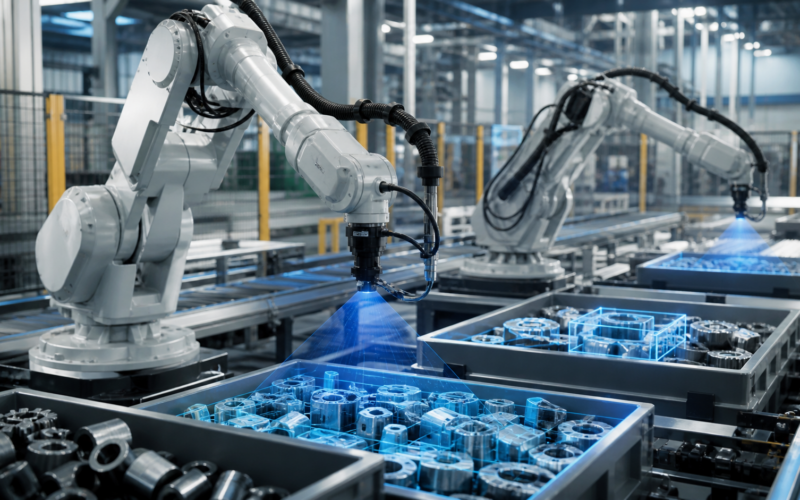
Zebra Technologies Corporation (NASDAQ: ZBRA) has made a strategic investment in Apera AI through Zebra Ventures, strengthening its push into intelligent automation, industrial robotics and machine vision for manufacturing and logistics customers. The investment adds another layer to Zebra Technologies Corporation’s automation strategy after its 2025 acquisition of Photoneo, a 3D machine vision company focused on automotive manufacturing, logistics and other industrial use cases. Zebra Technologies Corporation shares recently closed at $227.08, with a market capitalization of about $11.5 billion and a 52-week range of $199.05 to $352.66, placing the stock well below last year’s high even after a short-term rebound. The strategic question is not whether Zebra Technologies Corporation wants more exposure to factory automation, but whether it can turn vision-guided robotics into a repeatable platform advantage rather than a collection of promising assets.
Why is Zebra Technologies investing in Apera AI as factory automation shifts from fixed robotics to adaptive systems?
Zebra Technologies Corporation’s investment in Apera AI points to a broader shift in industrial automation from rigid, pre-programmed robotics toward systems that can respond to variation on the factory floor. Traditional robotic workcells perform well when parts, lighting, fixtures and workflows are predictable. The problem is that real factories rarely behave like neat demo labs. Parts shift in bins, surfaces reflect light, grippers wear down, and production lines change faster than many automation systems can be re-engineered.
Apera AI’s 4D Vision system is designed to address that messy middle ground. The company’s technology enables robots to locate, identify and manipulate complex parts in dynamic manufacturing environments using light-resilient stereo vision and AI models. Its value proposition is especially relevant for hard-to-handle items such as clear, shiny, overlapping or irregularly shaped parts, where conventional vision systems can struggle. In practical terms, Zebra Technologies Corporation is backing a company trying to make robots less dependent on perfectly controlled surroundings and more capable of operating in the imperfect conditions that define high-volume manufacturing.
That matters because manufacturers are no longer looking at robotics only as a labor substitution tool. They increasingly want automation that can absorb product variation, support shorter production cycles and reduce the engineering time needed for deployment. If Apera AI can help customers deploy robotic picking and handling systems with less calibration and faster ramp-up, the commercial case becomes less about futuristic robotics and more about near-term return on investment. That is the kind of argument factory managers actually care about, because nobody gets a bonus for buying a robot that needs six months of babysitting.

How does Apera AI fit into Zebra Technologies’ Connected Factory and machine vision strategy?
The Apera AI investment fits neatly into Zebra Technologies Corporation’s Connected Factory framework, which aims to improve visibility, quality and workforce augmentation across industrial environments. Zebra Technologies Corporation has long been associated with data capture, barcode scanning, mobile computing, RFID and asset visibility. The company’s newer challenge is to extend that heritage into higher-value automation software, machine vision and AI-enabled decision systems.
The Photoneo acquisition already gave Zebra Technologies Corporation a deeper position in 3D machine vision. Photoneo expanded Zebra Technologies Corporation’s ability to serve automotive manufacturing, logistics and industrial automation customers with 3D imaging capabilities. Apera AI adds a complementary angle by focusing on vision-guided robotics software and AI perception in unstructured environments. Put simply, Photoneo strengthens Zebra Technologies Corporation’s sensing and 3D imaging layer, while Apera AI potentially strengthens the robotics intelligence layer.
This is strategically important because the value pool in industrial automation is moving beyond hardware alone. Cameras, sensors and scanners remain essential, but customers increasingly want systems that interpret what they see, trigger workflows, guide robots and feed operational data back into enterprise platforms. Zebra Technologies Corporation appears to be positioning itself not just as a supplier of devices, but as a provider of automation infrastructure that connects perception, action and workflow intelligence. That is a more ambitious and defensible position, provided the integrations actually work.
Why does 4D Vision matter for manufacturers dealing with unstructured production lines?
The phrase 4D Vision can sound like trade-show glitter until it is tied to operational pain. In manufacturing, the fourth dimension is essentially about motion, time and adaptability. A robotic system does not only need to recognize a part. It must recognize the part under variable conditions, choose a picking path, adjust to changing geometry and repeat the task reliably at production speed.
For automotive original equipment manufacturers, Tier 1 suppliers and industrial manufacturers, this can be the difference between automation that scales and automation that stalls at the pilot stage. Robots that can handle predictable metal components in fixed orientations are useful. Robots that can handle mixed, reflective, overlapping or partially occluded parts are much more valuable. Apera AI’s system is aimed at that second category, where factories need precision but cannot afford endless custom engineering.
The deployment angle is critical. Apera AI’s software-first approach, including training in virtual simulation environments, is meant to reduce calibration time and make systems easier to scale across production lines. If that works consistently, it could lower one of the biggest barriers to robotics adoption: the hidden engineering cost that sits between proof of concept and plant-wide rollout. That is where many automation dreams go to become expensive PowerPoint archaeology.
What does this investment signal about Zebra Technologies’ competitive position in automation?
Zebra Technologies Corporation is operating in a competitive field that includes machine vision specialists, robotics software companies, industrial automation incumbents and diversified technology groups. The company’s advantage is not that it owns every part of the automation stack. Its advantage is that it already sits close to frontline workflows in retail, manufacturing, transportation, logistics and healthcare. That customer access gives Zebra Technologies Corporation a route to embed new automation capabilities into environments where it already has operational relevance.
The Apera AI investment also suggests Zebra Technologies Corporation is using venture capital strategically rather than purely financially. Zebra Ventures can give the company exposure to emerging technologies without immediately absorbing full integration risk. This approach allows Zebra Technologies Corporation to track customer traction, product maturity and compatibility with its existing automation portfolio before deciding whether deeper commercial alignment is justified.
There is still execution risk. Strategic investments can create useful optionality, but they do not automatically create revenue synergy. Zebra Technologies Corporation will need to show that Apera AI’s technology can complement its existing machine vision and automation offerings without becoming a disconnected portfolio item. For customers, the key test will be whether Zebra Technologies Corporation can simplify adoption, support integration and reduce vendor complexity rather than adding another intelligent widget to an already crowded factory stack.
How should investors read Zebra Technologies stock performance around the Apera AI investment?
Zebra Technologies Corporation’s stock context makes the Apera AI investment more interesting. The share price has recovered from recent weakness, with ZBRA up about 9.55% over the past 30 days and closing at $227.08 on May 1, 2026. MarketBeat data showed a 5-day gain of around 2.75% and a 1-month gain of around 11.95%, although short-term performance readings can vary by provider and calculation window. Even so, the stock remains far below its 52-week high of $352.66, which means investors are still applying a meaningful discount to the company’s broader growth story.
That gap matters. The market is not treating Zebra Technologies Corporation as if its automation strategy has already won. Instead, investors appear to be waiting for proof that AI, machine vision, RFID and workflow automation can translate into sustained revenue growth, margin resilience and stronger customer spending. The company’s first-quarter 2026 results are scheduled for May 12, 2026, which will likely give investors a clearer view of demand trends, automation order momentum and management’s outlook.
The Apera AI investment is unlikely to move near-term earnings by itself. Its significance is strategic rather than immediately financial. However, it gives Zebra Technologies Corporation another proof point in the narrative that its future growth will depend on intelligent operations, not only traditional barcode, scanning and asset-tracking markets. For long-term investors, the key question is whether these investments can become attachable, scalable and margin-accretive products across Zebra Technologies Corporation’s installed base.
What are the main risks if Zebra Technologies cannot convert vision-guided robotics into scalable revenue?
The biggest risk is that Zebra Technologies Corporation builds technological breadth without commercial simplicity. Manufacturers want automation, but they are wary of systems that require long integration cycles, specialist maintenance and unpredictable payback periods. If Apera AI’s technology remains too bespoke for each use case, it could remain a high-value niche rather than a broad platform lever.
Another risk is competitive compression. Machine vision, robotics perception and AI-enabled factory automation are attracting capital from many directions. Large automation vendors, sensor specialists and software-first robotics companies are all chasing the same customer pain points. Zebra Technologies Corporation will need to differentiate through workflow integration, customer support, deployment speed and measurable uptime improvements, not just better perception technology.
There is also a portfolio discipline question. Zebra Technologies Corporation has made several moves to expand beyond its legacy strengths, including Photoneo and now Apera AI. That strategy can create a stronger automation ecosystem, but only if the company maintains clear product architecture and sales discipline. Industrial customers do not buy strategy maps. They buy systems that work on the floor, survive harsh environments and make operations more predictable.
What happens next for Zebra Technologies, Apera AI and the intelligent automation market?
The next phase will likely depend on commercial validation. Zebra Technologies Corporation and Apera AI will need to demonstrate that 4D Vision can scale across automotive, logistics and industrial manufacturing environments with repeatable economics. Faster deployment, lower calibration burden and higher robotic uptime will be the metrics that matter most.
For Zebra Technologies Corporation, the investment strengthens a narrative that the company is moving from visibility into action. Asset tracking tells companies where things are. Machine vision tells systems what they are seeing. AI-guided robotics turns that visibility into automated execution. That progression is strategically powerful, but it also raises the bar for integration.
For the broader industry, the deal reinforces a clear direction of travel. The factory automation market is moving toward robots that can perceive, reason and adapt in less structured environments. The winners will not simply be the companies with the flashiest AI vocabulary. They will be the companies that make automation easier to deploy, easier to maintain and easier to justify financially. Zebra Technologies Corporation has bought itself a stronger seat at that table. Now it has to prove that the seat comes with pricing power.
Key takeaways on what Zebra Technologies’ Apera AI investment means for automation and ZBRA stock
- Zebra Technologies Corporation is using Apera AI to strengthen its position in vision-guided robotics, a higher-value layer of industrial automation.
- Apera AI’s 4D Vision technology targets real factory problems such as shifting bins, reflective parts, worn grippers and complex part geometry.
- The investment complements Zebra Technologies Corporation’s 2025 Photoneo acquisition and broadens its machine vision strategy beyond 3D imaging.
- The deal signals that Zebra Technologies Corporation wants to move from asset visibility toward intelligent execution inside manufacturing and logistics workflows.
- For manufacturers, the core promise is faster deployment, lower engineering friction and better robotic performance in unstructured environments.
- For investors, the investment is strategically relevant but unlikely to materially affect near-term earnings on its own.
- Zebra Technologies Corporation stock remains well below its 52-week high, suggesting investors still want stronger evidence of durable automation-led growth.
- The main execution risk is whether Zebra Technologies Corporation can integrate Apera AI’s capabilities into a scalable, commercially simple offering.
- Competitive pressure will remain intense as robotics software, machine vision and industrial AI vendors chase the same factory automation budgets.
- The bigger story is that intelligent automation is shifting from fixed robotic cells to adaptive systems that can operate in the messy reality of modern production.
Discover more from Business-News-Today.com
Subscribe to get the latest posts sent to your email.