



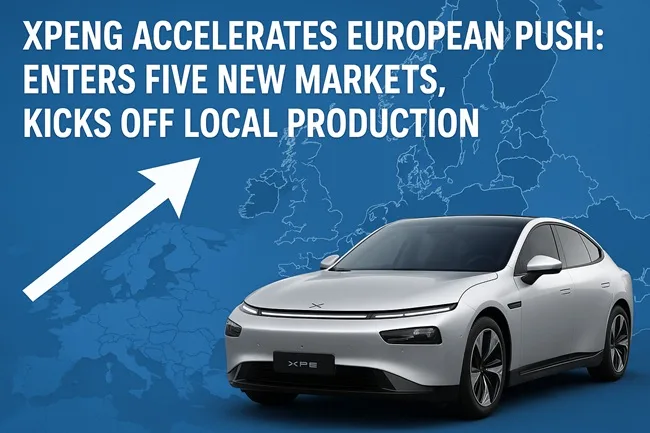
Shares of Xpeng Inc surged more than five percent in Hong Kong on Thursday, closing at HKD 90.80, after the Chinese electric vehicle maker announced a sweeping expansion into five new European markets and confirmed localized production in Austria. The positive stock reaction reflected investor confidence that Xpeng’s long-stated ambition to internationalize its business is finally taking on scale and credibility. The rally also signaled that global diversification is being seen as a hedge against mounting competition and price pressure in China’s domestic EV sector.
How significant is Xpeng’s entry into five new European markets for its long-term strategy?
The decision to launch operations in Switzerland, Austria, Hungary, Slovenia, and Croatia marks one of Xpeng’s largest international pushes to date. In Switzerland, the company has partnered with Hedin Group to convert existing dealerships into Xpeng-branded sales and service centers, aiming for ten outlets by the end of 2025 and thirty by 2026. Austria will follow with an authorized dealer model beginning in Vienna before moving into Salzburg, Graz, and Klagenfurt. These expansions are more than symbolic; they place Xpeng in the heart of Europe with a sales and service presence that builds customer trust and brand recognition.
In Hungary, Slovenia, and Croatia, the rollout will be executed via a joint venture with AutoWallis Group and Salvador Caetano Group. This route gives Xpeng rapid market entry and local expertise while avoiding the capital-intensive requirements of building its own networks from scratch. Pop-up stores are expected in Budapest, Ljubljana, and Zagreb later this year, further underlining the pace at which the Chinese EV maker is seeking to establish itself.
Which models will define Xpeng’s European offering and how does production in Austria change the game?
Xpeng is leading with its G6 and G9 sport utility vehicles, models tailored to consumer demand for crossovers and mid-sized SUVs in Europe. The company has also committed to bringing its P7+ sedan to the region in 2026, a move that will place it head-to-head with Tesla’s Model 3 and established German premium sedans.
What makes this expansion structurally different from earlier forays by Chinese EV firms is the addition of local production. Xpeng has contracted Magna Steyr in Graz, Austria, to manufacture its G6 and G9 vehicles. This decision reduces logistics costs, shortens lead times for European customers, and may allow the company to qualify for local EV incentives. Most importantly, producing in Europe signals to policymakers and consumers that Xpeng is embedding itself into the regional economy rather than exporting from China alone.
Why is Europe such a critical market and what headwinds could Xpeng face?
Europe has become a battleground for global electric vehicle dominance, with rising adoption driven by environmental regulation and consumer demand. For Xpeng, the continent is not just an opportunity but a necessity. The company has publicly stated that overseas markets could account for up to half of its global sales in the coming years, and Europe’s combination of regulatory support, purchasing power, and openness to new entrants makes it a natural target.
The headwinds are equally strong. The European Union has launched probes into Chinese EV subsidies and is weighing new tariffs, which could raise the cost of imports. Local production in Austria partially shields Xpeng from such risks but does not eliminate them. The brand also faces the challenge of low recognition compared to Tesla and entrenched European carmakers. Winning customers will require more than competitive pricing; it will hinge on after-sales service, reliability, and regulatory compliance, particularly for advanced driver-assistance systems that are subject to strict EU oversight.
How has the stock market reacted to Xpeng’s European push?
The immediate reaction was positive. In Hong Kong, the stock closed at HKD 90.80, up 5.03 percent from the previous session, while U.S.-listed shares hovered around the 22 to 23 dollar mark. Analysts viewed the expansion as a necessary step to diversify revenue away from China and to lay the groundwork for longer-term margin improvement once European volumes begin scaling.
Institutional investors, however, remain cautious. They are looking for concrete evidence that European deliveries will ramp up smoothly, that Magna Steyr production will meet quality and cost expectations, and that dealer partnerships will translate into real sales momentum. Until then, the stock’s upside may be capped by execution risk.
What expert sentiment and institutional outlook are shaping the debate on Xpeng’s expansion?
Industry observers have generally welcomed the dual move of entering new markets and beginning local production. Localized manufacturing in Austria is widely seen as a credibility boost that will help Xpeng navigate trade tensions and build goodwill with European regulators. Analysts also note that partnering with established dealer groups reflects a pragmatic approach that values speed and market access over complete operational control.
Still, experts warn that execution will be critical. Any delays in rolling out pop-up stores, missteps in service quality, or disruptions at the Graz production line could quickly undermine the momentum generated by the announcement. Competition from rivals such as BYD and Nio, not to mention Volkswagen and Mercedes-Benz, will make it difficult for Xpeng to achieve scale quickly. Institutional sentiment is therefore best described as cautiously optimistic, with investors looking to the next two to three quarters for proof of traction.
What are the final takeaways from Xpeng’s European expansion, shifting investor sentiment, and the road ahead for its global growth strategy?
Xpeng’s stock surge in response to its European expansion underscores investor appetite for credible growth beyond China. The launch into Switzerland, Austria, Hungary, Slovenia, and Croatia, paired with Magna Steyr production in Austria, represents a bold step that could redefine the company’s global profile.
The expansion reduces tariff exposure, lowers logistics costs, and signals a commitment to long-term European engagement. But success will depend on execution, from smooth dealer integration and production scaling to brand-building and after-sales reliability. For now, the market is giving Xpeng the benefit of the doubt, but sustained momentum will require consistent delivery volumes, customer satisfaction, and operational resilience in one of the world’s most competitive EV markets.
Discover more from Business-News-Today.com
Subscribe to get the latest posts sent to your email.