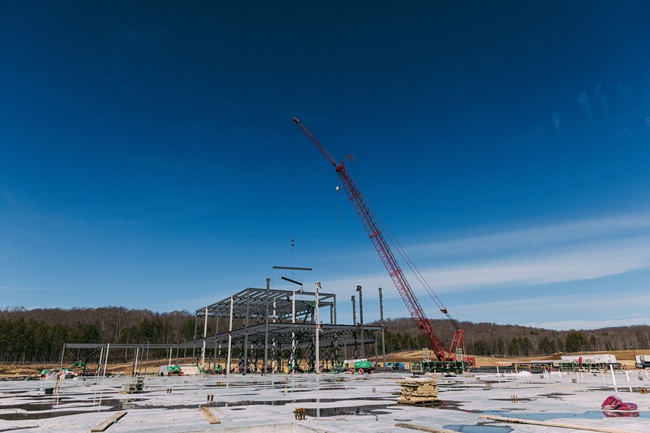
X-energy Reactor Company’s subsidiary TRISO-X has received the first-ever U.S. Nuclear Regulatory Commission Part 70 license authorizing commercial fabrication of high-assay low-enriched uranium fuel at its TX-1 and TX-2 facilities in Tennessee. The approval establishes the first new NRC-licensed fuel manufacturing facilities in over five decades and clears a critical bottleneck in the U.S. advanced nuclear supply chain. In parallel, X-energy has executed a decade-long graphite supply agreement with SGL Carbon, reinforcing its ability to support fleet-scale deployment of its Xe-100 small modular reactor platform.
Why the NRC Part 70 license materially changes the economics and credibility of advanced nuclear fuel supply in the United States
The significance of the Part 70 license extends well beyond regulatory symbolism. It grants TRISO-X authority to receive, possess, process, and transport high-assay low-enriched uranium across the full fuel manufacturing cycle, including continuous inventory management and commercial-scale production campaigns. This distinction matters because HALEU availability has emerged as the most persistent structural constraint on advanced reactor deployment in the United States and allied markets.
Unlike traditional reactor fuel pathways that rely on well-established enrichment and fabrication infrastructure, HALEU fuel has remained trapped in pilot-scale experimentation, government stockpiles, or foreign-controlled supply chains. The NRC’s decision effectively certifies TRISO-X as a commercial fuel supplier rather than a research adjunct, shifting advanced nuclear from demonstration dependency toward industrial repeatability.
From a market perspective, this licensing event reduces perceived execution risk across the entire advanced reactor ecosystem. Reactor developers, utilities, and institutional backers have repeatedly flagged fuel certainty as a gating variable for project financing. By converting HALEU fabrication from a theoretical future capability into a licensed commercial activity, TRISO-X materially improves bankability assumptions for downstream SMR projects.
How TRISO fuel manufacturing under Part 70 reshapes supply chain risk for SMR developers and utilities
TRISO fuel is not interchangeable with conventional nuclear fuel assemblies. Its tri-structural isotropic architecture enables higher operating temperatures, improved fission product retention, and enhanced passive safety characteristics. However, these advantages historically came with manufacturing complexity that limited scalability.
Part 70 licensing resolves this tension by validating TRISO-X’s hazard identification, safeguards, and security frameworks for sustained commercial operations. This approval confirms that TRISO manufacturing can be executed under the same regulatory rigor applied to legacy fuel facilities, eliminating the perception that advanced fuel remains regulatory uncharted territory.
For utilities evaluating SMR participation, this distinction matters. Fuel risk is not merely technical but contractual. Long-term power purchase agreements, capacity contracts, and infrastructure investments depend on predictable fuel availability across multi-decade operating lives. TRISO-X’s 40-year license horizon aligns with utility planning cycles and supports the transition from single-project pilots to standardized fleet deployment.
Why Oak Ridge matters strategically for rebuilding domestic nuclear industrial capability
The selection of Oak Ridge, Tennessee, as the anchor location for TX-1 and TX-2 is not incidental. Oak Ridge National Laboratory has served as the United States’ nuclear materials backbone for decades, and TRISO-X’s development pathway reflects a deliberate transition from national laboratory innovation to private-sector manufacturing discipline.
This geographic continuity lowers technology transfer risk while accelerating workforce readiness. The region already supports specialized talent in nuclear materials handling, safety systems, and quality assurance, reducing ramp-up friction as TX-1 moves toward operational readiness.
From a policy standpoint, this concentration supports federal objectives to rebuild sovereign nuclear capabilities without recreating Cold War-era centralized structures. Instead, it reflects a modular, commercial-first industrial strategy aligned with modern energy security frameworks.
How the SGL Carbon graphite agreement complements fuel licensing to enable fleet-scale execution
Fuel fabrication alone does not deliver reactors. The parallel graphite supply agreement between X-energy Reactor Company, LLC and SGL Carbon addresses another often-overlooked constraint in advanced reactor deployment: safety-critical materials at industrial scale.
Graphite components for high-temperature gas-cooled reactors must meet exacting performance standards under extreme thermal and neutron flux conditions. X-energy and SGL Carbon’s collaboration, dating back to 2015, has already advanced qualification of NBG-18 graphite for the Xe-100 platform. The new agreement converts that technical validation into contracted production capacity.
The initial three-year award valued at over $100 million anchors X-energy’s first commercial deployment with Dow in Texas, while the broader framework reserves future production capacity for the Cascade Advanced Energy Facility in Washington State. This forward reservation signals confidence in execution timelines while insulating X-energy from supplier congestion as global interest in advanced nuclear accelerates.
What the combined fuel and graphite milestones signal about X-energy’s commercialization posture
Taken together, the TRISO-X license and the SGL Carbon agreement suggest a shift in X-energy’s strategic posture from technology validation toward industrial orchestration. Rather than focusing solely on reactor design differentiation, the company is systematically de-risking upstream dependencies that have historically delayed nuclear programs.
This approach contrasts with prior SMR efforts that emphasized reactor physics while assuming fuel and materials challenges would resolve downstream. X-energy’s sequencing acknowledges that supply chain credibility increasingly determines project viability in capital-intensive energy sectors.
The alignment with the U.S. Department of Energy’s Advanced Reactor Demonstration Program further reinforces this posture. By integrating licensed fuel manufacturing, contracted materials supply, and defined deployment partners, X-energy presents a more cohesive commercialization narrative to policymakers and financiers.
How these developments affect investor sentiment and institutional confidence in advanced nuclear platforms
X-energy is privately held, limiting direct equity market signals, but institutional sentiment can be inferred from policy alignment, supplier participation, and project counterparties. The presence of Dow, Energy Northwest, Amazon-aligned projects, and multinational suppliers like SGL Carbon suggests growing comfort with execution risk profiles.
The NRC’s approval three months ahead of schedule further strengthens this perception. Regulatory timelines often drive cost overruns and investor skepticism. Early approval introduces a margin of schedule credibility that few nuclear projects enjoy.
For institutional infrastructure investors, pension funds, and sovereign entities evaluating long-duration clean energy exposure, these milestones reduce uncertainty around fuel availability, regulatory viability, and industrial scalability. That combination is rare in nuclear energy and could shift capital allocation discussions over the next investment cycle.
What still needs to go right before TRISO-X and X-energy reach full commercial impact
Despite the progress, material execution risks remain. TX-1 must complete construction, pass final NRC inspection, and demonstrate sustained operational performance before fuel deliveries can scale. TX-2 remains in the design phase, introducing typical risks associated with capital cost escalation and permitting coordination.
HALEU upstream enrichment capacity also remains constrained at the national level. While TRISO-X addresses fabrication, broader enrichment and feedstock availability will require continued federal coordination and private investment.
Finally, SMR deployment timelines remain sensitive to permitting, grid interconnection, and customer readiness. Fuel availability is necessary but not sufficient for fleet deployment success.
Why this moment represents a structural inflection point rather than a symbolic milestone
Advanced nuclear has long suffered from a credibility gap between concept and execution. By securing the first Part 70 license for HALEU fuel fabrication and pairing it with long-term materials supply agreements, X-energy and TRISO-X are addressing the least visible yet most consequential barriers to scale.
These moves do not guarantee commercial success, but they materially improve the probability that advanced reactors transition from demonstration artifacts to repeatable infrastructure assets. In capital markets and energy policy alike, probability shifts often matter more than proclamations.
Key takeaways: What the TRISO-X license and X-energy supply agreements mean for advanced nuclear deployment
- The NRC Part 70 license transforms TRISO-X from a development-stage entity into a commercial fuel supplier with multi-decade operational authority
- Licensed HALEU fabrication directly reduces financing and execution risk for SMR projects dependent on advanced fuel architectures
- The Oak Ridge location leverages existing nuclear infrastructure while accelerating workforce and operational readiness
- The SGL Carbon agreement secures safety-critical graphite supply at industrial scale, reinforcing fleet deployment credibility
- Combined fuel and materials milestones signal a shift from reactor-centric innovation to system-level commercialization strategy
- Early regulatory approval improves schedule confidence in a sector historically plagued by delays
- Institutional confidence is strengthened through alignment with industrial partners and federal demonstration programs
- Upstream HALEU enrichment remains a national constraint despite progress at the fabrication level
- TX-1 operational execution and TX-2 development will determine whether momentum converts into sustained scale
- Advanced nuclear’s success increasingly depends on supply chain orchestration rather than reactor physics alone
Discover more from Business-News-Today.com
Subscribe to get the latest posts sent to your email.