



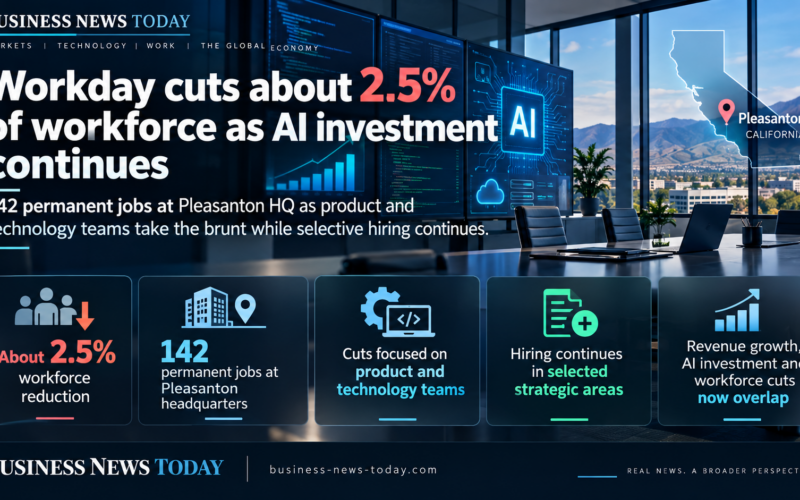
Workday, Inc. (NASDAQ: WDAY) is moving ahead with a global workforce reduction of approximately 2.5% as the enterprise software group reorganises product and technology teams around its strategic growth priorities. Based on the company’s recent workforce of roughly 21,000 employees, the reduction implies approximately 525 positions globally, although Workday has described the percentage rather than providing a definitive employee total for all jurisdictions.
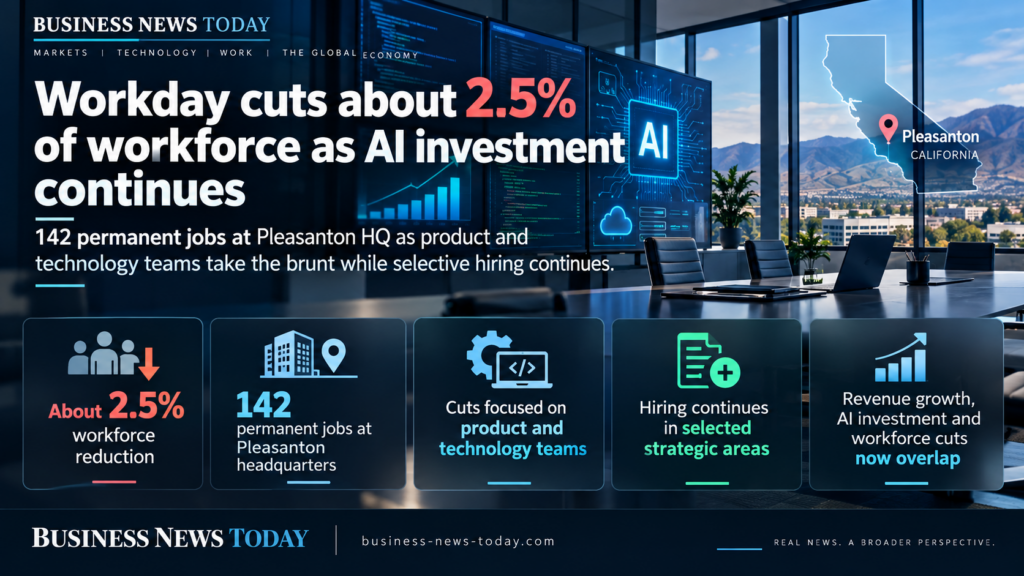
California employment filings provide a more precise view of the local impact. Workday plans to permanently eliminate 142 positions at its Pleasanton headquarters, with the layoffs scheduled to take effect on November 30. The affected California positions represent a substantial portion of the global programme and follow an earlier 2026 reduction at the same location.
The cuts arrive during a period of solid financial growth rather than collapsing demand. Workday reported fiscal second-quarter 2027 revenue of $2.65 billion, up 12.8% year over year, while subscription revenue increased 13.9% to $2.47 billion. That combination makes the restructuring a particularly useful example of how software companies are redesigning employment around artificial intelligence, margin expansion and changing development models.
Why is Workday cutting technology employees while revenue is growing?
Workday has said the restructuring is designed to align teams more closely with strategic growth priorities. Most of the reduction is concentrated in Product and Technology, the same broad organisation responsible for developing the software and artificial intelligence capabilities central to the company’s future.
This may initially appear contradictory. Technology businesses normally increase engineering and product headcount when subscriptions are growing, particularly when management is promising faster innovation. However, artificial intelligence is beginning to alter assumptions about how many employees are required to produce, test and maintain software.
AI-assisted coding can accelerate development, automated testing can reduce manual workloads and internal agents can handle activities that previously required larger support teams. These changes do not automatically eliminate entire engineering organisations, but they can alter the mix of skills and reduce demand for certain types of roles.
Workday has made clear that it will continue hiring in selected strategic areas and locations during fiscal 2027. The implication is therefore not that technology employment is becoming unnecessary, but that the company wants a different composition of talent from the one it built during earlier stages of growth.
How many Workday jobs are disappearing in Pleasanton?
California WARN records show 142 permanent layoffs at Workday’s Stoneridge Mall Road headquarters in Pleasanton. The notice was filed on September 29 and lists November 30 as the effective date.
The cuts follow another Pleasanton reduction earlier in 2026 involving 154 employees. Taken together, those two California notices represent 296 positions during the year, although they resulted from separate actions and should not be treated as one single announcement.
Pleasanton is particularly significant because it is Workday’s headquarters and historically one of its largest employment centres. Reductions there therefore provide a clearer view of the organisational changes than smaller local notices elsewhere might.
The latest cuts also arrive as the broader Tri-Valley technology market experiences continued workforce adjustment. Employers including Workday, Oracle, Chevron and other large companies have reduced local staffing, increasing competition among workers looking for comparable professional positions in the region.
How much will the Workday restructuring cost?
Workday expects approximately $65 million to $80 million of charges related to the programme. Around $40 million to $55 million is expected to consist of cash expenditures connected with severance, benefits and related employee costs.
Another approximately $10 million is expected to reflect non-cash stock-based compensation charges. The company also anticipates around $15 million in non-cash charges related to impairments on leased office space, showing that the restructuring extends beyond payroll into Workday’s physical footprint.
Most charges are expected to be recognised during the fiscal third quarter of 2027, with further costs following in the fourth quarter. Employee-related actions are expected to be substantially completed by the first quarter of fiscal 2028, subject to consultation requirements and local employment law.
The office-space component is important because hybrid work has left many technology companies with more real estate than they require. Reducing leased space can therefore reinforce payroll savings and create a structurally lower cost base rather than a one-time employment adjustment.
Is artificial intelligence driving the Workday layoffs?
Workday has not characterised the workforce reduction as a simple replacement of employees by artificial intelligence, and that distinction should be preserved. The company officially describes the programme as a reorganisation intended to align structures with strategic growth priorities.
AI nevertheless forms a major part of those priorities. Workday increasingly markets itself as an enterprise AI platform for human resources, finance and information technology, and management has been highlighting growing customer adoption of AI-related products.
AI products generated more than $100 million in new annual contract value during the fiscal second quarter, while annual recurring revenue associated with AI SKUs reached approximately $600 million, up sharply from a year earlier. Workday is also investing in AI research, agents and AI-native learning products.
This means the company is simultaneously selling AI to customers, adopting AI internally and changing its own product teams. The relationship between those developments should not be simplified into a claim that every eliminated job has been automated, but it would be equally misleading to view the restructuring without considering how AI is changing software economics.
Workday itself recently published research arguing that AI is rewriting jobs more often than eliminating them outright. Its own workforce programme now provides an important real-world test of that distinction.
What does Workday’s financial performance reveal about the cuts?
Fiscal second-quarter operating income reached $313 million, representing 11.8% of revenue compared with 10.6% a year earlier. On a non-GAAP basis, operating income reached $824 million and the margin expanded to 31.1%.
Those results indicate that Workday is already becoming more profitable while continuing to grow subscriptions. The workforce programme can therefore be interpreted as an attempt to accelerate operating leverage rather than rescue a business facing immediate financial distress.
That distinction matters for the wider technology labour market. Companies increasingly appear willing to cut employees before profitability becomes problematic, using restructuring proactively to prevent cost growth from matching revenue growth.
Investors reward software companies when additional subscription revenue produces disproportionately higher earnings. That creates powerful incentives for management teams to demonstrate that artificial intelligence and automation can allow the same organisation to generate more revenue without proportionally increasing headcount.
Workday is now applying that logic to its own operations.
How are investors responding to Workday’s workforce reset?
Workday shares closed at $186.59 on October 9, down 0.65% during the session. The stock remains well below its 52-week high of roughly $247, reflecting investor debate over software valuations, competition and the pace at which AI investment will convert into durable revenue.
The workforce programme has not produced a dramatic positive repricing, suggesting investors want evidence beyond simple cost removal. Workday needs to demonstrate that smaller or redesigned product teams can continue delivering AI innovation while protecting its strong position in enterprise human-capital and financial-management software.
Its Financial Analyst Day on October 13 should therefore receive increased attention. Investors will be looking for evidence about AI monetisation, long-term margins and whether the workforce changes represent an isolated efficiency programme or the beginning of a more fundamental redesign.
For employees, the restructuring shows how quickly assumptions about software-sector job security are changing. Workday is growing, profitable and strategically focused on AI, yet it is still eliminating hundreds of positions. Increasingly, growth may protect companies without protecting every job inside them.
Discover more from Business-News-Today.com
Subscribe to get the latest posts sent to your email.