

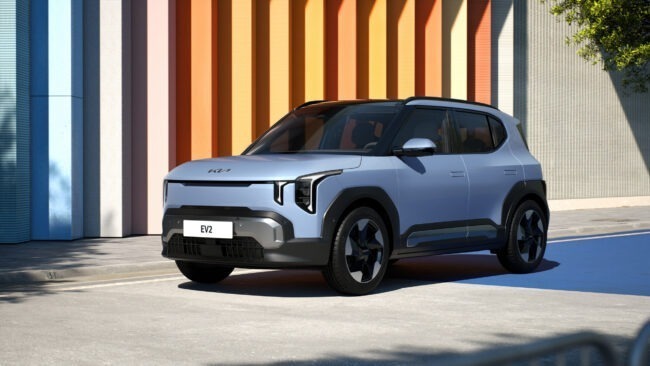
Kia Corporation unveiled the EV2 at the 2026 Brussels Motor Show, marking the global debut of its sixth dedicated electric vehicle. The EV2 is positioned as a compact B-segment SUV designed for first-time electric vehicle buyers and urban households seeking a more emotional and intuitive entry point into electric mobility. The company confirmed that production will begin in the first quarter of 2026, initially with a standard-range version. Long-range and GT Line trims will follow later in the year.
The EV2 announcement was accompanied by the reveal of new electric GT variants across the portfolio, including the EV3 GT, EV4 Hatchback GT, and EV5 GT. These additions reflect Kia Corporation’s strategy of simultaneously expanding volume and performance in its electric vehicle roadmap.

What strategic role does the EV2 serve in Kia Corporation’s broader electrification roadmap?
The EV2 fills a critical white space in Kia Corporation’s electric vehicle strategy by offering a compact yet versatile SUV tailored for dense urban markets. As the smallest model in the company’s electric vehicle portfolio, the EV2 acts as a volume driver while introducing younger, urban, and cost-conscious consumers to the brand’s electric mobility platform.
Kia Corporation has made it clear that the EV2 is not a stripped-down compliance vehicle. It is equipped with class-above features such as bidirectional vehicle-to-load functionality, an EV route planner, Plug & Charge capability, and a projected range of up to 448 kilometers. By integrating these technologies into a compact footprint, Kia Corporation is sending a signal that practicality does not have to come at the expense of emotional engagement or functional sophistication.
Rather than solely chasing low acquisition cost, the EV2 is engineered to create brand affinity in the entry segment. It allows Kia Corporation to replicate the success of its EV6 and EV9 with a younger demographic and in more price-sensitive regions, while retaining the core design and technology ethos that defines its electric portfolio.
Why is Kia Corporation prioritizing the compact electric SUV category in 2026?
The shift toward compact electric sport utility vehicles is a reflection of where global demand, regulatory incentives, and urban consumer behavior are converging. In European markets where electric adoption is accelerating, policy makers are increasingly favoring smaller, energy-efficient vehicles through differentiated subsidies and taxation. The B-segment SUV category offers a balance of usable space, driving comfort, and lower energy consumption, making it ideal for high-density city living.
In addition, the competitive environment is shifting rapidly. Rivals including the Volvo EX30, Volkswagen ID.2, and Renault 5 E-Tech Electric are all targeting the sub-30,000 euro segment. Kia Corporation’s EV2 is expected to compete directly in this category, but with the advantage of an SUV form factor rather than a hatchback.
Strategically, compact electric sport utility vehicles also allow better battery-to-price ratios compared to smaller A-segment cars, where battery costs can account for up to 40 percent of the total build cost. By operating in the B-segment, Kia Corporation is able to extract more value from each unit while still hitting affordability benchmarks required to scale volume.
Can the EV2 create pricing pressure without eroding margins?
While pricing details have not been disclosed, industry analysts expect the Kia EV2 to launch in Europe at a starting price between 25,000 and 29,000 euros. This would position it aggressively against Chinese electric imports from brands such as BYD and MG, which have leveraged lower battery and labor costs to undercut legacy original equipment manufacturers.
Kia Corporation’s response appears to be one of surgical inclusion. By offering advanced features from its higher-end models in a cost-contained package, the EV2 may avoid a race to the bottom. Platform optimization, likely through a shortened version of the E-GMP architecture or a related cost-reduced variant, will be key to maintaining margins.
Localization of production, potentially in Slovakia or another European plant, may also play a role in reducing logistics and tariff exposure. The EV2’s eventual global rollout will test how successfully Kia Corporation can scale without compromising on quality or user experience. Regional pricing flexibility, supported by feature modularity, could allow the company to hit different cost and demand profiles without fragmenting its brand identity.
What does the reveal of the EV3 GT, EV4 GT, and EV5 GT indicate about Kia Corporation’s EV identity?
Alongside the EV2 debut, Kia Corporation showcased its next wave of electric GT models. These performance-oriented variants build on the company’s desire to retain an emotionally resonant identity even as it transitions fully into the electric era. The GT series includes dual-motor setups, performance-tuned suspensions, and sportier aesthetics, and they collectively signal Kia Corporation’s confidence in serving both sides of the demand curve.
The duality of the EV2 and GT lineup suggests a maturing electric vehicle strategy. Where the EV2 emphasizes accessibility, the GT models are about aspiration. This mirrors the approach taken by brands like Tesla, which introduced the Roadster before democratizing with the Model 3, and Hyundai Motor Company, whose Ioniq 5 N targets performance enthusiasts.
Importantly, Kia Corporation is not offering watered-down performance. The EV6 GT, a precursor to the current GT expansion, was praised for delivering track-level capabilities. The new GT variants are expected to inherit this engineering philosophy, positioning Kia Corporation as not just an electric vehicle brand, but a performance brand in the electric age.
What operational or market risks could limit the EV2’s impact?
Despite the favorable positioning, the Kia EV2 will face challenges that could limit its near-term commercial upside. First is supply chain volatility, particularly in battery cell availability. Any disruptions in module sourcing or allocation could delay the production ramp or constrain volume at launch. Second is internal competition within Kia Corporation’s own lineup. The EV2 must differentiate clearly from internal combustion engine models like the Kia Seltos or the Niro EV, avoiding confusion or cannibalization.
Execution risk also lies in the ownership ecosystem. As a first electric vehicle for many buyers, the EV2 will require more than just strong specs. It will need bundled offerings for home charging, public charging network access, and over-the-air software support. If this ecosystem is underdeveloped or inconsistently delivered across markets, customer satisfaction could be compromised.
Brand messaging poses another layer of risk. While Kia Corporation emphasized the “emotionally engaging” nature of the EV2, such abstract positioning may not resonate equally across cultures. Some markets may prioritize range, resale value, or charging convenience over intangible benefits. Adapting the launch narrative to suit local preferences will be crucial.
How are investors and industry observers reacting to the EV2 launch?
Market reaction to the EV2 unveiling has been cautious but constructive. Kia Corporation’s stock remained flat in the days following the announcement, mirroring broader investor uncertainty in the electric vehicle sector due to ongoing price wars, subsidy cuts, and geopolitical friction affecting trade flows. However, analysts noted the importance of the EV2 as a proof point for downward scalability without dilution of brand value.
Institutional investors will likely view the EV2 as a test of margin discipline. Unlike premium electric vehicles that command significant gross profit buffers, compact sport utility vehicles rely on operational efficiency and volume for profitability. The EV2’s production targets, supplier contracts, and regional manufacturing strategies will therefore be key indicators for future coverage and valuation models.
From a competitive standpoint, the EV2 increases pressure on traditional European brands that have been slower to scale mass-market electric vehicles. It also adds a layer of defensibility for Kia Corporation in protecting its European market share from Chinese competitors, especially if local content thresholds enable the company to qualify for favorable tariff treatment or government incentives.
What does the EV2 launch signal about the future direction of Kia Corporation’s electric vehicle business?
The EV2 is more than a product launch. It is a strategic signal. It tells the market that Kia Corporation believes it can sustain emotional design and technological credibility even at the lower end of the pricing spectrum. It indicates that the company is not retreating from Europe’s competitive and regulatory-intensive market but leaning into it.
It also reveals a willingness to evolve the concept of “entry-level” electric vehicles beyond simple affordability. By bundling real-world driving range, bi-directional energy use, and intelligent route planning into a compact platform, Kia Corporation is redefining expectations of what urban electric mobility can feel like.
Whether the EV2 becomes a best-seller will depend on execution. But its very existence broadens the perception of Kia Corporation from a value brand to a serious electric platform player with global ambition.
What does the EV2 launch reveal about Kia Corporation’s long‑term electric vehicle economics, capital discipline, and growth priorities?
Kia Corporation has made a decisive move with the EV2, positioning itself to win in both the volume and performance ends of the electric vehicle market. The launch aligns with the company’s dual-track strategy of emotional design and functional accessibility. With the EV2, Kia Corporation enters a hotly contested segment but with a differentiated approach that prioritizes user experience, modular range configurations, and feature depth.
The upcoming GT variants reinforce this by sustaining brand excitement and retaining high-margin consumer interest. Risks around supply chain resilience, message localization, and internal product overlap remain, but Kia Corporation appears structurally prepared for the next phase of its electric vehicle evolution.
Key takeaways on what Kia’s EV2 debut means for the electric vehicle landscape
- Kia Corporation has unveiled the EV2, its smallest dedicated electric SUV, targeting first-time EV buyers and urban drivers
- The EV2 offers a range of up to 448 kilometers, V2L capability, Plug & Charge, and EV route planning, making it a high-feature entry vehicle
- Kia will begin production in Q1 2026 with staggered rollouts of standard-range, long-range, and GT Line trims across multiple regions
- The EV2 fills a strategic gap in Kia’s lineup and could emerge as a volume driver in European cities and emerging EV markets
- Simultaneous reveals of EV3 GT, EV4 Hatchback GT, and EV5 GT highlight Kia’s push toward dual-track growth: accessible EVs and performance EVs
- Execution risks include battery sourcing, regional pricing, and ICE vs EV cannibalization within Kia’s SUV lineup
- Investor sentiment remains measured but optimistic, with focus shifting to Kia’s margin discipline and production readiness
- Kia’s EV2 launch positions it to directly challenge Chinese EV imports with a more brand-trusted, quality-centric alternative in Europe
Discover more from Business-News-Today.com
Subscribe to get the latest posts sent to your email.