




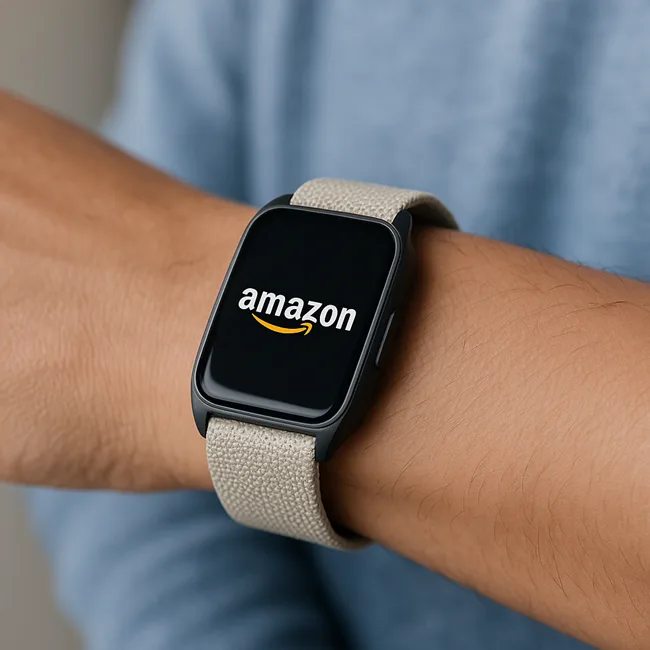
Amazon.com Inc (NASDAQ: AMZN) has signed a definitive agreement to acquire Bee, a San Francisco-based startup known for its AI-enabled bracelet that continuously listens to conversations and transcribes them into actionable summaries and searchable logs. The deal, announced on July 22, 2025, has sparked intense debate about Amazon’s wearable hardware ambitions and whether this low-cost, transcription-first device could serve as the foundation for a broader ambient computing strategy.
The acquisition marks Amazon’s first major re-entry into wearables since discontinuing its Halo fitness tracker in 2023. Bee’s bracelet, priced at US $49.99 with a US $19 monthly subscription, promises over 160 hours of battery life and on-device processing to ensure quick transcription without cloud dependency. While financial details remain undisclosed, analysts view the move as a strategic play to integrate AI-driven ambient intelligence into Amazon’s Alexa and Amazon Web Services (AWS) ecosystems.
Why is Amazon betting on Bee to re-enter wearables and how does this align with its ambient computing vision?
Amazon’s pivot to Bee reflects lessons learned from its earlier struggles with Halo. Unlike Halo’s fitness-centric focus, Bee’s bracelet targets productivity, positioning itself as a lightweight AI assistant rather than a lifestyle gadget. It listens to conversations, transcribes them locally, and generates real-time summaries—capabilities that naturally extend Amazon’s Alexa vision from reactive voice responses to proactive, context-aware assistance.
Analysts believe this integration could eventually enable Bee-powered devices to automate tasks across Amazon’s ecosystem. For example, users might dictate grocery items mid-conversation that automatically sync to Amazon Fresh or issue calendar updates without speaking a wake word. By embedding always-on context, Amazon could close the gap with rivals such as Google and Meta, which are also experimenting with hands-free AI hardware.
Institutional sentiment suggests Amazon is leveraging Bee to accelerate its ambient computing roadmap by starting small—targeting professionals and productivity-conscious users before expanding to mass-market consumers.
How does Bee’s technology differentiate itself from other wearable AI devices in price, utility, and design?
Bee’s bracelet takes a utilitarian approach in a market crowded with multifunctional wearables. Its single-purpose design—focused on transcription—keeps hardware simple, allowing for a significantly lower retail price than competitors. At under $50, it undercuts Apple Watch models, Google’s Gemini earbuds, and Meta’s Ray-Ban smart glasses, all of which exceed $200.
Battery performance stands out as a competitive advantage. Bee’s 160-hour charge cycle contrasts sharply with premium devices that require daily charging. By forgoing advanced displays or AR projections, Bee avoids the energy drain that plagued Humane’s AI Pin, which struggled to last a full day.
From a user experience perspective, Bee’s dual microphones and noise-filtering ensure accurate voice capture even in busy environments. Its local processing minimizes latency, delivering fast transcription in multiple languages—an advantage for professionals needing meeting notes, journalists conducting interviews, or students summarizing lectures.
What privacy and regulatory challenges could impact Amazon’s wearable AI strategy with Bee?
Privacy remains the biggest barrier for always-on AI wearables. Bee attempts to address these concerns by processing audio locally, storing only text transcriptions, and allowing users to mute the device or delete data directly.
However, scaling Bee globally will require Amazon to navigate strict data protection regimes. Markets such as the European Union, governed by the GDPR, will scrutinize even text-based transcripts for consent compliance. In the U.S., states like California and New York mandate two-party consent for recording conversations, which could limit Bee’s adoption unless Amazon builds robust consent management features.
Institutional observers caution that Amazon’s reputation for data privacy will face renewed scrutiny. Past controversies, including Ring’s sharing of doorbell footage with law enforcement, have already made consumers wary. Analysts argue that transparent policies and frequent privacy audits will be essential to gaining regulatory approval and consumer trust.
What are the financial and strategic implications of acquiring Bee for Amazon’s wearable ambitions?
Though Amazon has not disclosed the acquisition price, Bee’s prior funding of approximately US $7 million suggests a modest valuation compared to typical Big Tech hardware deals. This makes Bee a low-risk entry point into AI wearables while giving Amazon access to proprietary transcription technology and a specialized engineering team.
Bee’s approximately 20 employees will join Amazon’s Devices division under Panos Panay, formerly of Microsoft’s Surface hardware division. Analysts expect this integration to accelerate the development of Bee-powered wearables, potentially rebranded under the Alexa line. Launch timelines could fall within 12 to 18 months, with future products bundled with Alexa+ or AWS-powered edge AI services.
From a strategic perspective, Bee also positions Amazon to expand into enterprise markets. Potential use cases include transcription services for corporate meetings, legal documentation, and healthcare, aligning with AWS’s ambitions in cloud-based productivity solutions.
How are investors interpreting Amazon’s wearable AI pivot and what impact could it have on stock sentiment?
Investor reaction to the Bee acquisition has been cautiously optimistic. Institutional investors see it as a small but strategic bet that diversifies Amazon’s hardware portfolio beyond Echo smart speakers and Fire TV. The acquisition aligns with market expectations for Big Tech to monetize generative AI through consumer devices, not just cloud services.
However, analysts warn that any privacy misstep could trigger regulatory probes and erode public trust, negatively affecting Amazon’s brand. For now, the low acquisition cost and clear productivity-focused use case keep the risk profile manageable. If Bee succeeds, it could boost long-term investor confidence in Amazon’s ability to scale affordable AI devices.
What is the long-term outlook for Bee’s technology in Amazon’s broader AI ecosystem?
Looking ahead, analysts expect Bee’s technology to evolve from a niche transcription tool into a broader ambient computing node. Future iterations may integrate real-time language translation, sentiment detection, and predictive task automation, creating a seamless bridge between conversations and actionable outcomes.
Amazon could also open Bee’s platform to third-party developers, encouraging the creation of specialized apps for industries such as education, journalism, and healthcare. Patents for extended battery technology, low-power processors, and improved microphone arrays may indicate the direction of future development.
While success will depend heavily on public trust and regulatory compliance, analysts believe Amazon has a first-mover advantage in affordable, context-driven AI wearables. If executed well, Bee could help Amazon establish a new product category where consumer expectations are shaped more by utility than by flashy hardware.
Discover more from Business-News-Today.com
Subscribe to get the latest posts sent to your email.

