



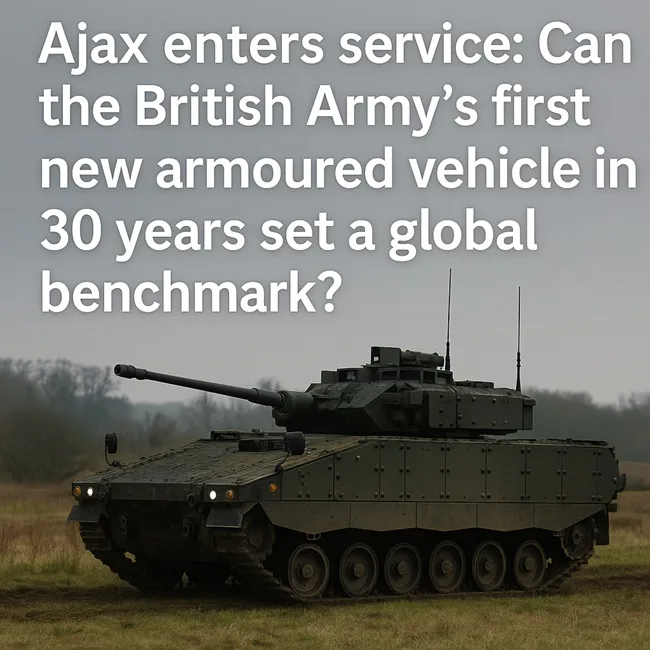
The British Army has formally brought the Ajax armoured fighting vehicle into active service, marking the most significant land combat platform deployment in over three decades. Built by General Dynamics UK at its Merthyr Tydfil facility in Wales, the Ajax family has achieved Initial Operating Capability (IOC), allowing an operational squadron to now be deployed. This milestone confirms the readiness of a programme that has endured over a decade of design, scrutiny, and re-engineering, making it one of the most controversial yet transformational defence projects in recent UK military history.
The six-variant fleet will replace the ageing CVR(T) vehicles that have been in service since 1971. It is positioned at the centre of the British Army’s Future Soldier programme and modernisation roadmap, underpinned by a £41 billion equipment and support investment plan over the next decade. While the vehicle’s military role is core to its relevance, the Ajax platform has also become an economic symbol of UK defence industrial revival, supporting more than 4,100 jobs and over 230 suppliers across the nation.
Why was the Ajax programme controversial, and how did it overcome early setbacks?
The Ajax platform began life in 2010 under the Scout SV (Specialist Vehicle) designation, part of the broader Future Rapid Effect System (FRES) initiative. After the FRES programme was shelved due to complexity and cost, Scout SV was carved out as a standalone next-generation reconnaissance vehicle. In 2014, the United Kingdom Ministry of Defence signed a £3.5 billion contract with General Dynamics UK for 589 Ajax-family vehicles in six configurations: Ajax (reconnaissance), Ares (personnel carrier), Apollo (recovery), Atlas (repair), Athena (command and control), and Argus (engineering reconnaissance).
Early promise soon gave way to systemic setbacks. Between 2017 and 2020, the programme experienced technical integration issues, particularly in the harmonisation between hull and turret systems. The most severe challenges emerged in 2021 and 2022 when testing revealed serious noise and vibration concerns. Crew members experienced physical injuries, including hearing loss and joint damage, prompting a suspension of trials and a parliamentary inquiry.
Remedial engineering addressed these issues. The design was retrofitted with improved suspension systems, shock-absorbing seats, acoustic insulation, and upgraded software interfaces. These changes restored institutional confidence and eventually led to the declaration of Initial Operating Capability in 2025 following rigorous field testing by the Household Cavalry Regiment.
What makes Ajax stand out from previous armoured vehicles and global peers?
Ajax is a digitally enabled, networked combat platform designed for high-speed reconnaissance, command integration, and precision engagement. It has a maximum road speed of 70 kilometres per hour and is armed with a CT40 cased telescopic 40mm cannon capable of defeating light armour and infantry positions. Each vehicle in the family contributes to a highly modular, interoperable battlefield ecosystem. The digital fire control systems, sensor arrays, and battlefield communication modules allow seamless sharing of reconnaissance data, target location, and movement coordination across allied platforms.
Unlike older-generation vehicles such as the CVR(T), Ajax enables 360-degree crew awareness through panoramic digital displays, allowing even the driver—not just the turret commander—to maintain situational control. Its “spiral development” capability means that future upgrades including AI-driven navigation, autonomous convoying, or advanced electronic warfare modules can be integrated without major overhauls.
This makes Ajax competitive not only in national deployment but also in international defence export markets where allied forces are modernising to counter hybrid warfare and grey zone threats.
How is the vehicle expected to shape the British Army’s operational capabilities?
Ajax is the backbone of the British Army’s new Armoured Brigade Combat Teams and Deep Reconnaissance Strike Brigades. These units are being designed for rapid deployment, multi-domain integration, and sensor-led targeting. Through its integrated surveillance and targeting technologies, Ajax delivers a significant boost to intelligence, surveillance, target acquisition, and reconnaissance (ISTAR) missions.
As part of the Future Soldier restructuring, the United Kingdom aims to increase battlefield lethality by tenfold. The Ajax platform, with its digital-first architecture, enables faster decision-making cycles, enhanced target precision, and reduced collateral engagement. It also reduces crew fatigue and increases survivability through its advanced modular armour and onboard safety systems.
The vehicle plays a pivotal role in integrating with the Morpheus battlefield communication system, allowing real-time information exchange across battalion and brigade levels, even in contested electromagnetic environments.
How does Ajax support the UK economy and defence supply chain?
The economic footprint of the Ajax programme is as significant as its military capability. General Dynamics UK manufactures the vehicles in Merthyr Tydfil, Wales, and integrates components from a wide supply chain involving more than 230 British companies. Over 4,100 jobs have been directly supported through the programme, spanning high-precision machining, software integration, and electronic systems engineering.
This is aligned with the United Kingdom government’s “Defence as an Engine for Growth” strategy, which promotes sovereign manufacturing, exports, and innovation in the defence industrial base. The investment has revitalised regional economies, particularly in South Wales, where Merthyr has emerged as a critical node in the UK’s land defence production map.
Defence Readiness and Industry Minister Luke Pollard and Secretary of State for Wales Jo Stevens have reiterated that the Ajax programme is not only a defence asset but a strategic driver of economic opportunity. Their public statements underscore a renewed policy focus on embedding defence supply chains into domestic industrial renewal.
What is the export outlook for Ajax and its role in the UK’s global defence posture?
While no formal export deals have been announced yet, early-stage discussions are already underway with several NATO allies and Indo-Pacific partners. The Ajax platform is seen as an attractive option for countries modernising their medium-weight armoured fleets, especially those looking for digitised command integration, modularity, and NATO-standard interoperability.
The Ministry of Defence has already secured significant defence export deals in 2025, including Type 26 frigates for Norway and Eurofighter Typhoons for Türkiye. The Ajax family is expected to be positioned as the land systems equivalent of these strategic platforms. Success in export markets could extend the vehicle’s production lifecycle, reduce unit costs through scale, and consolidate the United Kingdom’s position as a reliable defence technology exporter post-Brexit.
What does the programme’s trajectory tell us about UK defence procurement?
Ajax is arguably the most dramatic example of a UK defence programme that recovered from near-collapse to deliver a transformative capability. While critics have highlighted the programme’s earlier failures, its completion signals an institutional shift toward long-term platform strategies with adaptive upgrade paths.
The UK Ministry of Defence’s approach with Ajax suggests a new procurement mindset—focused less on one-off equipment purchases and more on ecosystems of digital, modular, and export-ready platforms. Institutional investors tracking UK defence contractors and industrials are watching Ajax as a bellwether of whether lessons from the programme will inform future initiatives such as the Boxer infantry carrier, Challenger 3 main battle tank upgrades, and next-generation autonomous land systems.
What are the key takeaways from Ajax entering service and how will it affect UK defence capability and the national supply chain?
- Ajax has officially achieved Initial Operating Capability, allowing the British Army to deploy an operational squadron for the first time using the new vehicle family.
- It is the first new tracked armoured fighting vehicle to enter British service in nearly 30 years, replacing the legacy CVR(T) fleet introduced in 1971.
- The vehicle programme faced major delays due to noise and vibration issues, but these were mitigated through design upgrades including new suspension systems, acoustic dampening, and crew protection enhancements.
- Ajax’s advanced digital systems, including 360-degree situational awareness for all crew members, significantly improve reconnaissance and command capabilities on the battlefield.
- The family of six variants—Ajax, Ares, Apollo, Atlas, Athena, and Argus—supports a wide range of roles from reconnaissance to repair, forming a modular combat ecosystem.
- More than 4,100 jobs and over 230 companies across the UK are part of the Ajax supply chain, with manufacturing centred in Merthyr Tydfil, Wales, underlining the MOD’s emphasis on sovereign defence production.
- The Ministry of Defence is exploring export opportunities, positioning Ajax as a NATO-compliant, upgradeable armoured platform for global customers.
- Institutional and defence analyst sentiment has turned more positive post-IOC, seeing Ajax as a recovery story for UK land defence procurement.
- Ajax is built for long-term adaptability through spiral development, allowing future upgrades like autonomous systems, AI-driven targeting, and electronic warfare capabilities without structural overhauls.
- If successfully integrated into active operations and NATO frameworks, Ajax could signal a shift in UK defence procurement towards modular, scalable, and exportable military platforms.
Discover more from Business-News-Today.com
Subscribe to get the latest posts sent to your email.