



The United States military has conducted another round of airstrikes targeting Islamic State positions in Syria, as part of an ongoing counterterrorism campaign responding to a deadly ambush in December 2025 that claimed the lives of two U.S. soldiers and a civilian interpreter. The January 10, 2026 strikes were carried out under the designation of Operation Hawkeye Strike and were coordinated by United States Central Command.
The airstrikes, executed at approximately 12:30 p.m. Eastern Time, involved U.S. forces in conjunction with unnamed partner nations. While CENTCOM confirmed allied participation, it did not disclose the identity of those countries in the January operation. However, a similar strike on December 19, 2025, was conducted jointly by the United States and Jordan, suggesting a continuation of regional coordination.
United States Central Command stated that these strikes were intended to degrade ISIS operational capabilities across Syria and to prevent further attacks on American and partner personnel. The campaign follows the December 13, 2025 killing of three Americans in Palmyra, Syria, by an ISIS-affiliated gunman who was later neutralized.
What is Operation Hawkeye Strike and how does it relate to U.S. military strategy in Syria?
Operation Hawkeye Strike appears to represent a tactical intensification of U.S. military efforts against the Islamic State group in Syria. While the United States has maintained a counter-ISIS presence in Syria since 2015, this specific operation was initiated following the deaths of American personnel last month and marks a transition to more proactive targeting of ISIS positions using coordinated airpower and partner-supported strikes.
The campaign name and structure suggest a formalization of what might previously have been individual strike responses. Operation Hawkeye Strike now forms the umbrella under which multiple waves of airstrikes, including the December 19 and January 10 missions, are being conducted.
CENTCOM has not disclosed the total number of ISIS targets engaged during the January strikes, nor has it released assessments of post-strike damage or militant casualties. However, statements from the command emphasize that the campaign is focused on “large-scale” targeting of ISIS infrastructure and personnel, reinforcing the impression that this is not a limited retaliatory action but a sustained operational push.
What are the military and diplomatic implications of U.S. strikes on Syrian territory?
The January 2026 airstrikes underscore the complex legal and geopolitical dynamics surrounding the U.S. presence in Syria. American forces currently operate in Syria without the explicit consent of the Syrian government, under the legal justification of collective self-defense against terrorist threats. This positioning is rooted in a combination of Congressional Authorizations for Use of Military Force and international counterterrorism obligations under coalition frameworks.
While the Islamic State group no longer controls significant territory, U.S. officials maintain that the group continues to operate in decentralized cells, particularly in eastern Syria. CENTCOM’s airstrike campaign is intended to prevent the reconstitution of these cells into larger operational units.
However, any renewed U.S. military engagement in Syria risks friction with other actors operating in the same airspace, including Russian and Iranian forces. Russia, in particular, has previously objected to unilateral U.S. operations and maintains its own air defense posture in Syria through the Khmeimim airbase. Iran-aligned militias have also increased their activity near U.S. bases, leading to periodic flare-ups. The risk of escalation remains a background concern in any U.S. decision to expand or prolong air operations in the region.
How the deaths of Iowa National Guard soldiers have shaped U.S. response posture
The deaths of two Iowa National Guard members and a U.S. civilian interpreter in Palmyra on December 13 marked one of the most serious incidents involving American personnel in Syria in over a year. While CENTCOM identified the attacker as a lone ISIS-affiliated gunman, the scale of the U.S. response suggests that intelligence assessments view the incident as part of a wider resurgence or risk pattern rather than an isolated episode.
The political and military response to American casualties is often shaped by both operational necessity and domestic expectations around force protection. In this case, the targeting of U.S. service members has triggered a multi-week series of airstrikes, publicly framed as necessary to prevent future incidents. CENTCOM’s repeated statements on “resolute pursuit” of ISIS operatives signal an intent to maintain deterrence and reinforce that threats to U.S. personnel will be met with force projection, not withdrawal.
What role do regional allies play in ongoing U.S. operations in Syria?
Although the January 10 strike did not specify partner countries, previous missions under Operation Hawkeye Strike have confirmed Jordan’s involvement, indicating a coalition structure that extends beyond U.S. unilateral action. Jordan has played a consistent role in the U.S.-led coalition against ISIS, particularly in intelligence sharing and regional basing support.
Turkey, Iraq, and the Syrian Democratic Forces have all historically been involved in varying degrees of counter-ISIS operations, though their relationships with the United States remain complex. Turkey views certain U.S.-backed Kurdish groups as security threats, while Iraq has been pushing for a gradual reduction of foreign military presence.
CENTCOM’s emphasis on “partner forces” may be deliberately broad to accommodate these sensitivities. Nonetheless, the ability of the United States to launch deep strikes inside Syria likely depends on continued overflight permissions, airbase access, and intelligence cooperation with at least some regional actors.
What does this signal about the future of U.S. counterterrorism policy in the Middle East?
The resumption of large-scale airstrikes in Syria could be interpreted as a recalibration of U.S. counterterrorism posture under the current administration. While there has been a broader shift in American defense strategy toward great-power competition, events such as the December ambush in Palmyra and subsequent strikes indicate that the U.S. military is maintaining readiness to re-engage against non-state actors when triggered by casualties or perceived escalations.
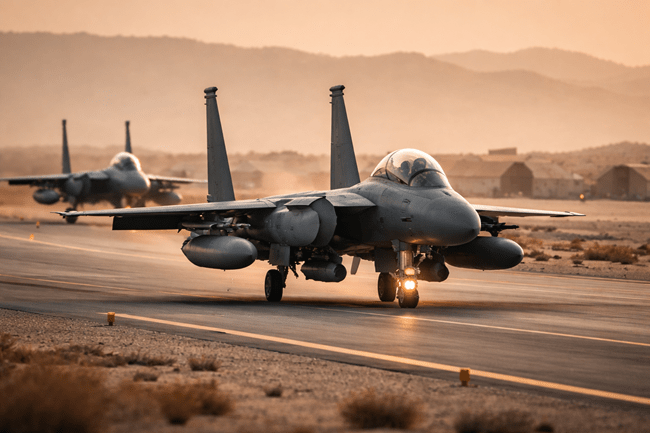
CENTCOM’s framing of the operation as essential to “protect American and partner forces in the region” echoes familiar language from earlier counterterror campaigns. However, the formal naming of the mission, sustained engagement across weeks, and imagery of deployed assets such as the F-15E Strike Eagle suggest a more structured effort than an isolated retaliatory act.
The question of whether Operation Hawkeye Strike will continue or escalate remains open. As of now, CENTCOM has not announced a timetable for completion or drawdown. Any continuation is likely to depend on the frequency and severity of ISIS-linked incidents involving U.S. personnel, as well as broader political considerations about U.S. military commitments in the region.
Key takeaways on what this development means for the countries, institutions, and global context involved
- The United States conducted large-scale airstrikes across Syria on January 10, 2026, under Operation Hawkeye Strike in retaliation for a December 2025 ISIS attack.
- United States Central Command confirmed allied participation in the strikes but did not name the specific partner countries involved in the latest round.
- The operation reflects a more structured and ongoing campaign against ISIS rather than a one-time reprisal.
- CENTCOM emphasized deterrence, force protection, and degradation of ISIS capabilities as core objectives of the ongoing strikes.
- The U.S. military remains operationally active in Syria without the consent of the Syrian government, amid ongoing risks of confrontation with other regional actors.
Discover more from Business-News-Today.com
Subscribe to get the latest posts sent to your email.