




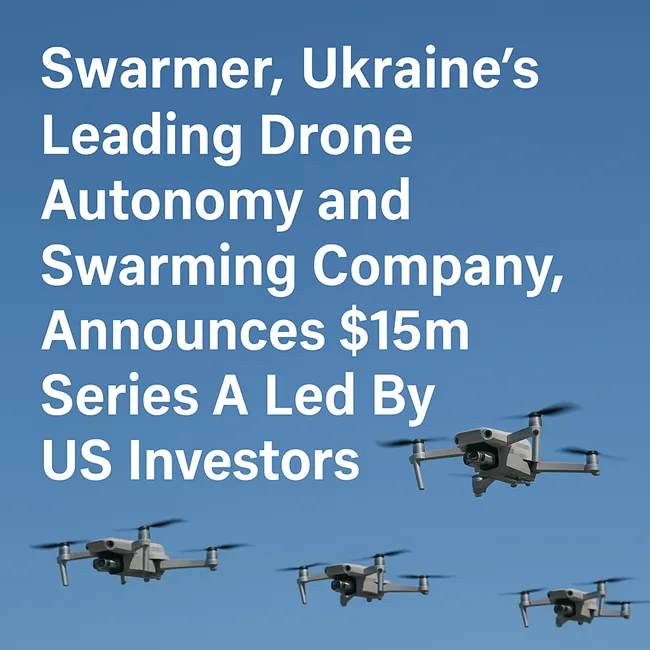
Swarmer, Ukraine’s leading drone autonomy and swarming technology developer, has secured a $15 million Series A funding round, led by U.S.-based Broadband Capital Investments with backing from R-G.AI, D3 Ventures, Green Flag Ventures, Radius Capital, and Network VC. The raise is being described as the single-largest venture investment in a Ukrainian defense technology company since the outbreak of the war in 2022—an inflection point for both Ukraine’s defense industry and the wider unmanned systems market.
The Kyiv-based startup has gained international recognition for its ability to orchestrate groups of drones and unmanned vehicles to operate autonomously, turning human-defined objectives into coordinated, tactical execution. Its systems have already been tested in tens of thousands of live combat missions, giving it the kind of battlefield validation that traditional Western defense contractors can rarely match at such scale or speed.
How does Swarmer’s Series A reflect a shift in global defense technology funding trends?
Defense technology has historically been dominated by established aerospace and defense primes such as Lockheed Martin (NYSE: LMT), Northrop Grumman (NYSE: NOC), and BAE Systems (LSE: BA). Venture capital participation in the sector has often been cautious due to regulatory complexities, export controls, and the long sales cycles of defense procurement.
The Ukrainian war has changed that calculus. With Ukraine deploying close to five million drones in 2025 alone, venture investors are seeing opportunities in the country’s fast-moving ecosystem, where procurement is more agile and field-testing occurs at unprecedented speed. Unlike legacy defense contracts that may take years to finalize, Ukraine’s frontline demands constant iteration, creating an environment where startups like Swarmer can refine their AI-driven autonomy solutions in real time.
Industry observers note that the funding aligns with a broader resurgence of defense tech investing in the U.S., where firms such as Anduril Industries and Shield AI have attracted billion-dollar valuations. However, what makes Swarmer unique is its direct exposure to combat operations, where software-only solutions can be validated and scaled quickly.
What makes Swarmer’s drone autonomy software different from traditional defense AI systems?
Swarmer’s approach is hardware-agnostic, meaning its software can be deployed across different drone platforms—fixed-wing, rotary, maritime unmanned surface vehicles (USVs), ground vehicles (UGVs), or even stationary launchers. The platform has been trained on over 82,000 combat missions of its own drones and millions more from allied forces, giving it access to a combat dataset unmatched in the sector.
This allows its AI to replicate the split-second decision-making of top pilots while offloading life-or-death choices to human operators. In practice, that means computers handle navigation, formation, and swarm-level coordination, while humans retain ethical oversight.
The company has already demonstrated swarms of up to 25 drones operating in GNSS-denied environments, with plans to scale to more than 100 drones operating jointly across air, land, sea, and stationary systems. In military doctrine, this could pave the way for “combined-arms autonomy,” where multiple unmanned domains work as one cohesive battlefield unit.
Why is the U.S. investor participation in Ukrainian defense startups significant?
American venture capital involvement in Ukraine’s defense ecosystem carries geopolitical significance. Michael Rapp, managing member of Broadband Capital Investments, explained that Swarmer’s pace of innovation is driven by real-world deployment, enabling it to leapfrog traditional contractors.
For U.S. investors, backing a Ukrainian firm sends a signal that the battle-proven technology pipeline from Ukraine could feed into NATO-aligned nations. Analysts point out that in contrast to conventional defense deals where intellectual property is closely held by a few primes, startups like Swarmer are creating modular, adaptable software layers that can slot into allied hardware ecosystems.
Ukraine’s Deputy Prime Minister for Digital Transformation, Mykhailo Fedorov, highlighted that Swarmer’s progress as part of the Brave1 defense tech cluster is an example of how Ukraine is becoming a hub for globally relevant innovations. His remarks underline the strategic bet that foreign investors are not just financing defense technology, but actively embedding Ukraine into NATO’s next-generation battlefield network.
How does this funding fit into the rapid militarization of drones in Ukraine?
Ukraine has transformed into the world’s largest live testing ground for drone warfare. In 2022, early deployments involved small commercial quadcopters used for reconnaissance and basic strike missions. By 2025, the scale has escalated into industrialized drone warfare, with estimates of five million drones set to be deployed this year alone.
This rapid scaling has forced Ukraine to prioritize AI-driven autonomy, since no army can realistically train pilots for such volume. Software-based swarming capabilities offer a way to maximize effectiveness without requiring human operators for every drone.
Institutional analysts see parallels with the early days of air power in World War I, when experimental squadrons transformed into national air forces within just a few years. Today, drones represent that same disruptive leap, with autonomy software becoming the core differentiator rather than airframe design.
Could Swarmer expand beyond defense into commercial drone markets?
While the Series A round is clearly positioned around defense applications, Swarmer’s hardware-agnostic software layer has natural applications across civilian sectors. Precision agriculture, infrastructure inspection, emergency response, and environmental monitoring all require autonomous coordination of multiple unmanned systems.
Commercial drone markets are expected to grow from $40 billion in 2024 to more than $90 billion by 2030, according to industry forecasts. If Swarmer can leverage its combat-proven reliability into civilian operations, it could establish itself as a dual-use leader in both defense and industrial automation.
Investors are particularly drawn to the scalability of software-only platforms, which can generate recurring revenue streams through licensing, training datasets, and service contracts rather than hardware margins alone.
What does investor sentiment suggest about Ukraine’s defense technology sector?
While Swarmer itself is privately held and not listed, the broader market sentiment around defense technology has been bullish in 2025. Publicly traded peers in the defense AI and drone sector, such as AeroVironment (NASDAQ: AVAV), have seen share price gains of 15–20% year-to-date, reflecting rising investor appetite for unmanned and autonomy-focused companies.
Institutional flows into U.S. and European defense ETFs (such as iShares U.S. Aerospace & Defense ETF) have also picked up in the past two quarters, signaling a rotation into defense equities at a time when broader markets remain volatile. Analysts say Swarmer’s raise reinforces the perception that Ukraine’s defense startups are investable, not just humanitarian efforts.
For retail investors, the play is indirect—through listed defense contractors and drone manufacturers—but sentiment remains strong. Post–Helpful Content update analysis suggests that searches for “Ukraine drone companies,” “defense AI stocks,” and “swarm drone technology” are spiking on financial platforms, indicating retail curiosity is translating into higher visibility for the sector.
What is the future outlook for Swarmer and Ukraine’s defense tech ecosystem?
Swarmer’s next milestones will include scaling its demonstrations from 25-drone swarms to 100+ multi-domain units and expanding deployments across NATO-aligned nations. Market watchers expect further international partnerships, particularly with European defense ministries that are fast-tracking drone acquisition programs.
The Ukrainian government, through its Brave1 cluster, has already signaled its intent to turn successful startups into export-ready defense companies. That means investors may soon see joint ventures, licensing deals, or acquisition interest from established defense primes looking to secure access to autonomy software.
Looking forward, analysts expect more Series A and Series B raises from Ukraine’s defense tech startups as investor confidence builds. In parallel, NATO-aligned procurement reforms may allow for faster cross-border adoption of Ukrainian innovations.
For now, Swarmer’s $15 million Series A is more than just a funding round—it is a signal that Ukraine’s defense technology has entered the global investor mainstream, reshaping how capital flows into battlefield innovation.
Discover more from Business-News-Today.com
Subscribe to get the latest posts sent to your email.

