



A new generation of missile defence is quietly emerging, one that is defined not by a single launcher or radar, but by modularity, mesh architectures, and real-time decision orchestration. From Europe’s MBDA and Germany’s Rheinmetall to Israel’s Rafael and U.S. defence initiatives under the Missile Defense Agency and DARPA, leading defence contractors are building systems that swap platform-centric thinking for flexible, networked responses capable of adapting to fast-evolving threats.
This shift has been accelerated by the proliferation of hypersonic glide vehicles, swarm drones, and multi-vector strike scenarios that overwhelm fixed defences. To counter these, defence ecosystems are embracing plug-and-play sensors, dynamic effectors, and AI-enabled command layers that can respond not only faster, but smarter. In this new modular era, the winner is not necessarily the side with more interceptors. It is the side that can fuse data, reroute fire control, and deploy the right countermeasure at the right moment across air, land, sea, and space.
What is driving the push toward modularity in missile defence architectures?
Traditional missile defence systems were built around fixed assets such as centralised radars, dedicated launchers, and highly specialised interceptors. While powerful, these systems struggled with agility, scaling costs, and threat adaptability. The modern battlefield, however, is dynamic, with threats ranging from small, fast drones to long-range hypersonic cruise missiles, often deployed simultaneously.
This has created a demand for architecture that is not only layered, but flexible. Modular defence allows nations to mix and match sensors, radars, and effectors across domains, all controlled by software-defined logic that enables cross-asset interoperability. Instead of relying on one system to do everything, militaries can deploy a distributed mesh of specialised components that work as a unified, intelligent defence grid.
The result is greater survivability, lower costs over time, and faster integration of emerging technologies. Analysts say this model is particularly important for NATO and allied coalitions, where interoperability and field flexibility can make or break joint operations.
How are sensor meshes changing early detection and tracking?
The concept of a sensor mesh relies on multiple, often redundant, sensor types that cover overlapping domains and constantly share data across the network. These can include radar, infrared, passive RF sensors, and satellite-based detection systems. Mesh architectures allow for persistent 360-degree awareness, even in cluttered or contested environments.
Modern mesh-enabled systems such as Leonardo’s Michelangelo Dome and Saab AB’s GlobalEye platforms employ advanced sensor fusion engines to correlate incoming signals and predict intent before a threat fully materialises. The shift from “see-and-react” to “sense-and-predict” is key to managing threats like hypersonics or stealth UAVs that move faster than traditional command loops can process.
DARPA’s AMIGOS project and NATO’s upcoming battlefield edge sensor trials are further pushing this envelope by combining land-based radar, airborne ISR, and low-orbit satellite feeds into a single, latency-optimised fusion engine. By increasing redundancy and diversity of input, sensor meshes make it much harder for adversaries to blind or spoof a system.
Why are effectors-on-demand becoming the new missile defence model?
In a modular system, effectors are not tied to a specific launcher or threat profile. Instead, they are treated as resources in a network, selected, tasked, and fired by the central command logic depending on the target type, proximity, and kill probability.
Effectors-on-demand could include traditional surface-to-air missiles, loitering munitions, electromagnetic pulses, directed energy weapons, or even cyber-based countermeasures. The decision of which effector to deploy is increasingly handled by AI engines that can assess the threat envelope in real time and select the best available response.
The Israeli Iron Beam program, which pairs lasers with the Iron Dome’s kinetic systems, is a prime example. Rather than wasting expensive interceptors on low-value threats, the system can switch between hard-kill and soft-kill options based on real-time calculations. Rafael’s C-Dome naval variant integrates this logic with sea-based platforms, expanding effectors-on-demand to the maritime domain.
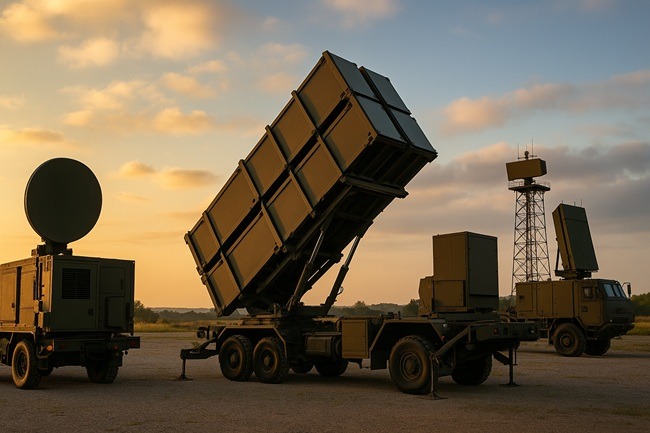
Germany’s Rheinmetall and MBDA are also developing containerised effectors and modular launcher kits that can be deployed on trucks, ships, or ground stations and connected to shared C2 nodes. The U.S. Missile Defense Agency has been testing similar concepts under the SHIELD and Glide Phase Interceptor programs, prioritising flexible, scalable interception over legacy system upgrades.
How are AI and software-defined command systems coordinating modular defence?
Software-defined command and control systems are the glue holding modular missile defence together. These systems use AI and machine learning to ingest sensor data, run predictive models, manage engagement priorities, and assign effectors at machine speed.
In traditional systems, these functions were distributed across manual teams and disconnected layers. Now, platforms like Thales Group’s Nexium Defence Cloud and Leonardo’s C2 modules allow for real-time orchestration. These platforms also support multi-domain operations, meaning they can coordinate responses between land-based systems, airborne sensors, and even space or naval assets.
For example, if a hypersonic missile is detected, an AI engine can simultaneously trigger early-warning alerts, prepare interceptor batteries, reassign drone patrols to extend radar coverage, and ready a decoy launcher on another continent to confuse trajectory tracking.
These capabilities are made possible through modular software stacks, containerised applications, and AI accelerators deployed at edge nodes. The trend is also giving rise to plug-in defence apps, tactical algorithms that can be swapped or updated like smartphone software, increasing agility and responsiveness across the force structure.
What are the benefits of modular missile defence for export markets and alliances?
Modular systems are inherently easier to customise, scale, and integrate into varied operational environments. For smaller nations or joint coalitions, this is a game changer. Instead of purchasing an entire missile defence suite, buyers can select compatible modules, sensors, or effectors based on geography, threat profile, and budget.
This flexibility has already influenced procurement in regions like Eastern Europe, Southeast Asia, and the Middle East. Leonardo’s joint venture with EDGE Group in the UAE, for instance, includes the development of regionally adapted systems built from modular Italian platforms. Rafael’s Iron Dome derivatives and MBDA’s Sea Ceptor kits are likewise being tailored for plug-in use with locally manufactured components or command systems.
Allied nations operating under NATO frameworks or bilateral defence treaties can benefit from modularity by establishing interoperability protocols and swapping sensor and launcher data during joint operations. The interoperability of effectors and targeting data could allow a ship from one country to fire an interceptor guided by a radar on land from another. This cross-border adaptability is a major strategic advantage.
What challenges still remain in implementing truly modular missile defence?
Despite its advantages, modularity is not without complications. One key challenge is standards. Without agreed protocols and interfaces, modules from different vendors or nations may not operate seamlessly. Interoperability frameworks, while improving, still require extensive testing and configuration.
Cybersecurity also becomes more complex. With distributed nodes, wireless updates, and AI decision loops, the attack surface expands. Modular defence systems need hardened encryption, secure boot chains, and real-time intrusion detection to prevent manipulation or false targeting.
There is also the human element. Training operators to manage multiple module types, interpret AI outputs, and respond to system recommendations requires a shift in doctrine and mindset. While AI can support decision-making, the final call often still rests with human commanders, particularly in politically sensitive scenarios.
Finally, cost can creep upward during initial deployment. While long-term modular systems promise lower lifecycle costs and greater upgrade potential, the up-front integration and testing phases can be capital intensive.
What does the road ahead look like for modular missile defence systems?
As global threats become more distributed, faster, and unpredictable, modularity in missile defence is likely to become the default, not the exception. The era of monolithic systems is giving way to agile networks that respond to threats as fluidly as they emerge.
Upcoming defence expos and battlefield trials in 2026 will showcase further integration of AI, satellite-linked sensor webs, and containerised effector pods across airbases, naval fleets, and mobile defence platforms. NATO is expected to release updated guidelines on multi-nation modular interoperability, and firms like MBDA, Leonardo, and Thales are poised to present fully interoperable modules for joint European deployment.
The U.S. Department of Defense is also restructuring its missile defence roadmap with a focus on modularity, distributed sensing, and AI-enabled response architecture under its Next Generation Interceptor and Integrated Battle Command System programs.
Ultimately, modular missile defence is not just a technological evolution. It is a strategic rethinking of how defence systems should be built, deployed, and sustained in a world where every second counts and every sensor matters.
Discover more from Business-News-Today.com
Subscribe to get the latest posts sent to your email.