

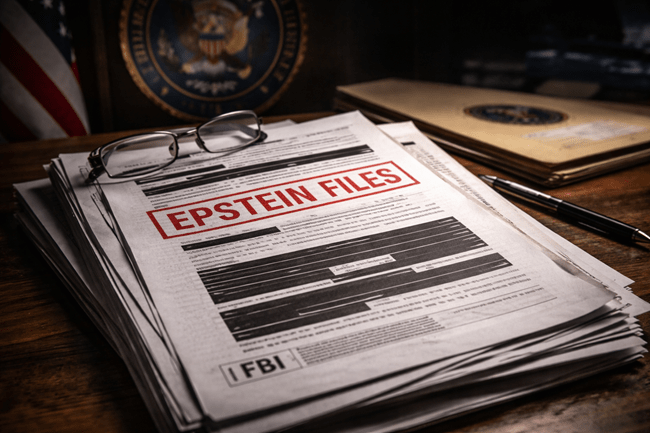
The United States Department of Justice has officially begun the release of the long-awaited “Epstein files,” publishing the first batch of what officials say will amount to several hundred thousand pages of internal records. These documents are being released in compliance with the Epstein Files Transparency Act, which was signed into law in November 2025. But within hours of their publication, one detail stood out more than any other: the inclusion of an FBI complaint from 1996 that predates the federal government’s first major criminal investigation into Jeffrey Epstein by nearly a decade.
The revelation has already intensified public debate around government accountability, institutional failure, and the extent to which early warnings about Epstein’s activities were overlooked. This latest disclosure is likely to raise uncomfortable questions not only about the Justice Department’s handling of Epstein but also about how institutional red flags were treated before the media, prosecutors, or the public ever knew his name.
What does the 1996 FBI complaint reveal—and how far back did federal awareness really go?
Among the most explosive elements in the first batch of files is a report filed in 1996 by a woman who alleged that Jeffrey Epstein engaged in child exploitation and used threats to silence her. She claimed he had taken sexually explicit photographs of minors as young as 12, and that he operated with a sense of impunity. The complaint, submitted to the FBI’s Miami field office, was one of the earliest known attempts to alert federal law enforcement to Epstein’s alleged crimes.
Until now, most public understanding of the Epstein timeline begins in 2005, when local Florida police began investigating after a parent filed a report involving a minor. But this newly surfaced complaint reveals that Epstein may have been on the federal radar nearly a decade earlier. While the 1996 complaint did not immediately lead to any arrest or follow-up investigation, its contents suggest there were serious allegations documented well before public scrutiny began.
The implications are significant. If this file was known internally, it challenges the prevailing narrative that Epstein’s criminality emerged suddenly in the mid-2000s. It also underscores the possibility that federal authorities failed to act decisively on credible early warnings, leaving victims unprotected for years.
Why the Epstein Files Transparency Act is driving such high-stakes disclosures
The release was prompted by legislation passed in 2025 requiring full public disclosure of all federal government records related to Jeffrey Epstein. The Epstein Files Transparency Act mandates that the United States Department of Justice must release all relevant documents, subject to narrow exceptions, within a fixed timeline. This includes FBI files, internal memos, communications between prosecutors, and photographic or video evidence.
Although the Department of Justice technically met the deadline for initiating the release, only a portion of the files were published on Friday. According to Deputy Attorney General Todd Blanche, additional documents will be released in “waves” over the coming weeks. Officials say that the reason for the phased approach is the need to redact sensitive information, including names and faces of victims, witnesses, and potentially uninvolved individuals.
However, the slow rollout has already triggered criticism. Lawmakers from both parties have raised concerns that the Department of Justice may be violating the spirit of the law by delaying full compliance. Some, including Representative Ro Khanna, have demanded that each redaction be publicly justified in writing, as stipulated in the statute.
What else was in the first batch—and what remains missing?
The initial tranche contains thousands of pages, including black-and-white photos from Epstein’s properties, images from social events, surveillance logs, and internal FBI summaries. Many of these materials are heavily redacted, showing scenes from inside Epstein’s Manhattan townhouse and his Florida estate. Some of the photos reportedly show high-profile figures in Epstein’s social orbit, though names and faces are obscured for privacy.
In addition to visual content, the files include interviews with alleged victims, agents’ handwritten notes, and a trail of email correspondence between field offices and Washington D.C. Notably absent from the first release are the most detailed intelligence reports, foreign travel logs, and documents potentially implicating other individuals. These are expected in future releases, though public pressure is mounting for the Justice Department to accelerate the timeline.
Public interest in the release overwhelmed the government portal shortly after it went live. The website experienced multiple crashes within the first hour due to what officials described as “unprecedented traffic.” For many observers, the technical difficulties only underscored the deep public thirst for answers in one of the most notorious and institutionally complex criminal cases of the 21st century.
Why lawmakers are warning the DOJ—and what happens next
Political response to the partial release has been swift and bipartisan. Critics argue that delaying or withholding files under the guise of redactions risks undermining the public trust that the Epstein Files Transparency Act was meant to restore. Lawmakers have threatened to subpoena records if the Department of Justice does not fully comply, and some are calling for an independent review to determine whether redactions are being applied too broadly.
The situation is politically sensitive. Beyond the obvious legal implications, the Epstein case continues to attract global attention because of the number of influential people he was connected to. Some fear that names could be redacted not for safety reasons but to shield reputational harm.
Legal experts also warn that if any document redactions are perceived to be unjustified, it could trigger constitutional challenges under the First Amendment or the Freedom of Information Act. Advocacy groups have already begun preparing litigation strategies to gain access to the unredacted files through judicial action if needed.
What this means for federal agencies and long-term public accountability
The revelation that a federal complaint was filed in 1996 and apparently went uninvestigated has reignited discussions about systemic failure inside the Federal Bureau of Investigation and the broader United States Department of Justice. Several former prosecutors and whistleblowers have argued that the Epstein case reveals a deeper pattern of federal inaction when influential figures are involved.
This release comes in the shadow of years of prior criticism regarding Epstein’s controversial plea deal in 2008, which was brokered with then-U.S. Attorney Alexander Acosta. That agreement allowed Epstein to avoid federal charges and serve just over a year in a local jail with work-release privileges. Subsequent investigations into that deal have already led to public condemnation and resignations, but this latest release threatens to reopen old wounds and add new ones.
The broader impact on public confidence in federal institutions could be substantial. If early FBI knowledge of Epstein’s activities is proven to have been credible but ignored, it may prompt structural reviews of how high-profile cases are internally handled—especially those involving wealthy or politically connected individuals.
Discover more from Business-News-Today.com
Subscribe to get the latest posts sent to your email.