





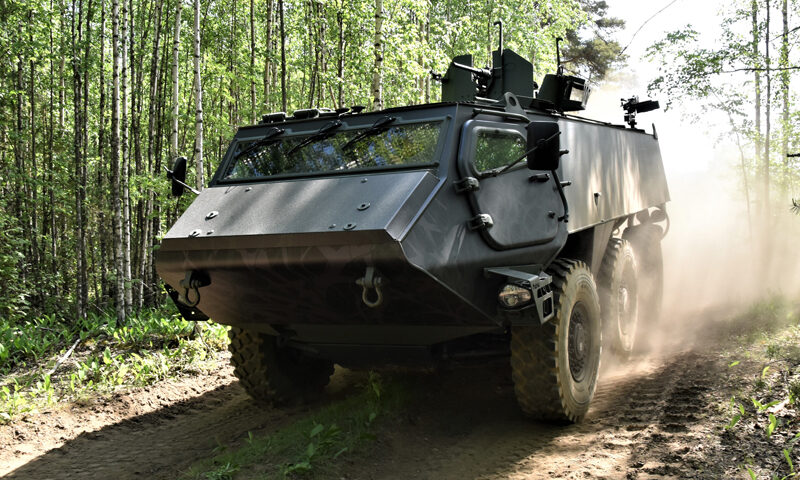
Patria has moved its multinational armoured vehicle programme a step closer to volume production after Norway signed the Common Armoured Vehicle System framework agreement on 26 May 2026. The signature clears the path for Norway to enter serial procurement of the Patria 6×6 armoured vehicle, the common platform underpinning one of Europe’s most consequential collaborative land mobility efforts. Patria is owned by the State of Finland with 50.1 percent and by Kongsberg Defence and Aerospace with 49.9 percent, with the latter wholly held by Oslo-listed Kongsberg Gruppen ASA (OSE: KOG), giving public market investors indirect exposure to the programme. The framework agreement matters now because it converts Norway’s 2025 political commitment into a contractual mechanism for placing firm orders, and it lands at a moment when NATO members are racing to rebuild depleted ground fleets. For a programme that already supplies Finland, Sweden, Latvia, Denmark and Germany, Norway’s progression signals that the Common Armoured Vehicle System is consolidating into a genuine European procurement standard rather than a loose buyers’ club.
What does Norway signing the Patria CAVS framework agreement mean for Nordic armoured vehicle procurement?
The framework agreement is the procedural bridge between membership and purchase. Norway joined the Common Armoured Vehicle System programme in 2025 alongside the United Kingdom, but joining a programme and committing capital are separate decisions. By executing the framework agreement, Norway establishes the legal and commercial scaffolding that allows its defence ministry to issue serial procurement orders without renegotiating terms from scratch each time. Patria’s Protected Mobility business area, led by Executive Vice President Jussi Järvinen, framed the move as enabling member nations to act quickly, purchase efficiently and sustain capability locally through shared industrial cooperation.
The strategic logic for Norway is straightforward. The country sits on NATO’s northern flank, shares a border with Russia, and has watched the Nordic security calculus reset since Finland and Sweden entered the alliance. Standardising on the same wheeled armoured platform already fielded by Finnish and Swedish forces removes interoperability friction across a contiguous Nordic operating theatre. Common spare parts, shared training pipelines and aligned maintenance doctrine reduce the lifecycle cost penalty that bespoke national fleets typically carry. For Norway, the decision is as much about logistics rationalisation across the Nordic bloc as it is about adding vehicles to the order of battle.
There is also a domestic industrial dimension. Kongsberg Gruppen’s ownership stake in Patria means Norwegian procurement under the Common Armoured Vehicle System carries a degree of national value capture that a foreign platform would not. That alignment of buyer, owner and sovereign interest is rare in European defence, and it strengthens the political durability of the commitment.
Why is the multinational Common Armoured Vehicle System programme reshaping European 6×6 defence procurement?
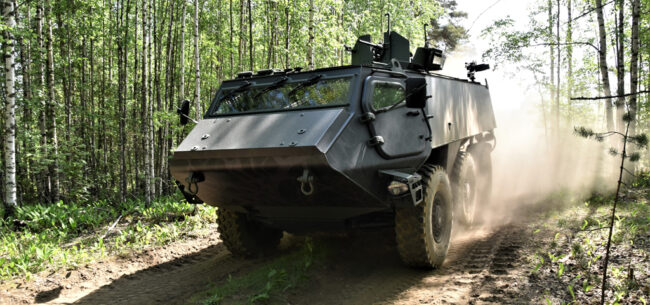
The Common Armoured Vehicle System was launched in 2020 through cooperation between the defence ministries of Finland and Latvia, with the goal of delivering a modern 6×6 armoured vehicle system built on the Patria 6×6 platform for European and NATO nations. What began as a bilateral effort has expanded into a multinational structure spanning Finland, Sweden, Latvia, Denmark and Germany on the delivery side, with Norway and the United Kingdom progressing through the membership and negotiation stages. Patria 6×6 vehicles are also operational in Ukraine, providing the programme with combat-relevant validation that few competing platforms can currently claim.
The reason this model is reshaping procurement is structural rather than technical. Traditional European defence buying has been fragmented, with each nation running separate tenders, separate requirements and separate sustainment contracts. That fragmentation inflated unit costs and slowed delivery. The Common Armoured Vehicle System inverts the model by pooling demand, coordinating product development and centralising lifecycle management across members. In 2024 the initiative received a 60 million euro allocation from the European Defence Industry Reinforcement Instrument through Joint Procurement, a signal that Brussels views the programme as a template for the kind of collaborative buying the bloc has long struggled to achieve.
The second-order effect is that volume aggregation improves Patria’s manufacturing economics. A larger combined order book justifies investment in production capacity, drives down per-unit cost through scale, and creates a more resilient supplier base. That is the precise outcome the European Commission has been trying to engineer across the continent’s defence industrial base, and the Common Armoured Vehicle System is becoming one of its clearest working examples.
How does the Patria 6×6 platform compete against General Dynamics and Rheinmetall in the NATO market?
The Patria 6×6 is a modular wheeled platform configurable as a personnel carrier, command and control vehicle, ambulance and several mission-specific variants. It offers STANAG Level 2 ballistic and mine protection, carries a crew of two, transports ten soldiers with individual equipment in the rear compartment, and mounts a roof platform for a machine gun. Those are competitive but not exotic specifications, which is deliberate. The platform’s commercial proposition rests on affordability, commonality and rapid fielding rather than on bleeding-edge capability.
That positioning puts Patria in direct competition with established players including General Dynamics European Land Systems, whose Piranha and Pandur families occupy adjacent segments, and Rheinmetall, whose broader armoured portfolio increasingly anchors European land programmes. The competitive risk for Patria is that larger primes can outspend it on research, marketing and political lobbying across multiple capitals simultaneously. Rheinmetall in particular has used its scale and order momentum to crowd into national programmes across the continent.
Patria’s counterweight is the multinational framework itself. By embedding the 6×6 platform inside a shared procurement structure with sovereign government backing from Finland and Norway, Patria converts what would otherwise be a vehicle sales pitch into a quasi-standardisation play. Once five or more NATO members operate a common fleet, the switching cost for a new entrant rises sharply, and incumbency becomes self-reinforcing. That network effect, more than any single specification, is Patria’s most durable competitive moat against larger rivals.
What execution and supply chain risks could slow serial procurement of Patria CAVS 6×6 vehicles?
The framework agreement is an enabler, not a guaranteed order. Norway still has to translate the agreement into funded procurement decisions, and defence budgets remain subject to political timing risk. A framework that allows fast purchasing does not compel it, and the gap between signature and signed contracts is where multinational programmes frequently lose momentum.
Production capacity is the more material near-term constraint. Patria has been building manufacturing capability specifically to absorb new vehicle orders, and the company has acknowledged that scaling supply chains is a central operational focus. Armoured vehicle production depends on specialised steel, electronic subsystems and skilled assembly labour, all of which face continent-wide demand pressure as European militaries rearm simultaneously. If multiple Common Armoured Vehicle System members move to serial procurement in overlapping windows, Patria’s ability to deliver on schedule across all of them becomes the binding question.
There is also integration risk inherent to multinational programmes. Coordinating product development across members with divergent operational requirements can slow decision-making and introduce specification drift. The United Kingdom’s next phases remain under negotiation, a reminder that even committed members move at different speeds. Managing that heterogeneity without diluting the cost advantages of commonality is the programme’s central governance challenge.
How does the Norway CAVS decision affect Kongsberg Gruppen and the Oslo Stock Exchange defence trade?
Patria is privately held, so the cleanest listed proxy for the Common Armoured Vehicle System momentum is Kongsberg Gruppen ASA (OSE: KOG), which owns 49.9 percent of Patria through Kongsberg Defence and Aerospace. As of 29 May 2026, Kongsberg Gruppen traded at 332.10 NOK, against a previous close of 333.10 NOK and a 52-week range of roughly 228.50 to 427.00 NOK. The shares sit well below their 52-week high, having retraced from the peak of the European defence rally even as order momentum remains strong.
The fundamental backdrop is robust. Kongsberg Gruppen reported a 55 percent surge in first-quarter 2026 operating profit, with revenue of about 9.2 billion NOK, up 26 percent year on year, and an EBIT margin near 16.6 percent, supported by air defence and missile execution. The twelve-month analyst price target clusters around 366.67 NOK, implying modest upside from current levels, with most coverage carrying a buy rating. The company also completed the demerger of Kongsberg Maritime onto the Oslo Stock Exchange in April 2026, sharpening the remaining group’s defence focus.
The Norway framework agreement is not, by itself, a share-price catalyst. The Patria stake is a minority holding, and the financial contribution of any single national procurement is modest relative to Kongsberg Gruppen’s missile and air defence franchises. The signal value is what matters. Each new Common Armoured Vehicle System member validates the long-duration thesis that Nordic defence industrial assets are positioned to compound through a structural NATO rearmament cycle. For investors, the read-through is directional confirmation rather than an earnings event, and the current valuation already embeds substantial growth expectations against the recent pullback from highs.
What does the Norway CAVS framework agreement mean for Patria, Kongsberg Gruppen, and the European defence sector?
- Norway’s framework agreement converts its 2025 Common Armoured Vehicle System membership into a contractual mechanism for serial procurement of Patria 6×6 vehicles, removing a key bureaucratic barrier to firm orders.
- The signature consolidates the Patria 6×6 as a de facto Nordic and northern European standard, joining Finland, Sweden, Latvia, Denmark and Germany under a single common platform.
- Demand aggregation across members improves Patria’s manufacturing economics and strengthens its bargaining position against larger primes such as Rheinmetall and General Dynamics European Land Systems.
- The 60 million euro EDIRPA allocation positions the Common Armoured Vehicle System as a working template for the European Union’s broader push toward collaborative defence procurement.
- Combat use of Patria 6×6 vehicles in Ukraine gives the platform operational validation that several competing 6×6 systems cannot currently match.
- The network effect of multinational standardisation, rather than any single specification, is Patria’s most durable competitive moat.
- Production capacity and overlapping delivery windows across members represent the most material near-term execution risk for Patria.
- Kongsberg Gruppen ASA (OSE: KOG) offers indirect listed exposure through its 49.9 percent Patria stake, though the holding is minority and not a standalone earnings driver.
- Kongsberg Gruppen’s first-quarter 2026 operating profit rose 55 percent, but the shares at 332.10 NOK trade below the 52-week high near 427.00 NOK, reflecting a defence-sector pullback rather than weakening fundamentals.
- For the European defence sector, Norway’s progression is directional confirmation that the post-2022 rearmament cycle is maturing from political intent into structured, multi-year industrial procurement.
Discover more from Business-News-Today.com
Subscribe to get the latest posts sent to your email.

