

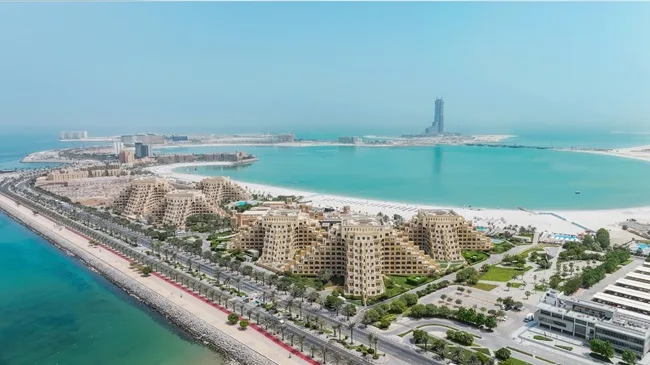
Marjan, the master developer of freehold properties in Ras Al Khaimah, has formally announced a landmark strategic merger with RAK Hospitality Holding, the government-owned investment and development platform focused on hospitality and tourism in the Emirate. The two entities will now operate under a single brand identity—Marjan—following the merger, consolidating real estate development, hospitality operations, and lifestyle experiences into a unified powerhouse aligned with the broader objectives of RAK Vision 2030.
The move marks a turning point in the transformation of Ras Al Khaimah into a global hub for tourism, luxury living, and investment-led development. With this merger, Marjan becomes the largest integrated developer in the Northern Emirates and positions itself among the top-tier real estate organizations in the United Arab Emirates. The strategic consolidation is designed not only to fast-track landmark destination developments but also to align public and private sector resources to scale infrastructure, visitor capacity, and investor access.
The announcement comes as the Emirate’s long-term blueprint, RAK Vision 2030, targets attracting 3.5 million annual visitors and establishing Ras Al Khaimah as a top-tier destination for sustainable prosperity, wellness tourism, and mixed-use urban development. The merger is also a key structural move that supports the delivery of mega-projects such as Al Marjan Island, RAK Central, Marjan Beach, and the Jebel Jais masterplan, which together form the backbone of Ras Al Khaimah’s next phase of economic diversification.
What strategic value does the merger bring to RAK Vision 2030 and destination investment?
By merging RAK Hospitality Holding with Marjan, the Emirate has effectively created a vertically integrated entity that can plan, fund, develop, operate, and promote mixed-use assets and lifestyle destinations under one cohesive strategy. The objective is to deliver a single-window approach for investors, hotel operators, global brands, and urban development partners. This reduces project complexity, streamlines land allocation and regulatory approvals, and accelerates delivery timelines across high-priority zones.
Announcing the merger, His Highness Sheikh Ahmed bin Saud bin Saqr Al Qasimi, Chairman of Marjan, said the combined entity would serve as a foundation to unlock the bold ambitions laid out under RAK Vision 2030. He emphasized that the unified platform would generate high-value employment opportunities for Emiratis, nurture national capabilities, and act as a catalyst for innovation in the tourism, real estate, and infrastructure sectors. He underscored the merger’s role in building thriving, future-ready communities that align with Ras Al Khaimah’s long-term vision for inclusive growth and global relevance.
With this consolidation, Marjan gains stronger institutional footing, government support, and operational flexibility to secure investment flows, onboard international hospitality partners, and drive forward landmark projects that enhance the Emirate’s profile as a destination of choice in the Gulf region.
How does the Marjan Beach launch align with the new unified development strategy?
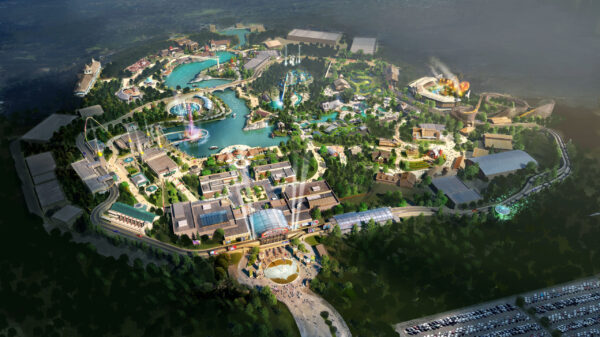
Just weeks before the merger was announced, Marjan revealed plans for a new mixed-use coastal township named Marjan Beach. The project, which spans 85 million square feet of masterplan area, is envisioned as a transformational catalyst in Ras Al Khaimah’s evolution into a global gateway for tourism and investment. Designed as a self-contained beach town overlooking the Arabian Gulf, Marjan Beach is expected to attract billions of dirhams in investment across hospitality, residential, retail, and recreational sectors.
The development includes 12,000 hotel keys, 22,000 residential units, and is expected to host a population of 74,000 residents, supported by a workforce of 32,000. It is projected to accommodate up to 180,000 visitors annually, making it both a residential enclave and a flagship tourism magnet. Eight distinct neighborhoods are planned within the destination, each offering a unique blend of beachfront access, luxury living, commercial infrastructure, and wellness-driven design. The project incorporates three kilometers of uninterrupted beach frontage and over 6.5 million square feet of open green space, reflecting the Emirate’s commitment to balancing urbanization with nature.
Strategically located in close proximity to key developments such as Wynn Al Marjan Island, Al Hamra Village, and the Ras Al Khaimah Economic Zone, the Marjan Beach township is also well-connected to national highways. Ongoing infrastructure enhancements are expected to improve regional and international accessibility, enabling smoother transit for both residents and global tourists.
What does institutional and market sentiment reveal about the merger and beach development?
Analysts and institutional investors tracking real estate growth in the Gulf Cooperation Council region view the Marjan–RAK Hospitality merger as a structurally sound, pro-investment consolidation. It is expected to simplify the operating model for investors, increase asset monetization potential, and position Ras Al Khaimah competitively alongside Dubai and Abu Dhabi in the regional real estate investment landscape. Analysts have highlighted that unified governance allows for better risk management and faster execution of mega-scale projects, particularly in sectors such as wellness tourism, sustainable urban infrastructure, and branded residences.
For sovereign investors and global private equity firms evaluating hospitality and tourism-linked real estate, Ras Al Khaimah now presents a clearer investment thesis. The combined entity removes previous fragmentation between land development and hospitality asset management. This enables international brands to pursue joint ventures or long-term lease agreements under a single legal and development framework.
Further, the timing of Marjan Beach’s announcement is widely seen as a strong signal to the market. With Ras Al Khaimah witnessing rising inbound tourism and growing investor interest post-pandemic, the launch reflects confidence in demand for high-end hospitality, branded residences, and nature-integrated living. Long-stay investors are also expected to respond favorably due to golden visa linkages tied to real estate ownership, offering new routes to residency and lifestyle migration.
What are the broader implications for regional real estate competition and positioning?
The emergence of Marjan as a mega developer with government-backed scale mirrors similar moves seen in other Emirates. In Dubai, conglomerates such as Dubai Holding and Meraas have unified land, leisure, and retail operations. In Abu Dhabi, strategic integration through developers like Aldar Properties and Miral has created turnkey platforms with centralized execution capacity. Ras Al Khaimah now follows suit, but with a differentiated value proposition centered on natural topography, beach access, and wellness-driven living.
Ras Al Khaimah has increasingly positioned itself as a quieter, sustainable alternative to the urban density of Dubai. With mountain terrain, extensive coastline, and emerging infrastructure connectivity, the Emirate is able to pitch a more balanced, livable ecosystem. Marjan’s new scale enhances the government’s ability to attract global events, eco-resorts, and second-home buyers seeking refuge from overstressed urban centers.
This alignment also opens the door for partnerships with global brands in entertainment, retail, and education. Institutions looking to expand into high-growth regions with long-term real estate footprints now have access to fully serviced development zones backed by a consolidated master planner.
What is the expected outlook for capital inflows, job creation, and tourism benchmarks?
From a forward-looking perspective, the merger and Marjan Beach development are expected to catalyze substantial foreign direct investment into Ras Al Khaimah. Institutional interest is likely to increase as clarity around permitting, project structuring, and asset management improves under Marjan’s integrated mandate.
The Emirate’s target of reaching 3.5 million visitors annually by 2030, coupled with plans to scale up to nearly 20,000 hotel keys, places it firmly in the spotlight for regional tourism growth. The merger supports this vision by offering integrated development capabilities that align infrastructure, residential capacity, and experiential tourism.
Job creation is also a central theme. As construction, operations, and lifestyle offerings ramp up, the platform is expected to generate tens of thousands of direct and indirect employment opportunities for Emiratis and skilled expatriates. Ras Al Khaimah’s labor force, traditionally reliant on industrial and service jobs, is likely to see greater diversity through roles in hospitality, destination marketing, urban planning, and real estate services.
Marjan’s projects—especially Marjan Beach, Jebel Jais, and RAK Central—will be monitored by regional developers, sovereign wealth funds, and family offices looking to capitalize on early-mover advantages in Ras Al Khaimah’s transformation journey.
How will the Marjan–RAK Hospitality merger accelerate Ras Al Khaimah’s rise as a global destination?
The strategic merger between Marjan and RAK Hospitality Holding reflects a bold vision for Ras Al Khaimah’s future—one that embraces sustainable urbanization, destination integration, and investor-first infrastructure planning. With Marjan now spearheading real estate and hospitality development under one cohesive brand, the Emirate gains significant execution agility and market credibility in an increasingly competitive regional landscape.
Marjan Beach, as the flagship development of this new era, embodies the next generation of waterfront urbanism in the Gulf—highly livable, environmentally conscious, and investment-viable. If successfully delivered on time and at scale, the project could redefine Ras Al Khaimah’s status from a secondary tourism destination into a global benchmark for integrated lifestyle cities in the Middle East.
Investors, developers, and hospitality brands would be wise to track the execution momentum closely as Ras Al Khaimah opens its doors to the world—not just as a tourist destination, but as a global home for opportunity.
What are the key takeaways from the Marjan–RAK Hospitality merger and Marjan Beach launch?
- Marjan and RAK Hospitality Holding have merged to form a single entity under the Marjan brand, aligning with Ras Al Khaimah’s RAK Vision 2030 goals.
- The merger combines real estate development, hospitality operations, and lifestyle planning into a unified platform aimed at accelerating destination infrastructure.
- Marjan Beach, the newly announced mixed-use township, will feature 12,000 hotel keys, 22,000 residential units, and support a population of 74,000.
- The development is strategically positioned near Wynn Al Marjan Island and Al Hamra Village and is expected to attract over 180,000 visitors annually.
- Institutional sentiment is optimistic, with analysts highlighting streamlined governance, investor clarity, and alignment with golden visa-linked property investment models.
- The Emirate aims to attract 3.5 million annual visitors and deliver 20,000 hotel keys by 2030, with Marjan as the lead execution entity for mega-projects.
- Ras Al Khaimah is positioning itself as a livable, sustainable, and tourism-centric alternative to denser UAE cities, leveraging coastal and mountain terrain.
- The merger is expected to unlock significant foreign direct investment, job creation, and long-term urban transformation across the Northern Emirates.
Discover more from Business-News-Today.com
Subscribe to get the latest posts sent to your email.