

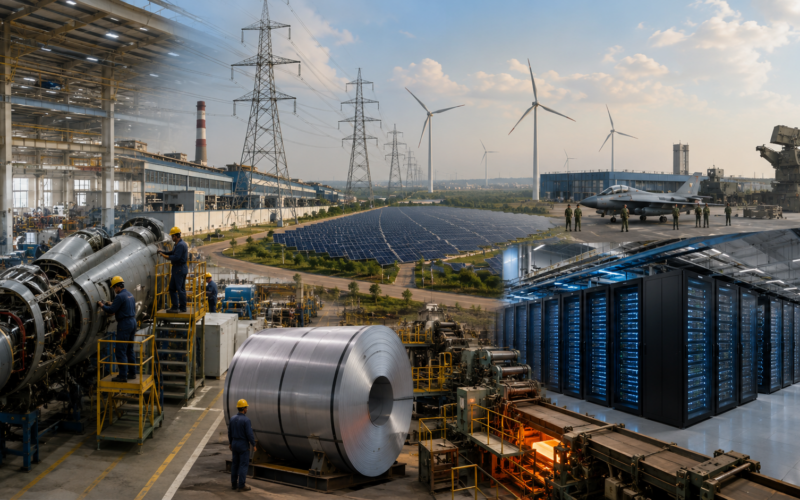
India Inc is entering FY27 with a sharper capital expenditure focus on defence manufacturing, energy security, metals, electric vehicles, data centres and AI-linked infrastructure. Aggregate capital expenditure by nearly 2,000 listed companies stood at around ₹10.5 lakh crore in FY26, up nearly 15% year on year, highlighting a broad investment cycle rather than a narrow sector rebound. The shift matters because Indian companies are increasingly allocating capital toward strategic capacity, supply-chain resilience and technology infrastructure instead of merely expanding conventional production lines. For investors, the emerging capex map could reshape market leadership across power, capital goods, defence, metals, industrials, utilities and digital infrastructure.
Why is India Inc shifting FY27 capital expenditure toward strategic infrastructure sectors?
The FY27 capex shift reflects a simple but important reality: corporate India is no longer treating infrastructure spending as only a growth-cycle decision. Energy security, defence preparedness, AI computing needs and supply-chain localization have become strategic priorities. That changes the quality of spending because companies are investing not just to sell more products, but to secure position in sectors where government policy, geopolitical risk and long-term demand are converging.
Defence is one of the clearest examples of this shift. India’s policy push toward domestic manufacturing, higher procurement localization and export ambitions has made defence capital expenditure more structurally visible than in previous cycles. Companies that once treated defence as an adjacent opportunity are now building dedicated manufacturing, electronics, systems integration and component capabilities. This has implications for listed industrials, precision engineering firms, shipbuilders, aerospace suppliers and electronics manufacturers.
Energy is another pillar of the cycle. Power demand growth, grid investment, renewable integration, transmission expansion and energy storage are forcing companies to invest across the value chain. This is not only about solar or wind capacity. It is also about transmission networks, transformers, cables, power equipment, battery systems, green hydrogen readiness and industrial power reliability. In other words, the humble electricity grid is suddenly getting main character energy, and markets are noticing.
How does the FY27 capex cycle differ from previous Indian corporate investment booms?
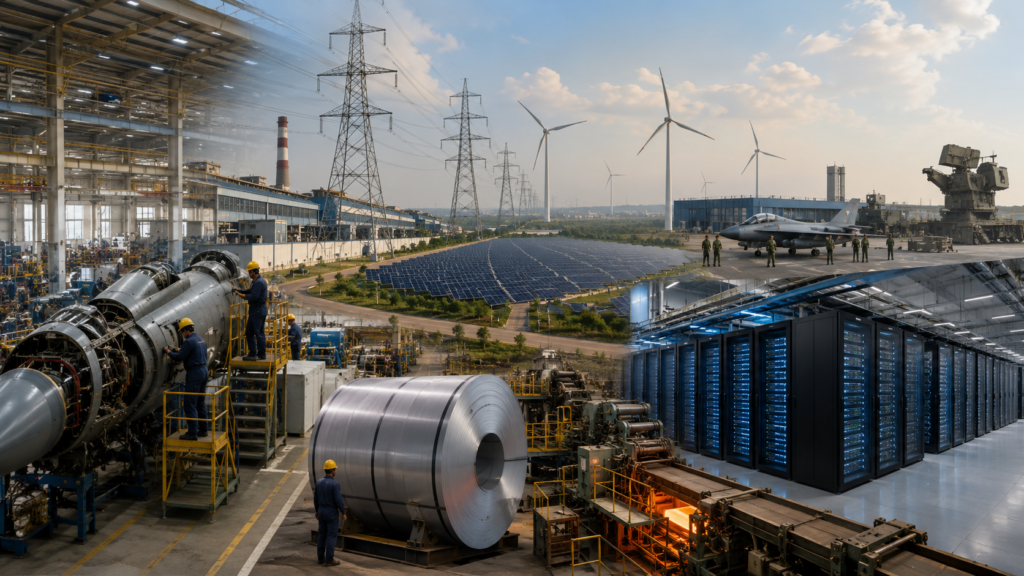
Previous Indian capex cycles were often driven by credit expansion, real estate, basic infrastructure or commodity-linked optimism. The current cycle looks more diversified and more strategically anchored. Instead of a single theme pulling investment, several structural themes are moving together: defence localization, power demand, metals capacity, electric mobility, digital infrastructure and AI computing.
That diversification matters because it can reduce the risk of a one-sector boom turning into a balance-sheet problem. When capital expenditure is spread across utilities, industrials, metals, data centres and defence, the earnings impact can be broader and more durable. It also creates second-order opportunities for suppliers, engineering companies, logistics players, automation providers and financing institutions.
However, the new cycle also carries execution risk. Strategic sectors often require long gestation periods, complex approvals, high technical standards and large upfront capital. Defence contracts can be lumpy. Energy projects can face land, grid and regulatory bottlenecks. Data centres need power, cooling, fiber connectivity and customer commitments. A capex announcement can create stock market excitement in minutes, but project execution still moves at the speed of permits, equipment delivery and cash flow. Markets sometimes forget this until the bill arrives.
Why are defence and energy security becoming core boardroom priorities for listed Indian companies?
Defence and energy security are moving from policy language into corporate strategy because both sectors sit at the intersection of national priorities and commercial opportunity. For defence, geopolitical volatility has increased the urgency around domestic capability. For energy, rapid demand growth and industrial expansion are forcing companies and policymakers to think beyond short-term fuel availability.
Listed Indian companies are responding because these sectors offer visibility that many consumption-led sectors currently lack. Defence orders often come with long timelines and institutional buyers. Power and transmission investments benefit from structural demand. Metals companies gain from infrastructure spending and manufacturing expansion. Capital goods companies benefit when investment turns into equipment orders. The chain reaction is exactly why capex cycles matter for equity markets.
There is also a competitive angle. Companies that invest early in capability, certification, vendor approvals and scale may enjoy stronger positioning when tenders expand. Late entrants may still participate, but they could be pushed into lower-margin subcontracting roles. That is why the FY27 capex cycle is not merely about who spends the most. It is about who spends early enough, wisely enough and with enough balance-sheet discipline to survive delays.
How could AI infrastructure and data centres change India’s corporate investment landscape?
AI infrastructure is becoming a physical investment story, not just a software narrative. Data centres require land, power, cooling, fiber networks, specialized construction, backup systems and high-density computing equipment. As Indian enterprises, cloud providers and global technology companies expand AI workloads, the need for scalable digital infrastructure is likely to rise.
This creates a different kind of capex opportunity for India. The beneficiaries may include power utilities, cable manufacturers, cooling equipment suppliers, engineering companies, renewable energy developers, real estate infrastructure players and telecom network providers. The economic value does not sit only with companies selling AI software. It also flows to the industrial ecosystem that makes high-compute infrastructure possible.
The risk is that data centre economics can become stretched if capacity runs ahead of contracted demand. Power availability and electricity pricing will be critical. AI workloads are energy-intensive, and India’s data centre ambitions will depend heavily on whether developers can secure reliable power at competitive cost. This is where the AI story meets the old economy. Even the smartest model still needs a plug socket.
What does the capex cycle mean for Indian stock market sector rotation in FY27?
The emerging capex pattern could support continued investor interest in power, capital goods, industrials, defence, metals and select infrastructure-linked companies. Recent market action already shows stronger appetite for sectors tied to physical investment, with power, capital goods, realty and metals outperforming in the latest trading session while some consumption and technology areas lagged. That rotation suggests investors are trying to identify beneficiaries of the next earnings upgrade cycle.
The key question is whether stock prices have already moved ahead of fundamentals in parts of the capex trade. Defence and power equipment stocks have enjoyed strong investor interest in recent years, and valuations in some pockets already reflect high growth expectations. That means execution, margins and order conversion will matter more than announcement headlines. A company can have the right theme and still be the wrong stock if the valuation leaves no room for disappointment.
For institutional investors, the challenge is to separate structural beneficiaries from narrative beneficiaries. Companies with order visibility, manufacturing capability, manageable leverage and proven execution should command more confidence than companies relying on theme association alone. In capex cycles, every company suddenly sounds strategic. The balance sheet usually tells the truth before the presentation deck does.
How could metals and electric vehicles benefit from India’s FY27 investment priorities?
Metals remain central to the capex cycle because energy infrastructure, defence manufacturing, railways, data centres, electric vehicles and industrial construction all require steel, aluminium, copper and specialty materials. For large metals companies, the opportunity is tied not only to volume growth but also to value-added products. Defence, power equipment, transmission, battery enclosures and advanced manufacturing require more specialized material supply chains.
Electric vehicles add another layer. India’s EV ecosystem needs battery manufacturing, charging infrastructure, power electronics, components, vehicle platforms and grid connectivity. This creates opportunities across auto components, chemicals, metals, power distribution and renewable energy. The investment case is no longer limited to vehicle assemblers. The deeper opportunity may sit in the suppliers that enable scale.
The risk is demand timing. EV adoption depends on pricing, charging availability, financing, policy support and consumer confidence. If infrastructure investment runs ahead of actual vehicle penetration, returns could be delayed. If adoption accelerates faster than expected, early infrastructure investors may gain operating leverage. The sector therefore offers upside, but it is unlikely to reward every player equally.
What are the biggest risks in India Inc’s FY27 capex expansion?
The first risk is balance-sheet discipline. A 15% rise in aggregate capital expenditure is encouraging, but it also raises the stakes for funding quality. Companies that rely too heavily on debt in long-gestation sectors could face pressure if revenue conversion is delayed or interest costs remain elevated. The best capex stories will be those where funding, demand visibility and execution timelines are aligned.
The second risk is policy dependency. Defence, energy, EVs and data centres all depend on regulatory clarity, procurement frameworks, grid approvals, land access and fiscal incentives. Policy support can accelerate a cycle, but policy uncertainty can slow it sharply. Investors should therefore pay close attention to order conversion, not just announcements.
The third risk is capacity duplication. When a theme becomes popular, multiple companies often build similar capacity at the same time. That can create oversupply, margin pressure and weaker returns. The stronger companies will be those that combine scale with customer visibility, technology depth and cost control. The weaker ones may discover that strategic sectors can still produce very ordinary returns if capital is poorly allocated.
What should executives and investors watch as India’s FY27 capex cycle develops?
Executives should watch whether capex announcements translate into real orders for equipment, engineering services, construction, power systems, automation and components. The transmission from boardroom approval to supplier revenue will determine how quickly the cycle supports earnings. Investors should watch order books, working capital, debt levels, operating cash flow and margin discipline across companies exposed to the capex theme.
The second signal will come from government-linked demand. Defence procurement, power transmission awards, renewable tenders, railway projects, grid investment and data centre policy clarity can all accelerate or slow private-sector spending. A capex cycle backed by both public and private demand is more durable than one driven only by corporate optimism.
The third signal will be market breadth. If only a handful of high-valuation stocks rally, the theme may become fragile. If earnings upgrades spread across industrial suppliers, utilities, metals, capital goods, logistics and technology infrastructure, the cycle becomes more investable. The FY27 capex story is powerful, but the market will eventually demand proof. It always does. Usually right after everyone becomes most confident.
Key takeaways on what India Inc’s FY27 capex shift means for companies, investors and strategic sectors
- India Inc’s FY27 capex cycle is becoming more strategic, with spending moving toward defence, energy security, metals, EVs, data centres and AI infrastructure.
- Aggregate capex of nearly ₹10.5 lakh crore across around 2,000 listed companies in FY26 shows that the investment cycle is already broadening.
- Defence manufacturing could benefit from localization, procurement visibility and export ambitions, but execution timelines and order concentration remain key risks.
- Energy and power infrastructure may become durable investment themes as demand growth, grid expansion and renewable integration require large physical upgrades.
- AI infrastructure is creating opportunities beyond software, especially in data centres, power supply, cooling, cables, real estate and telecom connectivity.
- Metals companies could benefit from infrastructure and manufacturing demand, particularly where value-added products support defence, power and EV supply chains.
- Stock market leadership may continue rotating toward capital goods, power, industrials and infrastructure-linked sectors if earnings upgrades follow capex announcements.
- Valuation risk is rising in popular capex-linked sectors, making balance-sheet strength and order conversion more important than thematic exposure alone.
- The biggest long-term winners are likely to be companies that combine strategic sector exposure with funding discipline, execution capability and real customer demand.
Discover more from Business-News-Today.com
Subscribe to get the latest posts sent to your email.