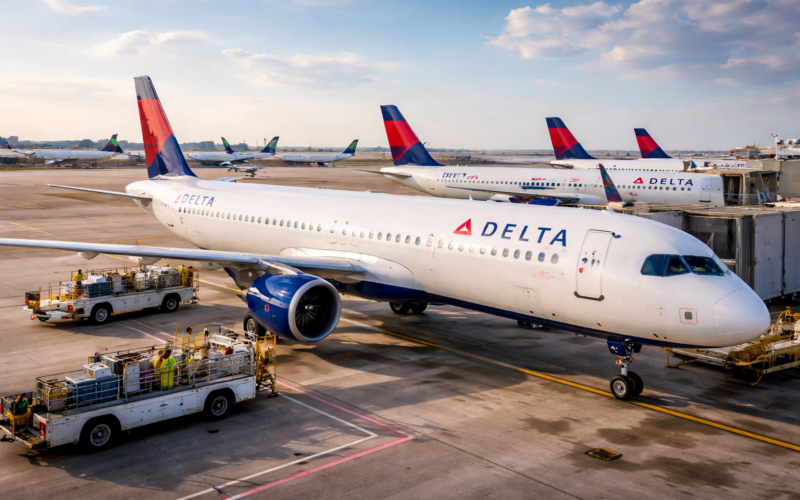
Delta Air Lines (NYSE: DAL) exercised options on February 27 to acquire 34 additional Airbus A321neo narrowbody aircraft, marking the Atlanta-based carrier’s third aircraft order announcement in less than six weeks and bringing its total A321neo commitment to 189 jets, the largest single fleet type in Delta’s history. The transaction, with deliveries beginning in 2029, cements the A321neo as the structural backbone of Delta’s domestic and short-haul international network through the next decade. Coming alongside a parallel widebody expansion covering Boeing 787-10s and new Airbus A330-900 and A350-900 commitments, the order signals that Delta’s management team has concluded the conditions for a comprehensive, multi-front fleet overhaul are now firmly in place.
Why is Delta Air Lines ordering 34 Airbus A321neo jets now, and what does this signal about its long-term fleet strategy?
The short answer is that Delta is locking in delivery slots while it can. Aircraft orderbooks at both Airbus and Boeing remain congested well into the 2030s, and airlines that hesitate on option exercises risk losing their delivery positions to competitors or lessors who move faster. By converting options into firm orders, Delta secures 2029 delivery slots that would otherwise be vulnerable to reallocation, giving the airline a degree of certainty over its fleet composition that rivals cannot easily replicate in the near term.
The deeper answer is structural. Delta currently operates 92 A321neos in active service, and the type has already proven its commercial case within the fleet. The A321neo delivers the lowest operating cost per seat among Delta’s narrowbody aircraft and offers between 20 and 30 percent better fuel efficiency than the previous-generation aircraft it replaces. That is not a rounding error in an industry where fuel remains the largest single operating cost line. Delta’s own unit cost leadership relative to American Airlines and Southwest Airlines has been a consistent differentiator over the past two years, and the accelerating replacement of older narrowbodies with A321neos directly reinforces that advantage.
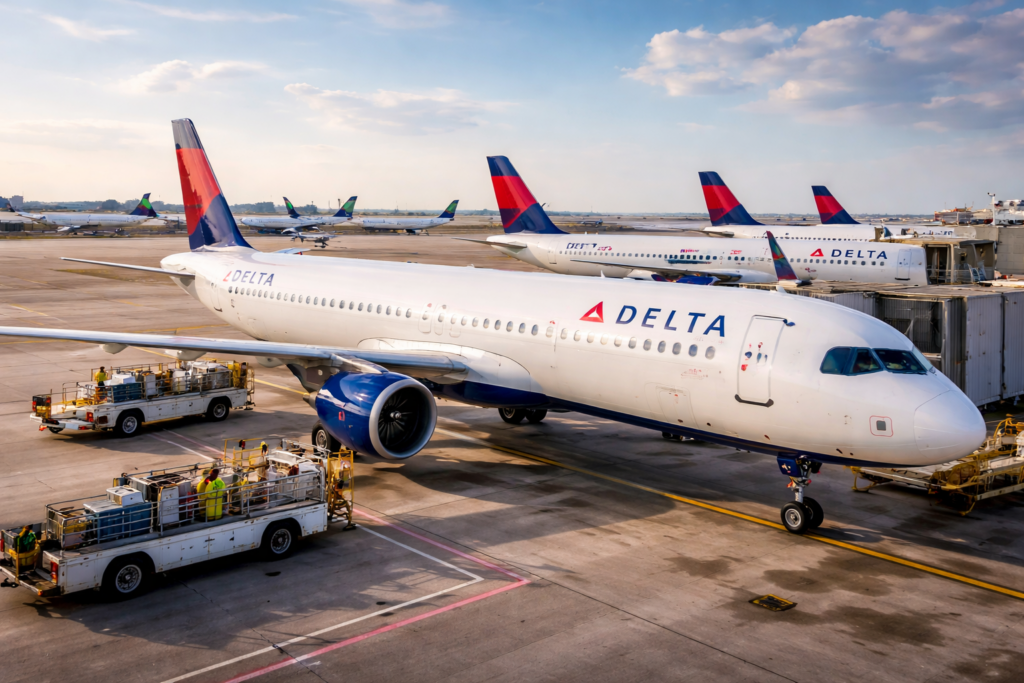
The premium revenue angle is equally important. The A321neo carries more Delta First and Delta Comfort seats than any other narrowbody in the fleet, positioning it as the primary vehicle for Delta’s push to shift domestic revenue mix toward higher-yielding cabin classes. As unit economics improve and premium seats expand simultaneously, the A321neo essentially does double duty as both a cost reduction tool and a revenue optimization asset.
How does the latest A321neo order fit into Delta’s broader six-week fleet transformation?
The narrowbody exercise is the third leg of what has quietly become one of the most aggressive fleet renewal campaigns in Delta’s history. On January 13, Delta announced its first-ever direct order for Boeing 787 Dreamliners, placing a firm order for 30 Boeing 787-10 jets with options for 30 more, targeting transatlantic and South American routes where its ageing Boeing 767-300ERs are increasingly uncompetitive on unit economics. Those deliveries begin in 2031, timed to coincide with the expected retirement of the 767-300ER fleet.
Two weeks later, on January 28, Delta placed a firm order for 31 Airbus widebody aircraft comprising 16 A330-900s and 15 A350-900s, with an option for an additional 20 jets. That order will expand Delta’s A330neo fleet to 55 aircraft and its A350 fleet to 79 aircraft, supporting international expansion into Asia, Africa, the Middle East, and the South Pacific with an upgraded premium cabin product including Delta One Suites and Delta Premium Select.
In aggregate, Delta now has 232 narrowbody and 85 widebody aircraft on order, a backlog that represents a fundamental reshaping of the airline’s cost structure, revenue mix, and international footprint between now and the early 2030s. The capital commitment is substantial, but Delta has consistently framed all three orders as falling within previously announced capital expenditure and capacity targets, giving investors some assurance that management is not overextending the balance sheet in pursuit of growth.
What are the competitive implications of Delta’s A321neo dominance for United Airlines and American Airlines?
United Airlines has built its narrowbody strategy primarily around the Boeing 737 MAX family, and its widebody ambitions center on an eventual fleet of more than 200 Dreamliners. American Airlines has also leaned heavily on Boeing narrowbodies while managing a more complicated widebody replacement picture. Delta’s decision to go deep on the A321neo creates a meaningful operational divergence from its two primary domestic competitors.
The A321neo’s economics are not inherently superior to those of the Boeing 737 MAX 10, the type that United and American are counting on for their own fleet renewal, but the MAX 10 remains uncertified. Until the Federal Aviation Administration grants certification for the 737 MAX 10, United and American face execution uncertainty on their narrowbody renewal plans that Delta, already receiving A321neo deliveries, does not. Delta’s 92 A321neos already in service represent a functioning fleet advantage today, not a promised one.
On the widebody side, the Boeing 787 order is particularly significant because it ends Delta’s status as the last major U.S. legacy carrier without a direct Dreamliner commitment. American Airlines has operated the 787 for years, and United Airlines is the type’s largest customer by aspiration. Delta’s late entry into the 787 program means it will benefit from lessons learned by earlier operators, but also that its transatlantic and South American widebody fleet will remain anchored to older 767-300ERs until 2031 at the earliest.
How do Pratt & Whitney GTF engine considerations affect the A321neo order and Delta’s operational planning?
The incoming A321neos will be powered by Pratt & Whitney’s geared turbofan engines, and Delta has structured its maintenance strategy around a dedicated GTF facility operated by Delta TechOps in Atlanta. That in-house maintenance capability is a meaningful hedge against the kind of fleet disruptions that other carriers experienced in 2023 and 2024 when GTF engine inspection campaigns forced widespread aircraft groundings across multiple European and Asian airlines.
Delta’s vertical integration into GTF maintenance provides a degree of operational resilience that pure-operator airlines relying on third-party MRO providers cannot easily replicate. It also creates a long-term cost advantage as the GTF fleet scales to 189 aircraft, since the fixed costs of the Atlanta facility are spread across a growing number of engines. Whether that facility’s capacity will be sufficient to handle a fleet of 189 A321neos without supplemental third-party support is a question worth watching as deliveries accelerate after 2029.
What does DAL’s stock performance suggest about how the market is pricing the fleet renewal strategy?
Delta Air Lines shares reached a 52-week high of $76.39 on February 11, 2026, before pulling back to approximately $69 to $70 in the days surrounding the A321neo announcement. The retreat was driven primarily by rising geopolitical tensions and oil price volatility rather than any fundamental reassessment of Delta’s fleet strategy. Indeed, the Barclays buy rating issued in February and the airline’s own fourth-quarter 2025 results, which included approximately $5 billion in pre-tax profit and record free cash flow, suggest that the investment case for Delta’s management quality remains intact even as the stock digests broader macro headwinds.
The fleet renewal program is, in principle, exactly the kind of multi-year capex discipline that institutional investors should reward over a full cycle. Lower unit costs, higher premium revenue capacity, and a modernized fuel burn profile all compress the break-even load factor and widen margin tolerance in a downturn. The market’s muted reaction to the A321neo order specifically reflects the fact that option exercises are less newsworthy than fresh commitments, and that investors were already aware of Delta’s broad fleet renewal intentions from the prior two announcements. The more meaningful valuation test will come when Delta publishes guidance that translates fleet modernization into specific margin expansion targets.
What execution risks accompany Delta’s fleet expansion ambitions?
Three risk categories stand out. First, delivery reliability. Airbus has faced production bottlenecks, supply chain shortfalls, and engine availability challenges across its narrowbody program. Deliveries from 2029 provide substantial runway for those issues to resolve, but the compressed timelines at Boeing, which is simultaneously trying to stabilize 737 MAX production and ramp 787 output, raise questions about whether the broader aerospace supply chain can sustain the delivery volumes that Delta and its peers are collectively counting on.
Second, demand duration. Delta’s premium expansion thesis rests on the assumption that the post-pandemic appetite for premium domestic and transatlantic travel persists through the 2030s. If economic conditions soften materially or if corporate travel rationalizes under ongoing hybrid work patterns, the premium cabin build-out embedded in both the A321neo and the new widebody orders may prove more expensive than the returns it generates.
Third, financing costs. Aircraft acquisitions at this scale require long-term financing at rates that are meaningfully higher today than during the 2010s when much of the industry locked in cheap capital. Delta’s balance sheet remains solid, with a market capitalization approaching $45 billion and an EBITDA margin near 13 percent as of early 2026, but rising interest costs are a constant headwind that management must manage alongside the operational benefits of fleet modernization.
Key takeaways: What Delta Air Lines’ A321neo expansion means for DAL investors, Airbus, and U.S. aviation competition
- Delta’s exercise of options for 34 Airbus A321neo jets is the third aircraft order in six weeks, confirming a strategic pivot toward comprehensive fleet renewal rather than incremental upgrade.
- Total A321neo commitment now stands at 189 aircraft, making it the largest single fleet type in Delta’s history and locking in the type as the dominant narrowbody platform through the 2030s.
- The A321neo delivers 20-30% better fuel efficiency and the lowest operating cost per seat in Delta’s narrowbody fleet, directly reinforcing Delta’s unit cost advantage over American Airlines and Southwest Airlines.
- Delta’s in-house Pratt & Whitney GTF maintenance facility in Atlanta provides operational resilience and long-term maintenance cost control at a scale few peer carriers can match.
- The six-week buying spree covering 787-10s, A330-900s, A350-900s, and now more A321neos adds 317 potential firm and option aircraft to Delta’s orderbook, reshaping its cost structure and international footprint to the early 2030s.
- DAL shares pulled back from a 52-week high of $76.39 to approximately $69-70 on geopolitical and oil price concerns, not fleet strategy concerns, suggesting the market views the renewal program neutrally to positively at current prices.
- The Boeing 787-10 order, with deliveries from 2031, ends Delta’s status as the only major U.S. legacy carrier without a direct Dreamliner commitment and diversifies the airline’s widebody supplier base for the first time in years.
- The 737 MAX 10’s ongoing certification delay creates a near-term operational gap for United Airlines and American Airlines that Delta, already flying 92 A321neos, exploits with every quarter of continued narrowbody renewal.
- Execution risk centers on Airbus and Boeing delivery reliability, long-term premium demand durability, and aircraft financing costs in a persistently higher interest rate environment.
- For Airbus, the commitment is a supply chain planning signal at scale: 189 A321neos from a single customer represents an anchor order that supports program economics and production slot planning across the back half of the decade.
Discover more from Business-News-Today.com
Subscribe to get the latest posts sent to your email.