



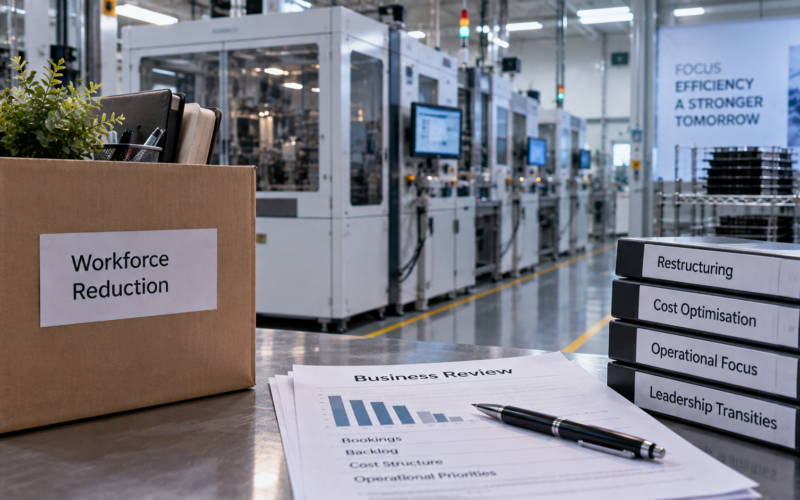
CVD Equipment Corporation (NASDAQ: CVV), a Central Islip, New York-based manufacturer of chemical vapor deposition, thermal-processing and advanced-materials equipment, is reducing its workforce by approximately 50% and abandoning the pursuit of new orders for the equipment business around which the company has operated for decades. The board approved the restructuring after reviewing strategic alternatives and concluded that the remaining organisation should be sized only to finish existing equipment backlog, meet warranty commitments and support the spare-parts, quartz and services activities that will remain. CVD Equipment expects to record approximately $800,000 to $1 million of restructuring charges during the third quarter, primarily for severance and related employee costs.
The decision amounts to a fundamental change in the company’s business model rather than a temporary manufacturing slowdown. CVD Equipment will no longer actively seek new system orders for its core equipment operation, meaning future revenue will increasingly depend on completing existing customer commitments and monetising aftermarket activities instead of repeatedly winning large capital-equipment contracts. Chairman Lawrence J. Waldman said weakness in prospective equipment orders, declining backlog, continuing operating losses and the absence of a sufficiently attractive strategic alternative had led the board to shift the company toward a substantially smaller parts, quartz and service operation.
The restructuring has also triggered an immediate leadership change. Emmanuel Lakios and the board mutually agreed that he would leave his positions as president, chief executive officer and director effective September 3, while Vice President of Manufacturing Operations Warren Cheesman was appointed acting chief executive. CVD Equipment told the SEC that Lakios’ departure did not result from a disagreement over the company’s operations, policies or practices, while Cheesman now takes control of an organisation whose priorities are no longer expansion of equipment manufacturing but completion of backlog, preservation of cash and evaluation of additional ways to monetise corporate assets.
How many CVD Equipment jobs could disappear under the 50% workforce reduction?
CVD Equipment has not published a precise number of employees affected by the September restructuring, so the company’s disclosure that the workforce is being reduced by approximately half should remain the principal confirmed measure. At the end of 2025, CVD Equipment employed 85 people, already down substantially from 118 at the end of 2024, including 39 employees in manufacturing, 22 in engineering, four in field service, seven in sales and marketing and 13 across general management, maintenance and administration. None of those employees was covered by a collective bargaining agreement.
That year-end comparison shows that CVD Equipment had already reduced employment by approximately 28% before announcing that its remaining workforce would be cut roughly in half again. The exact September starting headcount has not been disclosed, making it inappropriate to simply calculate 42 or 43 layoffs from the December 2025 figure because departures, restructuring actions and the sale of the SDC division changed the organisation during 2026. What can be stated with confidence is that CVD Equipment has moved through multiple stages of workforce contraction and is now resizing the company to support a much narrower operating model than the vertically integrated equipment manufacturer it historically maintained.
The latest reduction is also qualitatively different from ordinary efficiency layoffs because it follows a decision to stop pursuing new orders for an entire core business activity. Manufacturing employees who remain will principally be needed to finish contracted equipment, while field-service, quartz and spare-parts capabilities will support customers after those systems are delivered. Once the equipment backlog is substantially completed, management may need to reconsider the appropriate long-term staffing structure again unless new businesses or strategic transactions create alternative work for the remaining workforce.
Why has CVD Equipment stopped taking new equipment orders entirely?
The central problem is that new equipment demand has not been strong enough to justify the fixed costs associated with maintaining CVD Equipment’s existing manufacturing organisation. Second-quarter orders from continuing operations totalled only $1.2 million, down from $1.5 million a year earlier, while revenue fell 42.6% to approximately $2 million because system bookings had remained weak throughout 2025 and early 2026. Backlog declined to $3.9 million at June 30 from $4.6 million three months earlier, leaving the company with a shrinking pool of future contracted work.
The direction had been visible well before September. CVD Equipment ended 2025 with $6.6 million of backlog compared with $19.4 million at the end of 2024, a decrease of approximately $12.8 million in only one year, while management had already begun shifting from vertically integrated manufacturing toward greater outsourcing of fabricated components. The company also implemented a previous workforce reduction in late 2025 that it expected to reduce annual operating costs by approximately $1.8 million during 2026, demonstrating that the board had already tried to make the equipment business economically viable with a lower fixed-cost structure before choosing a more radical exit from new orders.
That sequence is important because the September decision appears to be the conclusion of a progressive restructuring rather than a sudden reaction to a single bad quarter. CVD Equipment reduced employment, outsourced more manufacturing work, changed its sales approach and evaluated strategic alternatives while continuing to pursue equipment customers, but the pipeline did not improve sufficiently. The board has now decided that preserving capital and servicing existing customers offers a better risk-reward profile than continuing to fund a manufacturing organisation while waiting for uncertain system orders.
Why did CVD Equipment struggle despite exposure to semiconductor and advanced-materials markets?
CVD Equipment operates in markets that appear attractive on paper because its systems can be used in semiconductor research, silicon-carbide power electronics, aerospace and defence materials, electric-vehicle battery technologies and other advanced industrial applications. Its equipment includes chemical vapor deposition systems, physical vapor transport tools, thermal-processing platforms and associated process solutions used in both research centres and commercial production environments. Those end markets can eventually grow strongly, but customer purchasing patterns for specialised capital equipment can be highly volatile and individual orders can be large relative to a company of CVD Equipment’s size.
The company has repeatedly highlighted delays in customer decision-making, geopolitical uncertainty and inconsistent funding conditions as factors affecting orders. Universities and research institutions can depend on public funding cycles, while emerging technologies such as silicon carbide, advanced battery materials and ceramic matrix composites may take longer than expected to move from research into high-volume manufacturing. A specialised equipment supplier can therefore have strong technical exposure to long-term growth themes while still suffering from insufficient near-term orders to cover engineering and manufacturing overhead.
Customer concentration adds another layer of volatility. CVD Equipment disclosed that two customers represented approximately 27.6% and 13.7% of 2025 revenue, while one aerospace customer accounted for 29.4% of year-end backlog and one industrial customer represented another 15.4%. When only a handful of customers can materially alter annual revenue or backlog, delays or cancellations can disproportionately affect capacity utilisation and profitability compared with a much larger diversified equipment manufacturer.
Why did CVD Equipment sell its SDC division before halving the workforce?
The restructuring follows another transformative action completed in April when CVD Equipment sold its SDC division for $17.4 million. The transaction generated approximately $15 million of net cash proceeds after transaction costs and estimated tax payments, helping cash and equivalents rise to $23.5 million at June 30 from $8.7 million at the end of 2025. CVD Equipment also reported no long-term debt at quarter-end, giving the company a much stronger liquidity position than its declining equipment revenue might otherwise suggest.
SDC had been an important revenue contributor rather than a negligible business. The division generated approximately $7.6 million of external revenue in 2025, representing about 29.5% of CVD Equipment’s consolidated annual revenue before the sale, meaning the divestiture deliberately made the remaining company materially smaller. Pro forma 2025 revenue excluding the divested operation would have been approximately $18.2 million compared with the reported $25.8 million consolidated figure.
The sale effectively exchanged operating scale for financial flexibility. CVD Equipment gave up a business producing millions of dollars of annual revenue but received enough cash to eliminate balance-sheet pressure and provide the board with time to evaluate what remained. The September restructuring shows that management ultimately concluded that a strong cash position alone did not justify continuing to invest in an equipment operation unable to generate enough new orders.
Why is CVD Equipment reporting profit while shutting down much of its business?
CVD Equipment’s second-quarter headline net income of approximately $12.6 million could create a misleading impression if viewed without the underlying transaction. The result was driven by approximately $13.9 million of income from discontinued operations associated with the SDC divestiture, while continuing operations generated a net loss of around $1.4 million. Revenue from continuing operations was only approximately $2 million and remained substantially below the level required to support the existing cost structure.
That distinction helps explain why management did not interpret the stronger balance sheet as evidence that its core problem had disappeared. Asset-sale gains can provide liquidity and strengthen shareholders’ equity, but they do not create recurring operating earnings once the transaction has been completed. CVD Equipment needed new system bookings to rebuild recurring revenue, and by September the board concluded that the probability and timing of those orders did not justify maintaining the required manufacturing capacity.
The company’s gross margin also provides useful context. Second-quarter gross margin from continuing operations improved to 16.8% from 14.1% a year earlier because non-system revenue represented a larger proportion of the mix, but that level remained insufficient to cover operating expenses and produce profitability. A future model concentrated more heavily on spare parts, quartz and services could potentially carry different economics, but CVD Equipment has not yet provided a long-term revenue or margin target for the post-restructuring business.
Why has Warren Cheesman been chosen to lead CVD Equipment through the restructuring?
Cheesman joined CVD Equipment as vice president of manufacturing operations in October 2022 and brings more than 30 years of experience across engineering, operations, quality and strategic sourcing. Before joining CVD Equipment, he held progressively senior positions at Veeco Instruments, Air Techniques and Kongsberg Defense & Aerospace, giving him experience relevant to advanced manufacturing as well as industries where technical quality and customer commitments can carry significant operational consequences. He also holds master’s degrees in technology management and materials science and engineering along with a bachelor’s degree in mechanical engineering.
That profile fits the unusual CEO mandate CVD Equipment now requires. Cheesman is not initially being asked to lead a conventional sales-driven expansion strategy; he must oversee completion of remaining equipment orders, manage warranties, preserve customer relationships, reduce costs and determine what physical and technical assets remain valuable after the restructuring. Manufacturing knowledge could therefore be particularly important while the company decides which capabilities need to be retained and which no longer fit a parts-and-services-focused future.
His title remains acting chief executive, leaving open the question of whether the board ultimately conducts a permanent CEO search or chooses a different strategic path before making that decision. CVD Equipment said the material terms of Cheesman’s compensation arrangement had not yet been determined when the September filing was submitted. The interim structure gives the board flexibility while it evaluates real estate, possible business opportunities and other transactions intended to maximise shareholder value.
What happens to former CEO Emmanuel Lakios after the restructuring?
Lakios left both the CEO position and the board on September 3 under a mutual agreement with CVD Equipment. The company explicitly stated that his departure was not the result of disagreement over operations, policies or practices, an important disclosure because his exit coincided exactly with the board’s approval of the restructuring plan. Under his employment agreement, CVD Equipment will continue paying his salary and employee benefits through October 2 and then provide his base salary and the employer portion of existing medical benefits for another nine months.
His tenure included several stages of CVD Equipment’s transformation, including the shift toward outsourced fabrication, previous workforce reductions, the SDC sale and the strategic review of the equipment business. In August, Lakios was still describing the SDC transaction as a milestone that increased financial flexibility while the company continued pursuing opportunities in target markets. Less than a month later, the board decided that the equipment opportunity set no longer supported continued pursuit of new system orders.
The speed of that change illustrates how quickly conditions can deteriorate for small capital-equipment suppliers when backlog falls and potential orders fail to convert. Lakios leaves CVD Equipment with significantly more cash than it held entering 2026, but the company he hands to Cheesman is also substantially smaller and no longer pursuing the same operating strategy. The board now appears more focused on preservation and monetisation than on attempting to rebuild the former manufacturing model under another chief executive.
Could CVD Equipment sell its Central Islip headquarters next?
The company has explicitly placed its real estate among the assets under review. CVD Equipment said the board will continue evaluating ways to reduce costs and monetise assets, including strategic alternatives involving its primary Central Islip facility, while also considering business opportunities that fit its financial resources and objectives. That means the workforce reduction may not be the final structural change associated with the retreat from new equipment manufacturing.
The logic is straightforward because a company requiring far fewer manufacturing employees and no longer building new equipment for future customers may eventually need significantly less industrial space. Selling a property could release additional cash while a smaller services and parts organisation operates from a more appropriate footprint, although CVD Equipment has not announced a sale process or committed to disposing of the site. Until an agreement is signed, the property should therefore be viewed as an asset under strategic review rather than a confirmed divestiture.
The Central Islip property also connects directly with the workforce story because manufacturing facilities carry costs that cannot always be reduced proportionally simply by dismissing employees. Property taxes, maintenance, utilities and insurance remain even after utilisation falls, which can make an oversized plant expensive for a shrinking business. The board’s willingness to consider real-estate monetisation suggests CVD Equipment intends to align physical capacity with the same smaller operating model now being imposed on staffing.
Why did CVD Equipment shares fall 25% after the restructuring announcement?
CVD Equipment shares closed at $4.68 on September 11, down 25.36% from the previous trading session, as investors processed the restructuring announcement and the decision to stop pursuing new system orders. Volume surged to approximately 844,000 shares compared with much lower turnover during many preceding sessions, indicating an unusually strong market response for a company with a market capitalisation of only around $32 million. The stock had closed at $6.27 on September 10 before the full market reaction unfolded.
The share-price response appears understandable because ending new equipment orders fundamentally changes the future revenue opportunity available to CVD Equipment. Investors who previously valued the company partly on potential growth in silicon carbide, aerospace, defence or advanced battery-materials equipment must now reassess it primarily around cash, remaining backlog, parts and services, quartz operations and whatever strategic alternatives the board ultimately pursues. The decision reduces operating risk but also removes much of the growth optionality associated with winning new capital-equipment systems.
By September 18, CVD Equipment shares were trading around $4.58, meaning the stock had not recovered most of the post-restructuring decline. The market value remained only modestly above the company’s June cash balance on a gross basis, although investors must also consider liabilities, restructuring expenses, ongoing operating losses and future cash needs rather than simply comparing market capitalisation with reported cash.
What should CVD Equipment employees and investors watch next?
The first issue is how quickly the company executes the roughly 50% workforce reduction and what the final headcount looks like after the restructuring is substantially complete. Because the company has not published a current employee total alongside the percentage reduction, the eventual quarterly or annual filing should provide a clearer picture of how far employment has fallen from the 85 people reported at the end of 2025. The $800,000 to $1 million restructuring charge expected for the third quarter should also provide additional information about the scale and timing of separation costs.
The second milestone is completion of the remaining backlog. CVD Equipment had only $3.9 million of backlog at June 30, down from $4.6 million at March 31 and $6.6 million at the end of 2025, and one $800,000 system order was already facing uncertainty after the associated customer entered a prepackaged Chapter 11 process. The speed at which that backlog converts into revenue will determine how quickly the equipment manufacturing operation winds down and how much cash the company consumes before reaching a steadier aftermarket model.
The third issue is what the board does with approximately $23.5 million of quarter-end cash and the company’s other assets. CVD Equipment has no long-term debt, is considering monetising its primary real estate and says it may evaluate new business opportunities consistent with the resources available, creating several potential paths ranging from a smaller continuing operating company to additional asset sales or a more fundamental strategic transaction. The next chapter may therefore be determined as much by capital allocation as by the performance of quartz, spare parts and service revenue.
CVD Equipment’s restructuring is particularly significant because it shows what can happen when repeated cost reductions fail to solve a demand problem. The company already lowered employment from 118 people to 85 during 2025, outsourced more manufacturing work, sold the SDC division and accumulated a debt-free cash position, yet weak orders and declining backlog continued to undermine the economics of its core systems business. The board has now chosen to remove the risk more decisively by stopping new equipment-order pursuit and reducing the workforce to what is necessary to fulfil existing obligations.
For employees, that decision ends any assumption that the earlier restructuring represented the final adjustment. For shareholders, the investment case has changed from whether CVD Equipment can win enough advanced-materials equipment contracts to support profitable growth toward whether its cash, remaining service activities, quartz business and potentially saleable assets can ultimately create more value than continuing to fund an unprofitable manufacturing operation. Warren Cheesman’s acting-CEO tenure begins with the difficult task of executing that transition while preserving enough technical and operational capability to honour commitments to customers that have already purchased CVD Equipment systems.
Discover more from Business-News-Today.com
Subscribe to get the latest posts sent to your email.
