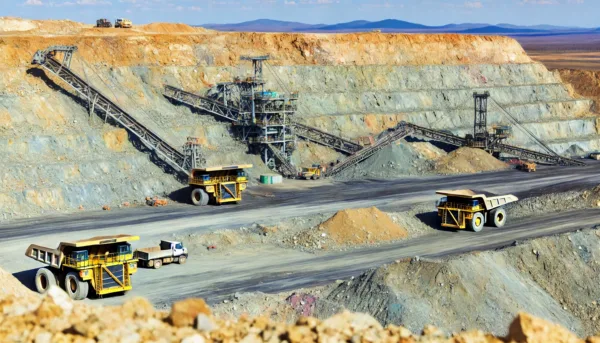
Celsius Resources, dual-listed on London’s AIM market and the Australian Securities Exchange, has just agreed to sell its cobalt-copper project in Namibia to a subsidiary of Chinese state-owned giant Chinalco for US$15 million, sending shares sharply higher. The deal marks a deliberate pivot away from African cobalt and toward the company’s flagship copper-gold project in the Philippines, which recently cleared a major feasibility milestone. Retail investors who caught the share price spike on the Chinalco news are now asking what the sale actually funds, how advanced the Philippine project really is, and what risks sit underneath the headline numbers.
What does Celsius Resources actually own across Namibia, the Philippines and Australia?
Celsius Resources is an Australia-headquartered explorer and developer with, until recently, its most advanced African asset being the Opuwo Cobalt-Copper Project in Namibia’s Kunene Region. Opuwo carries a mineral resource estimate of 225.5 million tonnes grading 0.12% cobalt, 0.43% copper and 0.54% zinc, equivalent to roughly 259,000 tonnes of contained cobalt and 970,000 tonnes of contained copper, a genuinely large deposit by junior mining standards even though it has not been carried at a high value on Celsius’ own balance sheet.
The company’s actual flagship asset is the Maalinao-Caigutan-Biyog, or MCB, copper-gold project in the Philippines, located in the Cordillera Administrative Region roughly 320 kilometres north of Manila. MCB is owned and operated through Makilala Mining Company Inc, a Philippine-registered affiliate, and has been under exploration and development since 2006, considerably longer than Celsius has been focused on Namibian cobalt.
The strategic logic behind selling Opuwo is straightforward on its face: redirect capital and management attention toward the more advanced Philippine project. The complicating factor, discussed further below, is that Celsius’ own control over the entity holding MCB has recently been the subject of an unresolved governance dispute, which retail investors should weigh before assuming Opuwo sale proceeds will flow smoothly into Philippine development.
Why did Celsius shares jump 78% on news of the Chinalco sale?
Celsius has signed a binding share sale agreement to sell its 95% interest in Opuwo Cobalt Holdings, along with an associated intercompany loan, to Chinalco (Xiong’an) Mining Corporation, a non-ferrous metals subsidiary of Aluminum Corporation of China focused on large-scale international base metals projects. The total consideration is US$15 million, equivalent to roughly A$21.7 million, a figure the company has noted represents a significant premium to Opuwo’s approximately A$3 million carrying value on Celsius’ own books.
That premium is the most likely explanation for the scale of the share price reaction. Selling an asset for several times its book value, to a buyer with the scale and credibility of a major Chinese state-owned metals group, is the kind of transaction that can meaningfully re-rate a small-cap explorer’s shares in a single session, particularly one that had not previously found a clear path to monetising Opuwo on its own.
The transaction is not yet complete. It remains subject to a list of conditions including Celsius shareholder approval under AIM Rules, renewal of Opuwo’s exclusive prospecting licence and environmental clearance certificate, approval from the Namibian Competition Commission and the Bank of Namibia, clearance from multiple Chinese regulatory bodies, and a waiver of pre-emptive rights held by a minority shareholder in the Opuwo entity. The cut-off date for satisfying these conditions is 29 December 2026, with a possible two-month extension, meaning the deal could still take the rest of the year to close.
How advanced is the MCB copper-gold project that Opuwo’s sale proceeds are meant to fund?
MCB is considerably further along than a typical junior exploration story. A Definitive Feasibility Study completed in January 2026 confirmed a maiden JORC-compliant ore reserve of 130.2 million tonnes at an average grade of 0.66% copper and 0.21 grams per tonne gold, supporting an estimated 35-year underground mine life using sub-level open stoping with paste backfill. The study reported a post-tax net present value of US$771 million and an internal rate of return of 24%, using what the company described as conservative long-term commodity price assumptions.
Production economics in the early years look particularly strong on paper, with the study projecting average annual output of around 26,500 tonnes of copper and 40,200 ounces of gold over the first decade, at a cash cost, net of by-product credits, of roughly US$0.41 per pound of copper. The project has also secured a 25-year mineral production sharing agreement from the Philippine government, renewable for a further 25 years, which the company has described as the first copper project approval in the Philippines in 15 years.
The gap between a completed DFS and an operating mine remains substantial, however, and Celsius itself has said it is still working through funding and offtake discussions to reach a final investment decision. Retail investors should treat the DFS numbers as a well-supported technical case for the project’s potential rather than as confirmation that construction financing and a construction timeline are already locked in.
What is the governance dispute at Makilala Mining, and why does it matter to Opuwo sale proceeds?
Celsius has disclosed an unresolved conflict over control of Makilala Mining Company, the Philippine entity that owns MCB. A proposed transaction under which a party called Sodor Inc would acquire a 60% stake in Makilala Mining, alongside an associated US$38 million processing investment, collapsed after a payment deadline lapsed. Sodor and a related party, PMR Holding, subsequently attempted to pay late and initiated conflict resolution proceedings to preserve their position.
Celsius has responded by issuing notice that Sodor’s and PMR’s arrangements should be relinquished, and has launched its own emergency conflict resolution process aimed at blocking Sodor from exercising shareholder or director rights at Makilala Mining while the broader dispute is resolved. The company has said it intends to transfer the relevant shares to a new Filipino partner instead and has indicated it will defend its position, including through potential legal action.
This matters directly to the Opuwo transaction narrative because Celsius has said proceeds from the Namibian sale are earmarked for MCB development, explicitly subject to resolving this dispute over control of the entity that owns the project. A retail investor reading only the Chinalco headline could reasonably assume the path from Opuwo sale to MCB funding is clear, when in fact a live governance conflict sits between the two.
What financing has already been lined up for MCB, and how much more is needed?
Celsius has secured support from Maharlika Investment Corporation, a Philippine state-linked investment vehicle, which has provided bridge loan financing to support completion of the MCB feasibility work and has been reported to have arranged a facility of up to US$76.4 million tied to the project. The company has also appointed Grant Samuel as financial adviser to help structure a comprehensive funding package, citing interest from international mining financiers, offtakers and investment groups following the DFS results.
Subsequent technical optimisation work referenced in company disclosures has pointed to an estimated total capital requirement in the range of US$276 million for the project, alongside projected lifetime revenue running into the billions of dollars given the scale and duration of planned production. These figures represent continued refinement of the DFS economics rather than a finalised, fully committed funding package.
The risk for shareholders is one common to pre-production mining developers of this size: a technically strong project still requires several hundred million dollars of committed capital, and the gap between advanced discussions with financiers and signed, binding funding agreements can take considerably longer to close than investors following the newsflow might expect, particularly while the Makilala Mining governance dispute remains open.
Why is Celsius walking away from cobalt just as critical minerals policy attention is rising?
Cobalt has been one of the most closely watched critical minerals of the past several years because of its central role in lithium-ion battery chemistries, and Opuwo’s scale, at nearly a quarter of a billion tonnes of resource, made it a genuine strategic asset rather than a marginal one. Selling it now, even at an attractive premium to book value, means Celsius is exiting a battery metals exposure at a moment when many governments and industrial buyers continue to prioritise diversified cobalt supply away from the Democratic Republic of Congo, which dominates global production.
The counterpoint from a company strategy perspective is that copper and gold, MCB’s primary commodities, carry their own strong demand narrative tied to electrification and grid infrastructure buildout, and a company with limited capital and management bandwidth generally benefits from concentrating on its most advanced, highest-confidence asset rather than running two capital-intensive development stories in parallel across different continents.
For a retail investor, the practical read is that this transaction is a capital allocation decision rather than a bet against cobalt or critical minerals more broadly. The interest from Chinalco, a Chinese state-linked buyer, in acquiring Opuwo also indicates that appetite for African cobalt assets from Chinese industrial buyers remains intact even as Celsius itself steps back from the space.
What should retail investors know about Celsius’ upcoming share consolidation?
Celsius has announced a one-for-twenty share consolidation on its AIM-listed shares, effective 23 July 2026. Share consolidations of this kind do not change the underlying value of an investor’s holding, since the number of shares held is reduced in the same proportion as the nominal share price increases, but they can create confusion for retail investors checking share price charts or historical data if they are not aware the adjustment has occurred.
Companies typically pursue consolidations of this scale to bring a very low nominal share price, often a fraction of a penny, to a level that is easier for institutional systems and some retail platforms to handle, and to present a less speculative-looking headline price. It is a housekeeping event rather than a signal about the underlying Opuwo or MCB stories, though it is worth investors double-checking their own brokerage statements around the effective date to confirm their holdings have been correctly adjusted.
Investors should also be aware that Celsius shareholders have seen meaningful dilution over the past year, with shares outstanding increasing by around 39% according to independent screening data, a common feature of small-cap resource developers funding exploration and feasibility work through repeated equity raises rather than operating cash flow.
Key takeaways for retail investors watching Celsius Resources
- Celsius Resources (AIM: CLA, ASX: CLA) has agreed to sell its Opuwo cobalt-copper project in Namibia to a Chinalco subsidiary for US$15 million, a significant premium to book value that drove a sharp share price rally.
- The sale remains conditional on a lengthy list of approvals from Namibian, Chinese and company shareholders, with a cut-off date of 29 December 2026 for completion.
- Proceeds are earmarked for the company’s more advanced MCB copper-gold project in the Philippines, which cleared a Definitive Feasibility Study in January 2026 showing a post-tax NPV of US$771 million and a 35-year potential mine life.
- An unresolved governance dispute over control of Makilala Mining Company, the Philippine entity that owns MCB, sits between the Opuwo sale proceeds and their intended use, and has not yet been settled.
- Financing for MCB’s estimated capital requirement of roughly US$276 million is still being assembled, with support from Maharlika Investment Corporation and an appointed financial adviser, but no fully committed funding package has been finalised.
- A one-for-twenty share consolidation takes effect on Celsius’ AIM listing on 23 July 2026, a technical adjustment that does not change underlying shareholder value but will alter the visible share price and share count.
- Shareholders have experienced substantial dilution over the past year, a pattern common to small-cap resource developers funding growth through equity issuance.
Discover more from Business-News-Today.com
Subscribe to get the latest posts sent to your email.