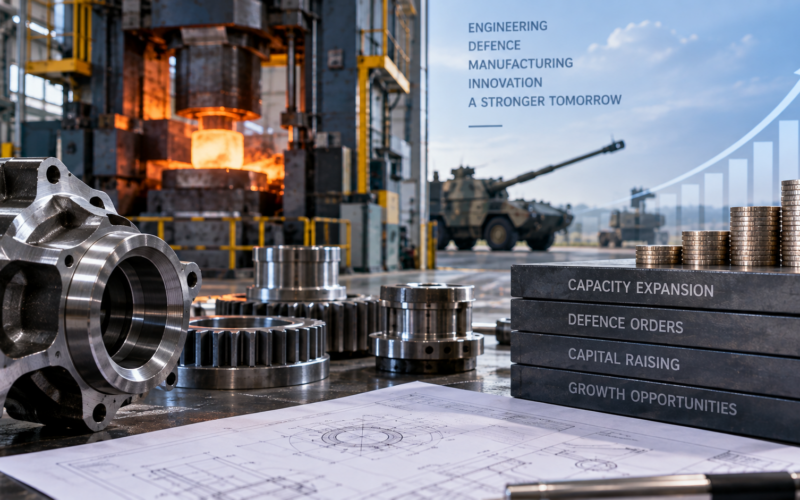
Bharat Forge Limited (NSE: BHARATFORG) has formally opened a qualified institutional placement of equity shares, setting the regulatory floor price at ₹1,947.70 per share as one of India’s largest diversified engineering groups moves another major capital-raising programme into execution. The QIP was opened on September 17 after the board approved fund raising on August 10 and shareholders subsequently authorised securities worth up to ₹25,000 million, or ₹2,500 crore, through a special resolution completed on September 11. Bharat Forge retains the option to price the institutional placement at a discount of up to 5% to the floor price, subject to applicable regulations.
Several market reports, including Business Today and Whalesbook, have described the active QIP as approximately ₹2,000 crore, while the formal shareholder mandate allows Bharat Forge to issue securities up to ₹2,500 crore. That distinction matters because the final transaction size and issue price will determine actual dilution. Bharat Forge had not fixed the final institutional price when the QIP opened, so ₹2,500 crore remains the authorised ceiling rather than automatically the amount being issued in the current book-build.
How much dilution could Bharat Forge’s latest QIP create at ₹1,947.70?
Bharat Forge reported paid-up equity capital of ₹95.627 crore at June 30, 2026, with shares carrying a ₹2 face value, implying approximately 47.81 crore existing equity shares. At the ₹1,947.70 floor price, a ₹2,000 crore issue would require roughly 1.03 crore new shares, equivalent to about 2.1% of the current share count before issuance. If Bharat Forge were ultimately to utilise the entire ₹2,500 crore shareholder authorisation at the same floor price, it would require around 1.28 crore shares, or approximately 2.7% of the existing base.
Those are scenario calculations rather than the final dilution because Bharat Forge can price the issue below the floor by up to 5%. A full 5% discount would produce an indicative issue price of about ₹1,850.32, requiring slightly more shares for any given amount raised.
The pricing window is unusually tight to the stock market. Bharat Forge closed September 18 at ₹1,962.10 on the NSE, only around 0.7% above the ₹1,947.70 floor price after rising 2.26% during the session. That proximity suggests the institutional book is being built near the prevailing market valuation rather than at a very large discount.
If Bharat Forge ultimately applies the maximum permitted discount, however, the implied ₹1,850 price would sit roughly 5.7% below the September 18 close. Investors therefore need the final pricing announcement before calculating the exact economic cost to existing shareholders.
Why is Bharat Forge raising capital again after its earlier ₹1,650 crore QIP?
Bharat Forge is not new to institutional equity issuance. The company raised ₹1,650 crore through a QIP in December 2024 at ₹1,320 per share, issuing 1.25 crore shares. Those proceeds were directed toward deleveraging certain subsidiaries, acquiring AAM India Manufacturing Corporation, now K Drive Mobility Solutions, and general corporate purposes. Bharat Forge later disclosed that the entire proceeds had been utilised.
The new fundraise arrives with a different strategic backdrop. Bharat Forge is scaling defence, aerospace, semiconductor-linked and data-centre component capabilities while simultaneously restructuring weaker European operations.
Its FY26 annual report highlights an unexecuted defence order book of ₹10,961 crore and new business secured worth ₹4,814 crore. During Q1 FY27, the company added another ₹1,352 crore of Indian manufacturing orders, while its defence order book rose to about ₹11,196 crore by June-end.
Bharat Forge has also outlined approximately ₹1,800 crore of investment in dedicated forging and machining capacity for sunrise sectors including defence, aerospace, semiconductors and data centres, as well as an energetics manufacturing project in Andhra Pradesh. Fresh equity can therefore support expansion without forcing the company to finance every project through incremental debt.
Why does the QIP arrive just after Bharat Forge reported a consolidated loss?
The June quarter produced one of the more complicated earnings pictures in Bharat Forge’s recent history. Consolidated revenue rose 18.7% year on year to ₹4,639.94 crore, but the group reported a net loss of approximately ₹89.7 crore after recording about ₹358 crore of exceptional charges tied mainly to restructuring at German subsidiary Bharat Forge CDP GmbH.
The underlying Indian operation remained profitable. Standalone revenue increased 11.5% to ₹2,347.42 crore, while standalone PAT was ₹321.40 crore and EBITDA ₹585.6 crore. The Q1 filing showed standalone debt-to-equity of only 0.34 times and an interest-service coverage ratio of 13.93 times.
The consolidated loss therefore should not be interpreted as evidence that Bharat Forge has suddenly lost access to operating cash generation. It largely reflects the financial cost of restructuring an underperforming European business while Indian manufacturing continues to grow.
That distinction makes the QIP strategically interesting. Equity raised during a period of domestic expansion can help Bharat Forge simultaneously invest into higher-growth businesses and avoid allowing European restructuring costs to constrain the balance sheet.
How important is defence to Bharat Forge’s next capital-allocation cycle?
Defence revenue reached approximately ₹495.68 crore in Q1 FY27, up 87.5% year on year, making it one of the fastest-growing parts of the consolidated portfolio. The company also secured what it described as its largest naval order during the quarter, covering 12 Marine Gas Turbine Generator Sets for the Ministry of Defence.
Bharat Forge’s defence exposure now ranges across artillery, armoured mobility, naval systems, underwater systems, small arms and energetics. Its FY26 operational disclosures put the defence order book above ₹10,900 crore before the latest Q1 inflows.
That matters for the QIP because defence manufacturing is capital intensive. New programmes often require machining centres, forging lines, explosives infrastructure, testing systems and working capital long before the entire contract value converts into revenue.
Fresh common equity can therefore support growth without placing all of that investment on debt-financed subsidiaries. The trade-off is dilution, which means management needs to produce enough incremental earnings from the new capacity to offset the larger share count.
What should Bharat Forge investors watch after the QIP opens?
The first number is the final issue size. The company has authority for up to ₹2,500 crore, while reports around the live transaction have referred to approximately ₹2,000 crore.
The second is pricing. Bharat Forge’s September 18 close was only marginally above the floor price, leaving institutional demand as the key factor in determining whether management needs to use part or all of the permitted discount.
The third is deployment. Bharat Forge’s previous ₹1,650 crore QIP produced a clearly identifiable acquisition and deleveraging outcome. Investors will expect similarly concrete disclosure around how this new capital supports defence, aerospace, semiconductor, data-centre and other strategic investments.
Bharat Forge is raising equity from a much stronger share-price base than it did in 2024. That reduces dilution per rupee raised, but it also raises the return hurdle: institutional investors buying around ₹1,950 will expect the next expansion cycle to deliver more than just a larger asset base.
Discover more from Business-News-Today.com
Subscribe to get the latest posts sent to your email.