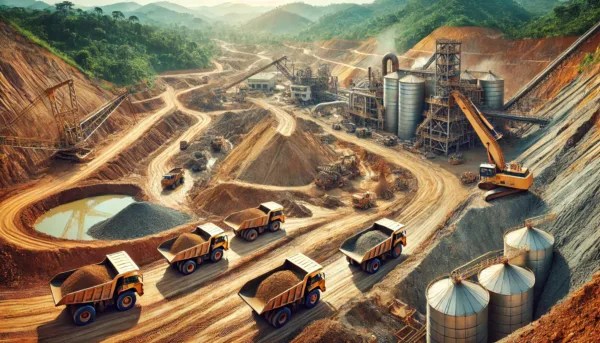



The United States’ renewed push into Democratic Republic of the Congo critical minerals has opened a new front in the global competition with China, after American company Virtus Minerals moved to develop major cobalt and copper assets through Chemaf’s Étoile and Mutoshi projects. The deal is being framed as a strategic win for President Donald Trump’s administration because it places a United States-backed operator inside one of the world’s most important mineral regions at a time when cobalt, copper and secure supply chains have become central to electric vehicles, artificial intelligence infrastructure, defense manufacturing and industrial policy.
The move matters because the Democratic Republic of the Congo sits at the center of the global cobalt market, while China has spent years building deep control across African mining, processing and logistics networks. For Washington, the Virtus Minerals-Chemaf push is not just another mining transaction. It is part of a wider attempt to reduce dependence on Chinese-controlled supply routes, support Western access to critical minerals and turn diplomatic engagement in Central Africa into industrial leverage.
The projects are expected to become significant producers once processing plants come online, with planned output of about 75,000 tonnes of copper and 20,000 tonnes of cobalt a year. Those figures make the development important not only for mining investors but also for automakers, battery manufacturers, defense contractors and governments trying to secure clean-energy and national-security supply chains before the next geopolitical shock exposes another dependency.
Why the Congo minerals deal matters in the United States-China supply-chain race
The Democratic Republic of the Congo is not just a mining jurisdiction. It is one of the most strategic resource battlegrounds in the world. Cobalt is widely used in batteries, electronics, aerospace systems and defense-related supply chains, while copper is essential for power grids, electric vehicles, data centers, weapons systems and industrial electrification. As demand grows, control over these minerals increasingly shapes the balance of economic and military power.
China understood this earlier than many Western policymakers. Chinese companies built long-term positions across African mineral assets, processing capacity, logistics channels and financing networks while the United States and its allies often relied on market access rather than direct supply-chain strategy. That allowed Beijing to gain structural influence over materials that are now critical to future industries.
The Virtus Minerals-Chemaf development is an attempt to shift that pattern. A United States-backed operator gaining control of major cobalt and copper production in the Democratic Republic of the Congo gives Washington a practical foothold in a sector where China has long held an advantage. It also signals that the United States is no longer treating critical minerals only as a trade issue. It is treating them as a national-security issue.
That shift is important because supply-chain security cannot be built by speeches alone. It requires mine access, processing capacity, financing, transport routes, transparency standards and long-term purchase agreements. The Congo deal gives the United States a chance to convert policy rhetoric into physical supply.
How Virtus Minerals and Chemaf fit into Washington’s African minerals strategy
Virtus Minerals’ investment in Chemaf gives the United States a potentially important role in two major Democratic Republic of the Congo mining operations. Étoile, located in Lubumbashi, and Mutoshi, located in Kolwezi, are positioned in the heart of the country’s copper-cobalt belt. If the projects reach planned output, they could become meaningful contributors to non-Chinese supply streams.
The deal also connects to the Lobito Corridor, the rail route backed by the United States with a multibillion-dollar investment commitment intended to move minerals from Central Africa toward an Atlantic port in Angola. That corridor is strategically important because logistics can decide whether mineral access is commercially useful. A mine without a reliable export route is not a secure supply chain. A mine connected to a transparent, Western-backed corridor becomes far more valuable.
This is where the story becomes bigger than Virtus Minerals. Washington is trying to build an ecosystem. The mine assets provide the resource base. The Lobito Corridor provides the export pathway. Diplomatic engagement with the Democratic Republic of the Congo provides political support. United States companies provide commercial presence. Together, those pieces create an alternative to China’s long-established resource networks.
The strategy is ambitious, but it is not guaranteed to work. Mining projects in the Democratic Republic of the Congo face political risk, infrastructure constraints, regulatory uncertainty, security concerns and community expectations. American involvement may help improve transparency and access to capital, but it does not remove the operational difficulty of building and running large-scale projects in a complex environment.
Why cobalt and copper are becoming national-security minerals
Cobalt and copper are no longer just commodities traded by mining specialists. They are strategic inputs for the technologies shaping the next phase of global power. Electric vehicles, grid-scale batteries, renewable-energy systems, smartphones, data centers and military platforms all rely on stable supplies of critical minerals. When supply chains are concentrated in one region or controlled heavily by one rival power, governments begin to see vulnerability.
The United States has already learned this lesson in semiconductors, pharmaceuticals, rare earth elements and energy. The same logic now applies to cobalt and copper. If China controls too much of the extraction, processing or transportation network, it can gain leverage during trade disputes, military crises or industrial shortages. That leverage may not always be used openly. Sometimes the threat is enough to shape corporate and government behavior.
The Democratic Republic of the Congo is especially important because it holds a dominant role in cobalt production. Western companies need reliable access, but they also need ethical sourcing, labor protections, environmental standards and traceability. That is a difficult combination. The faster the energy transition moves, the greater the temptation to prioritize supply over governance. That is where the United States will face a credibility test.
A stronger American role in Congo minerals could help diversify supply chains, but it must also avoid replicating the opaque practices that Western officials often criticize in Chinese-backed resource deals. If the United States wants to present itself as a better partner, the projects must show transparency, responsible labor standards and real benefits for Congolese workers and communities.
Why China’s position in African minerals will not be easy to dislodge
The Virtus Minerals-Chemaf move is strategically significant, but it does not erase China’s advantage. China has spent decades building relationships, financing infrastructure, supporting state-owned enterprises and embedding itself in African resource markets. Its position is not based on one mine or one contract. It is based on a network of capital, logistics, refining capacity and diplomatic influence.
That means the United States cannot win the minerals race through isolated deals. It needs consistency. American companies must be willing to operate in difficult jurisdictions. Washington must provide financing tools that can compete with Chinese state-backed support. Allied buyers must commit to long-term offtake agreements. Processing capacity must expand outside China. Without those pieces, American-controlled mines may still depend on supply-chain links where China remains influential.
The challenge is also political. African governments do not want to be treated merely as arenas for United States-China competition. They want investment, jobs, infrastructure, skills development and better terms for their resources. If Washington frames the strategy only as beating China, it may miss what Congolese leaders and communities actually need. The stronger message is partnership: secure supply chains for the United States and allies, but also more value creation inside the Democratic Republic of the Congo.
China will not stand still. Beijing can respond with pricing pressure, financing offers, diplomatic engagement, new acquisitions or deeper processing commitments. The minerals contest is likely to become a long game, not a single victory lap.
What risks could complicate the United States-backed mining push?
The biggest risk is execution. Mining deals often sound transformational when announced, but production timelines, financing needs, technical hurdles and local conditions determine whether they deliver. Chemaf’s assets have strategic appeal, but bringing processing plants online and sustaining full production will require capital discipline, operational experience and political stability.
Virtus Minerals has also faced scrutiny over its mining experience. That matters because strategic ambition does not replace operating capability. A company can be backed by powerful geopolitical logic and still face questions over whether it has the technical depth, management systems and financial structure to deliver a complex copper-cobalt ramp-up in the Democratic Republic of the Congo.
Another risk is security. The broader region has been affected by conflict, including continued instability linked to armed groups in eastern Congo. While the main copper-cobalt belt sits away from some of the worst fighting, national political risk still affects investor confidence. Washington’s broader regional diplomacy, including efforts connected to Rwanda and the Democratic Republic of the Congo, will therefore influence how secure the minerals strategy looks.
There is also a reputational risk around labor, environmental and community impacts. Cobalt mining in the Democratic Republic of the Congo has long been associated with concerns over unsafe working conditions, child labor in artisanal mining, pollution and uneven local benefits. If United States-backed projects want to distinguish themselves from opaque foreign extraction models, they will need visible safeguards and strong reporting.
How the Lobito Corridor could decide whether the strategy works
The Lobito Corridor may become one of the most important pieces of the United States mineral strategy in Africa. The rail route links mineral-producing areas in Central Africa to Angola’s Atlantic coast, creating a potential alternative to routes that are more exposed to Chinese influence or regional chokepoints. For copper and cobalt producers, reliable logistics can be as important as the mine itself.
A secure corridor could give Western buyers a more auditable supply chain. That matters for automakers, battery companies and defense contractors that face pressure to prove where their inputs come from. Traceability is no longer a public-relations extra. It is becoming a commercial requirement as governments tighten rules around forced labor, sanctions, environmental standards and national-security sourcing.
The corridor also gives the United States a way to support infrastructure that benefits more than one mine. If the route becomes commercially successful, it could attract additional mining, processing and logistics investment across the region. That is why Washington sees the project as a platform rather than a single transport line.
The risk is that infrastructure projects in Africa often face delays, governance problems and financing gaps. The corridor must be maintained, secured and integrated into real commercial flows. If it works, it could become a powerful alternative to China-dominated supply channels. If it underperforms, the minerals strategy will remain vulnerable.
What should readers watch next in the United States-Congo minerals race?
The most important signal will be whether Étoile and Mutoshi can move from announced capacity to reliable production. The projected output gives the deal strategic weight, but actual production will determine whether it changes critical mineral supply-chain realities. Any delays tied to financing, processing plants, technical execution or local operating conditions would weaken the project’s impact and give China more time to defend its position.
Long-term offtake agreements will also shape the deal’s real value. If United States-aligned automakers, battery manufacturers, defense suppliers or industrial buyers secure supply from the projects, the Virtus Minerals-Chemaf move becomes more meaningful for Western supply-chain security. Without clear buyers tied to the United States or allied markets, the minerals may still enter global trade in ways that do not fully reduce dependence on Chinese-linked networks.
Washington’s next moves in the Democratic Republic of the Congo will be just as important. A single flagship investment can send a message, but a durable minerals strategy requires more projects, stronger financing channels, processing partnerships and transparent export routes. If more American or allied companies follow Virtus Minerals into Central African mining, the United States could begin building a more credible alternative to China’s long-standing influence in the region.
Governance will remain a major test. The United States will need to show that its model brings stronger transparency, local jobs, skills development and community benefits. If Congolese workers and communities see little improvement, the political case for American-backed mining investment will weaken, especially in a country that has often seen foreign companies extract resources without delivering enough local value.
The United States-Congo minerals push is important because it moves the competition with China from policy speeches into physical assets. It gives Washington a chance to secure metals needed for electric vehicles, defense systems and industrial resilience. But the outcome will depend on execution. The deal can challenge China’s grip only if the mines produce, the Lobito Corridor works, investors stay committed and the Democratic Republic of the Congo sees real value beyond another foreign scramble for minerals.
Key takeaways from the United States-backed Congo minerals push
- The United States-backed Virtus Minerals push into Chemaf’s Democratic Republic of the Congo assets marks a significant move in the global critical minerals race.
- The Étoile and Mutoshi projects are expected to produce around 75,000 tonnes of copper and 20,000 tonnes of cobalt annually once fully operational.
- The deal gives the United States a stronger foothold in one of the world’s most important cobalt and copper regions.
- China has long held deep influence across African mineral extraction, processing and logistics networks.
- Cobalt is critical for batteries, electronics and defense-linked supply chains, while copper is essential for electrification, data centers and industrial infrastructure.
- The Lobito Corridor is central to the strategy because it could provide a Western-backed route for exporting minerals through Angola.
- The deal could help reduce United States and allied dependence on Chinese-controlled critical mineral supply chains.
- Virtus Minerals has faced scrutiny over its mining experience, making execution and operational credibility important issues to watch.
- The Democratic Republic of the Congo will be looking for jobs, skills development, infrastructure and stronger local benefits from foreign mining investment.
- The long-term test is whether the project can deliver real production, transparent supply chains and a durable alternative to China’s dominance.
Discover more from Business-News-Today.com
Subscribe to get the latest posts sent to your email.