




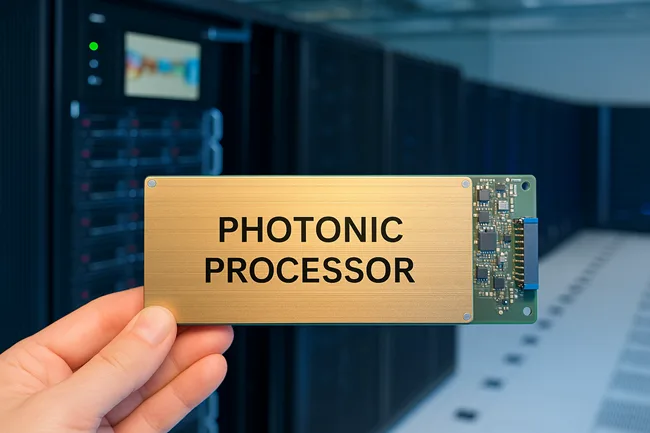
How could photonic processors reshape the energy, cost, and performance profile of hyperscale data centers by 2030?
The growing demand for artificial intelligence (AI) and high-performance computing (HPC) is pushing hyperscale data centers to their operational limits. According to the International Energy Agency, data-center energy consumption is expected to exceed Japan’s annual electricity usage by 2026, with AI inference and training models emerging as primary drivers. In this context, photonic processors—chips that compute with light instead of electrons—are increasingly being viewed as a viable alternative to traditional CMOS-based architectures. By 2030, analysts believe mainstream adoption of photonic processors could radically change the way data centers are designed, powered, and cooled.
European startup Q.ANT GmbH, which recently secured €62 million in Series A funding, has emerged as a leading contender in this transition. Its Thin-Film Lithium Niobate (TFLN)-based Native Processing Server (NPS) promises up to 30 times energy efficiency and 50 times performance improvement compared to conventional chips, with the potential to increase compute density by 100 times without active cooling. Institutional investors view such metrics as critical to slowing the rise in data-center operating expenses, which have been increasing alongside power tariffs and infrastructure expansion costs.
Why do analysts see energy efficiency and cooling elimination as the biggest near-term advantages of photonic processors for data centers?
Energy consumption remains the single largest cost driver for hyperscale operators. Training a large-scale language model can consume several megawatt hours per week, with cooling systems accounting for up to 40 percent of total power usage in some facilities. Photonic processors, by generating significantly less heat than CMOS-based chips, could virtually eliminate the need for traditional active cooling in certain inference workloads.
Q.ANT’s NPS is designed as a plug-in co-processor, making it compatible with existing server racks. This hybrid integration approach allows operators to replace a portion of GPU-intensive workloads with photonic co-processing units without redesigning entire facilities. Analysts estimate that if even 25 percent of inference workloads in hyperscale environments were shifted to photonic processors by 2030, power usage effectiveness (PUE) metrics could drop from today’s average of 1.5 to closer to 1.1, translating to hundreds of millions of dollars in annual cost savings for large cloud providers.
In addition, photonic processing reduces the infrastructure footprint. Lower thermal output allows for denser rack configurations, enabling operators to increase compute capacity within the same physical space. Institutional sentiment suggests that these combined benefits give photonic processors a clear short-term edge over quantum computing, which still requires power-intensive cryogenic cooling.
Can photonic processors deliver the scalability required for hyperscale AI workloads by 2030?
The scalability question remains a crucial factor for mainstream adoption. While photonic processors offer impressive performance metrics in early testing, scaling production to meet hyperscale volumes will require significant advancements in manufacturing capacity. Thin-Film Lithium Niobate fabrication, a critical component in many photonic chips, is currently limited to a small number of specialized facilities.
Q.ANT is leveraging TRUMPF’s manufacturing expertise to ramp up production, while Belgian research institute imec is expanding its silicon-photonics pilot lines to support broader European photonics startups. Analysts say such vertically integrated efforts may allow European players to scale faster than previously expected. However, they caution that unless these efforts are matched with robust supply-chain partnerships, U.S. competitors like NVIDIA and Intel could still outpace them by integrating photonic interconnects into their existing product lines at scale.
Institutional investors believe the next two to three years will be decisive. If early deployments validate performance and reliability claims, photonic processors could move from specialized inference workloads to broader training and mixed-use AI operations by the end of the decade.
What are the software and ecosystem challenges that could delay mainstream adoption of photonic processors in hyperscale environments?
Despite strong hardware performance, software ecosystem readiness remains a significant hurdle. Developers are heavily invested in CUDA, ROCm, and other GPU-optimized frameworks. Photonic processors must achieve seamless compatibility with popular AI libraries such as PyTorch, TensorFlow, and JAX to gain traction among hyperscale operators. Q.ANT’s NPS has been designed to integrate into existing programming workflows as a co-processor, but ecosystem maturity is still at an early stage.
Analysts warn that without strong software-hardware co-design, photonic processors risk being limited to niche applications such as optical signal processing or physics simulations. U.S. semiconductor leaders, with entrenched developer ecosystems, may hold an advantage in this area, potentially bundling photonic elements into existing AI accelerator stacks to maintain customer loyalty.
However, institutional sentiment is cautiously optimistic that as energy and cost pressures grow, hyperscale operators will prioritize any technology that delivers measurable operational savings, even if initial software integration requires additional development efforts.
Could widespread adoption of photonic processors shift the balance of power in the global AI hardware market by 2030?
If photonic processors achieve mainstream adoption, the competitive dynamics of the AI hardware market could shift significantly. Traditional GPU vendors may face margin pressures as hyperscale operators diversify their hardware stacks to reduce energy costs. European photonic startups such as Q.ANT, alongside U.K.-based PsiQuantum and Belgium’s imec-backed initiatives, could carve out a meaningful share of the market, especially in energy-sensitive regions where sustainability regulations are tightening.
Regional funding policies also play a role. Development banks such as L-Bank are actively supporting deep-tech manufacturing in Europe, with the goal of reducing reliance on U.S. semiconductor imports. By 2030, analysts believe this policy-driven approach could help European players secure long-term contracts with hyperscale data-center operators, particularly in regions prioritizing low-carbon infrastructure.
Institutional investors, however, caution that U.S. semiconductor giants are unlikely to cede ground easily, despite the momentum of European photonic startups. Industry observers point out that companies such as NVIDIA and Intel are already deploying significant capital into photonic-electronic hybrid systems, which combine mature CMOS technology with optical interconnects to accelerate AI workloads. This hybrid strategy allows U.S. leaders to incrementally integrate photonic capabilities into existing GPUs and AI accelerators, offering immediate performance and energy-efficiency gains without the risks associated with building entirely new architectures.
NVIDIA, for example, is expanding research into silicon-photonic interconnects for its next-generation GPU clusters, aiming to reduce latency in data-heavy training environments while keeping software compatibility intact. Intel has made similar moves through its optical interconnect programs, targeting hyperscale data centers seeking faster chip-to-chip communication. Analysts believe these incremental upgrades, though not as energy-efficient as full photonic co-processing, could delay large-scale adoption of standalone photonic processors by offering operators a familiar, cost-competitive upgrade path.
The scale advantage of U.S. semiconductor giants further complicates the outlook for European startups. NVIDIA, Intel, and AMD control vast manufacturing and distribution networks that can push hybrid solutions to market faster and at lower unit costs. This global reach allows them to negotiate long-term contracts with hyperscale cloud providers, leveraging existing relationships built around established AI software ecosystems like CUDA. By contrast, European startups such as Q.ANT must overcome not only supply-chain limitations in Thin-Film Lithium Niobate fabrication but also the challenge of convincing hyperscale operators to invest in entirely new hardware stacks.
Institutional sentiment suggests that price parity will be a critical factor in the coming years. While photonic processors promise significant energy savings, analysts expect hyperscale operators to weigh those benefits against initial capital expenditures. U.S. incumbents, with their ability to bundle hybrid photonic solutions into existing infrastructure at competitive pricing, may hold an early advantage in winning large-scale contracts.
Still, some investors argue that this cost advantage may erode by the end of the decade. If European startups can scale manufacturing and demonstrate consistent operational savings, particularly in energy-constrained regions such as Europe and parts of Asia, hyperscale operators may prioritize long-term total cost of ownership over short-term procurement costs. Analysts say the decisive period will likely fall between 2027 and 2030, when data-center operators, facing mounting regulatory pressure to meet carbon-reduction targets, may favor fully photonic systems that eliminate active cooling entirely.
Discover more from Business-News-Today.com
Subscribe to get the latest posts sent to your email.