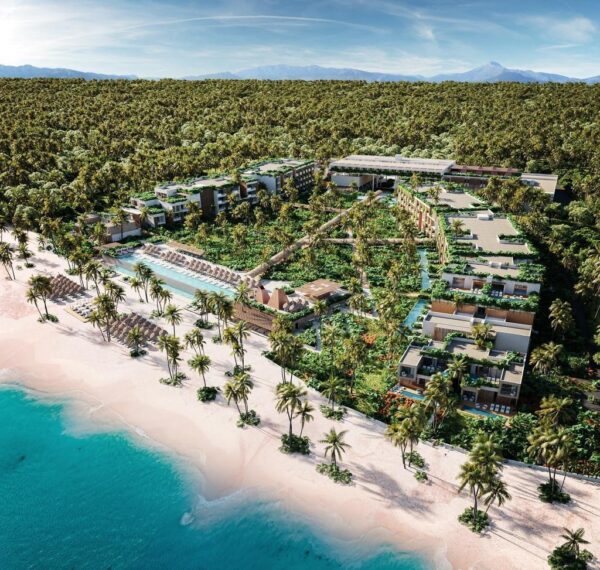


Walker & Dunlop, Inc. (NYSE: WD) has arranged $104.5 million in construction financing for the Ritz-Carlton Savannah, a 168-room luxury hotel redevelopment in Savannah’s Historic District, giving fresh momentum to one of the city’s most closely watched hospitality projects. The financing supports TMGOC Ventures’ plan to convert the historic 1911 “Savannah Skyscraper” into the first Ritz-Carlton-branded hotel in the city, with opening targeted for the first quarter of 2028. Strategically, the deal is more than another hotel loan: it is a read on where private capital is still willing to lean in across hospitality, adaptive reuse, and destination luxury. For Walker & Dunlop, the transaction also reinforces the importance of advisory-led capital markets execution at a time when commercial real estate financiers are being judged less on volume alone and more on where they can still close complex deals.
Why does the Ritz-Carlton Savannah financing matter for Savannah’s hotel market right now?
The Savannah angle is the real hook here. Luxury hotel development in historic urban cores is not a “just add capital and stir” business. Savannah’s Historic District is unusually constrained by preservation rules, selective review processes, and land scarcity, which means truly premium projects are hard to replicate quickly even when visitor demand is healthy. That matters because scarcity is often the hidden engine of hotel pricing power. When a city has strong tourism appeal but limited capacity to add top-end branded rooms at scale, each new opening can punch above its room count in average daily rate, meetings demand, and brand halo.
That is exactly why this project looks more strategic than its 168 keys might suggest. The Ritz-Carlton Savannah is not entering an oversupplied convention corridor or a generic Sun Belt growth zone. It is being inserted into one of the Southeast’s most tightly controlled historic markets, close to River Street, City Market, Forsyth Park, the Savannah College of Art & Design, and the Port of Savannah. In plain English, that means the project can draw from both leisure traffic and higher-yield corporate or event demand, while competing in a city where premium inventory remains relatively limited.

How does this deal reflect broader investor appetite for adaptive reuse hospitality projects?
The structure of the project says a lot about what kinds of hospitality deals can still attract conviction. This is not a greenfield luxury resort in search of a story. It is an adaptive reuse redevelopment of two existing office buildings, paired with historic rehabilitation tax credits and local property tax abatements. That combination matters because it softens development economics in a way that conventional new-build hotel projects often cannot match.
Investors and lenders have become far more selective about hospitality construction exposure since the easy-money era ended. Higher rates, construction cost volatility, labor uncertainty, and longer stabilization periods have made lenders wary of underwriting pure optimism. In that environment, adaptive reuse deals with tax-credit support, irreplaceable locations, and globally recognized luxury branding can look a lot more financeable than a generic upper-upscale box on cheap land. This Savannah project checks most of those boxes. It links capital to preservation, brand to scarcity, and development upside to an asset that is culturally difficult to reproduce.
That does not make it risk-free. Adaptive reuse is notorious for hidden costs, delayed approvals, structural surprises, and scope creep that can make developers age in dog years. But the presence of historic credit programs and a lender willing to underwrite the complexity suggests the capital stack is being built around resilience rather than pure speed. In this market, that alone is a signal.
What does the Ritz-Carlton Savannah project reveal about where luxury hospitality is still expanding?
Luxury hotel growth in the United States is increasingly bifurcated. On one side are resort and gateway markets that already have deep institutional attention and heavy brand concentration. On the other are secondary or heritage-rich markets where ultra-luxury supply is still thin, but tourism demand and civic identity are strong enough to support rate premiums if the right product arrives. Savannah fits squarely into the second bucket.
That makes the Ritz-Carlton flag especially important. A Ritz-Carlton is not merely a hotel operator’s badge on the door. It is a market-positioning device. Once attached to a project in a city like Savannah, it can reprice expectations for weddings, events, group demand, food and beverage ambition, and residential or mixed-use spillover in the surrounding submarket. It also sends a message to other developers that Savannah is not simply a charming regional destination. It is being tested as a city capable of absorbing a true luxury tier.
TMGOC Ventures’ broader framing reinforces that point. The developer is clearly pitching the project as a bridge between historic identity and global luxury destination positioning. Marriott International, which will operate the property through The Ritz-Carlton brand, appears to agree that Savannah can support that elevation in brand expression. If the project performs well after opening, it may embolden similar high-end adaptive reuse bets in culturally protected cities where new supply is structurally difficult to create.
Why is Walker & Dunlop using deals like this to reinforce its capital markets identity?
For Walker & Dunlop, this transaction is as much about positioning as fee generation. The company has been emphasizing its ability to source non-agency capital and execute across complex commercial real estate transactions. According to its investor materials, Walker & Dunlop delivered $55 billion in total transaction volume and $1.2 billion in revenues in 2025, while its servicing portfolio reached $144.0 billion. The company also highlighted strong brokered debt financing momentum in late 2025, reflecting broader capital availability from private sources even as traditional real estate markets remained uneven.
That backdrop helps explain why a hospitality redevelopment like Ritz-Carlton Savannah matters. Walker & Dunlop is effectively showing that it can still intermediate capital into deals that are messy, bespoke, and high-conviction rather than commoditized. In a commercial property environment where office remains fragile and not every multifamily or industrial financing assignment carries strategic distinction, complex hospitality and redevelopment mandates can serve as useful proof points.
There is another layer here too. Advisory businesses increasingly win by being embedded earlier in the transaction lifecycle. When a firm is helping shape the capital stack, tax-credit strategy, and lender positioning, it becomes harder to displace than when it is merely competing on financing spread. Walker & Dunlop’s partnership across its Capital Markets Institutional Advisory and Hospitality Advisory teams suggests that is the model it wants investors to notice.
What does current Walker & Dunlop stock performance say about market sentiment toward deals like this?
Walker & Dunlop’s share price context shows why management needs transactions like this to reinforce the durability of its strategy. Public quote pages show WD at about $44.44, only modestly above its 52-week low of $42.12 and far below its 52-week high of $90.00. Available public trading data also indicates the stock was down roughly 7.8% over one month, even though it had edged up from $43.49 on March 30 to $44.44 on April 2 in the latest short-term data visible through public quote services. In other words, the market has not exactly been throwing confetti.
That gap matters because a single financing announcement is unlikely to move sentiment on its own. Investors will not re-rate Walker & Dunlop simply because it arranged one marquee hotel loan. What they may do, however, is treat deals like this as evidence that the company’s advisory and private-capital positioning can offset weaker sentiment around commercial real estate cyclicality. The market appears to be asking whether Walker & Dunlop can turn episodic wins into a steadier narrative of capital markets relevance, margin resilience, and differentiated origination.
The answer probably depends less on Savannah specifically and more on repetition. If Walker & Dunlop keeps surfacing high-quality mandates in sectors where capital is still selective but active, the company has a better chance of rebuilding confidence. If not, the stock could remain trapped in the familiar real-estate-finance discount box, where investors wait for clearer proof that execution beats the cycle.
What execution risks could still complicate the Ritz-Carlton Savannah development before its 2028 opening?
No luxury hotel project is complete until it is open, staffed, stabilized, and charging room rates that make the spreadsheet blush for the right reasons. Between now and the targeted first-quarter 2028 opening, the Savannah project still faces the standard gauntlet: construction cost pressure, potential delays tied to historic redevelopment, labor availability, and the ever-annoying possibility that guests become more price-sensitive just as the hotel comes online.
There is also the brand risk that accompanies first-of-its-kind positioning in a market. If the Ritz-Carlton Savannah opens into soft luxury demand, operational underperformance would be more visible because the project has been framed as a market-defining addition. Conversely, if the hotel launches well, it could reset the benchmark for Savannah’s premium lodging segment.
The broader macro environment matters too. Luxury hospitality has held up better than many feared in recent years, but it is not immune to recession risk, corporate travel pullbacks, or shifts in international visitation patterns. A project like this is ultimately underwriting not just the charm of Savannah, but the persistence of affluent travel behavior and destination spending over a multi-year build-and-ramp window.
Could the Ritz-Carlton Savannah become a template for future historic-core luxury redevelopments?
It could, and that may be the most interesting takeaway. The project combines several features that are becoming increasingly attractive in American hospitality development: historic preservation, tax-credit support, brand elevation, adaptive reuse, and location scarcity. If the economics work in Savannah, developers and lenders may look harder at similar heritage-rich cities where luxury demand exists but supply is structurally capped.
That would not mean a copy-paste boom. Every historic-core redevelopment is highly local, politically sensitive, and operationally finicky. But the Savannah transaction does suggest that private capital remains willing to back hospitality projects when the asset story is hard to duplicate and the market positioning is clear. In a sector full of generic expansion announcements, that is a more useful signal than it first appears.
Walker & Dunlop, TMGOC Ventures, and Marriott International are all effectively making the same bet from different angles: that scarcity plus heritage plus luxury branding can still produce durable value in American urban hospitality. By 2028, Savannah will show whether that equation still balances as elegantly in financial statements as it does in development renderings.
Key takeaways on what Walker & Dunlop’s Ritz-Carlton Savannah financing means for the company, competitors, and the hotel industry
- Walker & Dunlop is using high-complexity transactions to reinforce its identity as an advisory-led capital markets platform, not just a volume lender.
- The Ritz-Carlton Savannah financing highlights continued lender appetite for hospitality deals when the asset is rare, branded, and supported by tax-credit economics.
- Savannah’s tight historic-district constraints make this project strategically more important than its 168-room size alone would suggest.
- Adaptive reuse is emerging as a more financeable route for premium hospitality development than many ground-up urban luxury projects.
- Marriott International’s Ritz-Carlton flag raises the commercial stakes by testing whether Savannah can sustain a true ultra-luxury operating tier.
- If successful, the project could encourage similar redevelopment plays in heritage-rich cities where luxury supply is limited and land is scarce.
- The deal shows how historic preservation, public incentives, and private capital can be aligned into a more investable hotel development model.
- Walker & Dunlop’s stock still reflects broader market caution toward commercial real estate finance, so marquee mandates need to become repeatable to shift sentiment.
- Execution risk remains significant because historic redevelopments often face hidden construction, timing, and cost pressures.
- The project is ultimately a broader bet that affluent leisure and premium mixed-demand travel to secondary destination cities will remain durable through 2028.
Discover more from Business-News-Today.com
Subscribe to get the latest posts sent to your email.