




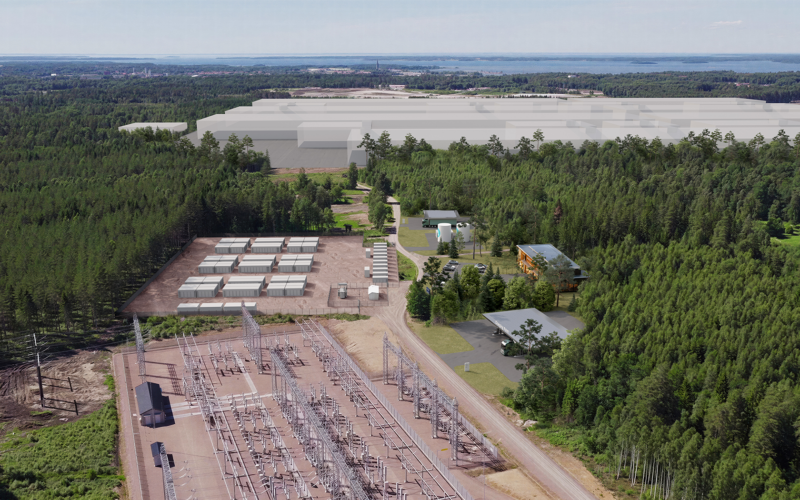
AB Volvo (STO: VOLV-B) plans to develop a large-scale energy park in Mariestad, Sweden, starting with approximately 70 MW of power and 260 MWh of battery storage capacity. The project will use Volvo Battery Energy Storage Systems from Volvo Energy and is expected to become operational during 2027, with stored electricity capable of supporting regional grid stability and flowing back into the local network through flexibility services. Volvo also intends to use the site as a full-scale test bed and customer demonstration environment for future energy products and business models. The project is located close to Volvo’s intended battery-cell manufacturing site, but that factory is not expected to begin production until after 2030, meaning the energy park has to create value independently for several years before the cell plant is operational.
The planned storage configuration equates to approximately 3.7 hours of energy duration when 260 MWh is divided by 70 MW. That places the project in a range suitable for shifting meaningful volumes of electricity across parts of the day rather than functioning only as very short-duration frequency response. Volvo has not disclosed the project cost, expected revenue from grid services or the economics of the batteries being installed.
Why is Volvo building the energy park before the planned battery-cell factory opens?
The timetable shows that the energy park is not merely supporting a future battery plant. Storage is targeted to begin operation during 2027, while battery-cell production at Mariestad is scheduled only after 2030. That creates at least several years during which the energy park must function primarily as grid infrastructure and a test environment rather than as an adjunct to cell manufacturing.
Volvo has a large industrial footprint in western Sweden, including its nearby Skövde powertrain plant, while the region has substantial electricity demand from manufacturing and logistics. Battery storage can improve resilience by absorbing electricity when supply is more abundant and returning it when the regional system needs additional capacity.
That ability could become more important as transportation and industrial processes electrify simultaneously. Heavy-duty vehicle charging, factory electrification and new battery manufacturing all increase the amount of power that local grids may need to accommodate without corresponding increases in generation at every moment.
Building storage early therefore allows Volvo to learn how energy assets interact with its industrial footprint before its most electricity-intensive future projects are completed. The project can generate operating data while the surrounding Mariestad industrial cluster continues developing.

What does a 70 MW and 260 MWh configuration reveal about Volvo’s intended business cases?
The ratio between storage energy and power indicates that the first stage is more than a high-power battery designed to discharge for only minutes. At roughly 3.7 hours of duration, the system can theoretically deliver its full 70 MW rating for close to four hours before exhausting the 260 MWh energy capacity, subject to operating limits and efficiency losses.
That creates several possible use cases. The batteries can support local grid flexibility, help shift consumption away from constrained periods and participate in electricity-market services where permitted. Volvo specifically says stored power can be returned to the local grid, confirming that the project is being designed as an active energy-market asset rather than only backup power.
The economics of those services can vary sharply. Frequency services may offer high value for short bursts, while energy arbitrage depends on differences between low-price and high-price hours. Grid-support agreements can create another revenue source if network operators value local flexibility.
Volvo has not published its expected return or revenue mix, so the 3.7-hour calculation should be treated as a technical indicator rather than an earnings forecast. Actual dispatch strategy will depend on electricity prices, battery degradation and regional grid needs.
Could Mariestad become a customer laboratory for Volvo Energy rather than only a corporate energy project?
Volvo explicitly intends to use the energy park as a real-scale customer demonstration and test facility. That creates a commercial purpose separate from lowering the group’s own electricity costs because customers can observe how Volvo Battery Energy Storage Systems perform under operating conditions rather than relying exclusively on specifications or small pilots.
The approach can support product development. Engineers can test control software, charging and discharging strategies, grid interaction and battery degradation while collecting data from a system large enough to resemble customer installations.
That matters because Volvo’s energy-storage opportunity extends beyond selling trucks or construction equipment. Fleet operators, charging depots and industrial customers may need batteries to reduce peak grid demand, stabilize charging loads or integrate renewable generation alongside electric vehicles.
Mariestad can therefore become part of the sales process for Volvo Energy. If customers purchase storage systems after seeing business cases demonstrated at the site, the park would generate value indirectly through product commercialization as well as directly through grid services.
Can Volvo finance the project comfortably while maintaining investment in its core vehicle business?
Volvo Group reported second-quarter 2026 net sales of SEK126.3 billion, up 3% year on year and 7% organically. Adjusted operating income increased to SEK14.78 billion from SEK13.48 billion, while the adjusted operating margin improved to 11.7% from 11.0%. Industrial Operations generated SEK5.84 billion of operating cash flow during the quarter.
Those figures show that Volvo is funding electrification initiatives from a large and profitable industrial business rather than relying on project financing from a pre-revenue energy startup. The company has not disclosed the Mariestad energy-park budget, preventing any calculation of the project’s size relative to annual capital expenditure.
The undisclosed cost also limits return analysis. A battery project can create grid benefits while still producing an unattractive financial return if installed costs are high or energy-market revenue proves volatile.
Volvo’s rationale appears broader than direct project yield because Mariestad also supports customer testing and future industrial infrastructure. Investors should therefore expect the economic case to combine energy-market revenue with product development and strategic resilience rather than judge the facility like a standalone merchant battery developer.
How did Volvo shares trade after the Mariestad plan was announced?
Volvo B shares closed at SEK339.20 on September 10, down 0.53% for the session and about 2.6% below the September 3 close of SEK348.30. The announcement was issued before the Stockholm market opened, so investors had the opportunity to trade on the information during the September 10 session.
The modest decline should not be assigned specifically to the energy park. Volvo did not disclose project cost or expected earnings, and a single 260 MWh storage project is small relative to a group generating more than SEK126 billion of quarterly revenue.
The stronger valuation indicators will emerge later. Construction cost, commissioning in 2027, utilization of flexibility services and customer orders arising from the test facility can show whether Mariestad creates measurable value.
The project becomes more strategically interesting over time because the nearby battery-cell factory is planned after 2030. Volvo is effectively building an energy ecosystem in stages, with storage and testing arriving first and large-scale cell production potentially following several years later.
Key takeaways on Volvo Group’s Mariestad energy park
- Volvo plans approximately 70 MW of battery-storage power at Mariestad.
- Initial energy capacity is expected to be roughly 260 MWh.
- That equates to approximately 3.7 hours of storage duration on a simple calculation.
- Volvo Battery Energy Storage Systems from Volvo Energy will be used.
- The energy park is expected to become operational during 2027.
- Stored electricity can support the regional grid through flexibility services.
- Volvo will also use the site for customer demonstrations and energy-solution testing.
- The nearby battery-cell plant is not expected to begin production until after 2030.
- Volvo reported SEK126.3 billion of second-quarter 2026 sales and SEK14.8 billion of adjusted operating income.
- Project cost, grid-services revenue and customer adoption remain undisclosed.
Discover more from Business-News-Today.com
Subscribe to get the latest posts sent to your email.
