




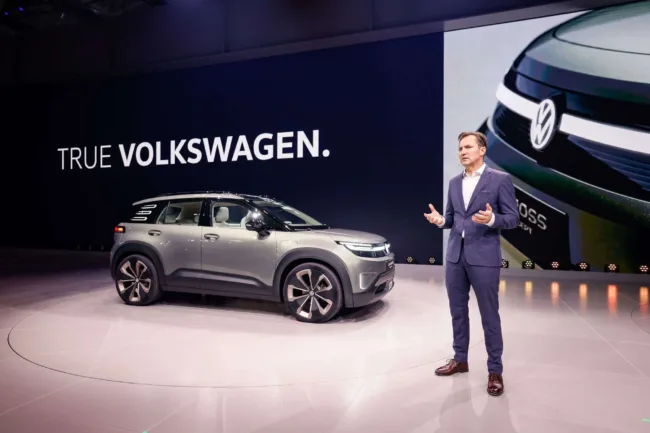
Volkswagen AG’s (ISIN: DE0007664039) preferred shares climbed 2.33% to close at €102.40 on September 8, 2025, reflecting a renewed sense of investor optimism. The uptick coincided with the company’s major presentation at IAA MOBILITY 2025 in Munich, where it revealed a sweeping overhaul of its brand strategy and electric vehicle (EV) lineup. Market participants responded positively to the unveiling of Volkswagen’s “True Volkswagen” initiative—a repositioning aimed at restoring brand identity while aggressively pursuing mass-market electrification.
The bounce in share price also comes after months of subdued price action, where €100 served as a stubborn psychological resistance. Bid and ask quotes hovered between €102.25 and €102.55 with tight volume parity, indicating active but measured institutional participation. The new strategy announcement seems to have given the market a reason to re-evaluate the German automaker’s long-term trajectory.
How is the “True Volkswagen” strategy expected to reshape the company’s brand identity and global product positioning?
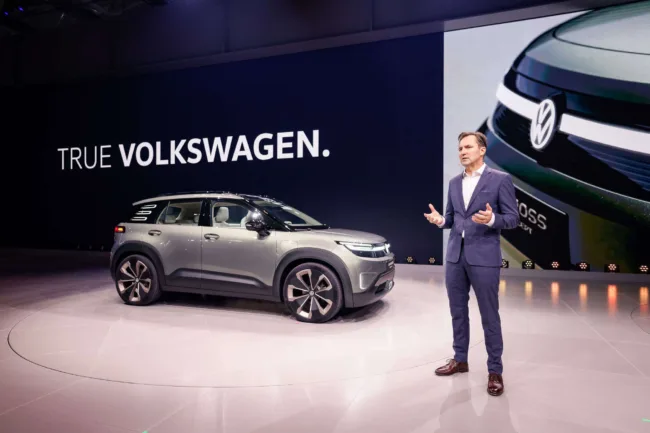
Volkswagen is leveraging the IAA platform not just for product showcases but to signal a deeper brand transformation. The “True Volkswagen” narrative introduced by CEO Thomas Schäfer anchors the company’s future around five pillars: clean and familiar design, high manufacturing quality, intuitive user interfaces, attractive price-performance ratios, and advanced in-house technology platforms.
This repositioning is a response to internal and external feedback that Volkswagen’s identity had become diluted in its rush toward electrification. Under the new strategy, familiar model names such as Polo and Passat will transition into the EV era with consistency and continuity. The ID. naming convention will remain—but with a sharper executional focus. The new ID. Polo, ID. Polo GTI, and ID. CROSS Concept, along with the budget-targeted ID. EVERY1, will anchor Volkswagen’s push into the small and compact EV segments. The ID. EVERY1 is expected to start at just €20,000—an aggressive pricing move aimed at capturing the entry-level EV market.
At the same time, Volkswagen is not abandoning internal combustion engine (ICE) vehicles. It will continue refining its hybrid and ICE offerings with redesigned versions of the T-Roc, Tiguan, Tayron, and Passat—models that remain popular in regions where EV adoption is slower. This dual-track strategy allows Volkswagen to serve divergent global markets while building a uniform brand story around flexibility, affordability, and German engineering quality.
What did Thomas Schäfer reveal at IAA 2025—and how does it reflect Volkswagen’s five-year roadmap?
Speaking in Munich, Volkswagen brand CEO Thomas Schäfer outlined a clear ambition: to become “the leading high-volume manufacturer for pioneering technology” by 2030. He asserted that the development work behind the 2025 model launches represents the beginning of this goal—not the end. According to Schäfer, the company has completed a three-year phase of engineering, design alignment, and digital systems consolidation. The focus now shifts to execution, scale-up, and market adoption.
The message from Wolfsburg is clear: Volkswagen is back, with a coherent EV strategy that doesn’t abandon its mainstream buyers. The company’s decision to maintain continuity in naming conventions—by adapting iconic nameplates like Polo for the EV age—is meant to preserve brand loyalty while signaling progress. Meanwhile, the ID. CROSS Concept, a compact SUV positioned just below the ID.4, is expected to fill a volume and pricing gap in the European crossover market.
Volkswagen is also launching a refreshed version of its popular ID.3 GTX under the special edition banner “FIRE+ICE,” which, while more symbolic, reflects the company’s renewed interest in brand storytelling through design trims and personalization options.
How is the new model strategy expected to impact Volkswagen’s production economics and unit margins?
The strategic pivot toward small and affordable electric cars is not without risk—especially in terms of margin compression. However, Volkswagen’s leadership believes the trade-off will be worthwhile in terms of market share and long-term loyalty. Unlike premium electric segments dominated by Tesla or luxury offshoots like Mercedes-Benz EQ and BMW i, the small and compact category is seen as the true battleground for volume-led electrification.
Volkswagen’s ability to achieve margin efficiency will largely depend on its MEB platform scalability, supplier base consolidation, and vertical integration in software. Industry watchers will also be paying close attention to whether the company’s new battery sourcing partnerships in Europe and China will yield sustainable cost advantages over competitors.
In 2024, Volkswagen delivered approximately 4.8 million vehicles, including both EV and ICE models, across 28 production facilities in 12 countries. Its global employee base stands at around 170,000, giving it deep scale leverage—particularly in markets like Germany, China, Brazil, and India. The ongoing rollout of its ACCELERATE strategy aims to streamline production, shift to fewer but more flexible platforms, and increase software-driven feature monetization over vehicle lifecycles.
How are analysts and institutions responding to Volkswagen’s realignment and near-term stock prospects?
Institutional sentiment appears to be cautiously optimistic. The 2.33% rise in the stock price reflects not only the immediate reaction to the IAA showcase but also improved clarity on product timelines, brand coherence, and affordability metrics. Some analysts view the new EV roadmap as Volkswagen’s strongest mass-market proposition since the original ID.3 was announced in 2019.
Trading volume on September 8 was evenly distributed across buy and sell orders, with Smartbroker showing 501 stock units each on bid and ask—suggesting institutional buy programs are being met with some profit-taking but no major offloading. Domestic institutional investors (DIIs) in Europe are reportedly maintaining “Hold” positions, while retail brokers in Germany have noted increased inflows from millennial investors attracted to the ID. EVERY1 affordability pitch.
Foreign institutional investors (FIIs), particularly from North America, remain more skeptical. Their concerns focus on execution risk—especially Volkswagen’s patchy software history, compliance challenges in China, and the uncertain impact of the EU’s regulatory push on sourcing and EV subsidies. However, no major downgrades or red flags have emerged from major brokerages post-IAA, indicating a watch-and-wait stance rather than active bearishness.
What are the next triggers that could drive Volkswagen stock in either direction?
The next major catalysts for Volkswagen’s stock will center around execution milestones. Investors are looking for concrete production dates for the ID. Polo and ID. EVERY1, along with commercial rollout details for the ID. CROSS Concept. Analysts will also track any updates regarding the localization of battery manufacturing and whether Volkswagen will opt for in-house packs or deepen existing partnerships.
Another focus area is digital cockpit maturity and over-the-air (OTA) update capabilities—especially in light of Volkswagen’s earlier issues with the ID.3 software stack. Any meaningful demonstration of a robust software-defined vehicle (SDV) architecture could significantly change analyst sentiment in favor of the stock.
Additionally, the automaker’s ability to maintain ICE momentum—particularly with refreshed models like the T-Roc and Tiguan—will serve as a financial cushion while EV margins mature. If these dual-track strategies succeed in parallel, the stock may enter a phase of sustained upward revision.
Is Volkswagen stock a buy, sell, or hold heading into Q4 2025?
Volkswagen’s preferred shares currently trade in a range where many institutional models peg fair value. The recent 2.33% gain brings the price to €102.40—a level seen by many as a consolidation zone, rather than a breakout trigger.
From a technical standpoint, breaching €105 in coming weeks could suggest further bullish momentum. Fundamentally, however, the story rests on execution. For long-term investors aligned with the EV transition theme, especially those targeting mid-cap exposure to Europe’s automotive backbone, Volkswagen may represent an accumulate-on-dips candidate.
In the short term, most analysts appear to be leaning toward a “Hold with positive bias” until more production-specific updates are released. The company’s willingness to blend brand heritage with affordability in the electric age has strengthened its narrative—but it’s the next 6–12 months that will determine whether the turnaround is sustainable or symbolic.
Discover more from Business-News-Today.com
Subscribe to get the latest posts sent to your email.
