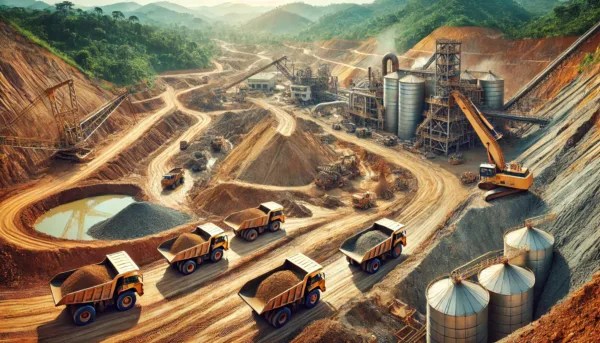
Viridis Mining and Minerals Limited (ASX: VMM) has selected Sedgman and Brazilian engineering group Blossom Consult as preferred engineering, procurement and construction management partners for the Colossus Rare Earths Project in Minas Gerais, taking another concrete step toward converting one of Brazil’s largest advanced ionic-clay rare-earth developments from feasibility work into an executable construction program. The appointment followed a competitive process involving 11 international and Brazilian engineering and project-delivery groups.
Viridis Mining and Minerals Limited has authorised up to US$3 million for an immediate pre-final-investment-decision bridging program rather than waiting for the formal investment decision before undertaking all detailed work. The scope includes advancing engineering toward design freeze, finalising plant layouts, managing long-lead equipment, developing procurement plans and improving site readiness. Sedgman and Blossom Consult have also completed a review of the definitive feasibility study aimed at identifying capital optimisation opportunities.
The market has not rewarded every Colossus execution milestone automatically. Viridis Mining and Minerals Limited shares closed at A$3.57 on September 11 after trading above A$4.00 in late August, even though the company has recently completed its definitive feasibility study, announced major strategic equity support, placed initial equipment orders, secured Brazilian development-bank financing and selected its preferred EPCM team. The pattern suggests investors have shifted from valuing studies and funding intentions toward demanding evidence that the US$449 million development can reach final investment decision and construction without material capital escalation.
How large is the Colossus Rare Earths Project and what did its definitive feasibility study establish?
Viridis Mining and Minerals Limited completed the Colossus definitive feasibility study in August 2026, transforming the project from a promising rare-earth resource into a development proposition with defined engineering, reserves, capital and financial estimates. The study is based on an approximately 200.1 million tonne ore reserve grading 2,894 parts per million total rare-earth oxides and supports a 25-year production profile. Initial development capital, including contingency, is estimated at around US$449 million.
Under the study’s principal economic assumptions, Viridis Mining and Minerals Limited reported an after-tax net present value at an 8% discount rate of approximately US$1.196 billion and an after-tax internal rate of return of 36.4%. Payback is estimated at roughly 2.7 years after production commences, with the project designed around processing approximately five million tonnes of ore annually. These are feasibility-study forecasts rather than realised returns and remain sensitive to rare-earth prices, recoveries, payability, operating costs, construction performance and financing terms.
Colossus is located within the Poços de Caldas alkaline complex in Minas Gerais, where ionic-adsorption clay mineralisation contains neodymium, praseodymium and the valuable heavy magnet rare earths dysprosium and terbium. Viridis Mining and Minerals Limited intends to produce a mixed rare-earth carbonate that can subsequently be separated and refined into individual rare-earth products.
The presence of both light and heavy magnet rare earths is important because the project’s economics do not rely solely on neodymium-praseodymium pricing. Dysprosium and terbium are used to improve the temperature performance of permanent magnets and carry strategic importance because global separated supply remains highly concentrated.
Why is Viridis Mining and Minerals Limited doing engineering work before the Colossus final investment decision?
The answer is schedule protection. Large projects can lose months if management waits until board approval before ordering engineering packages, completing detailed design or securing long-lead equipment. Viridis Mining and Minerals Limited is instead advancing selected activities ahead of final investment decision where management believes the expenditure reduces later schedule risk.
This approach can be sensible when feasibility work is mature and funding visibility is improving, but it also introduces capital-at-risk. If permitting, debt financing, offtake or project economics subsequently prevent final investment decision, some pre-FID expenditure may not deliver its intended value. The US$3 million bridging commitment is therefore small relative to the US$449 million project but symbolically important because it demonstrates that Colossus has entered an execution-oriented phase.
Sedgman brings large-scale mineral-processing and EPCM experience, while Blossom Consult contributes Brazilian engineering capability and local project-delivery knowledge. Viridis Mining and Minerals Limited has said the preferred partnership will operate across Perth, Canada, Belo Horizonte and the Poços de Caldas project site, combining international procurement and process expertise with local engineering execution.
The next step is not simply signing a contractor. Engineering must continue toward sufficient definition for construction commitments, while the project’s installation licence, debt package, offtake arrangements and final investment decision progress in parallel.
How much of the US$449 million Colossus funding requirement has Viridis Mining and Minerals addressed?
Viridis Mining and Minerals Limited announced up to US$120 million of strategic equity commitments in August, including funding from One Investment Management, ORE Investments, Régia Capital and a group of predominantly Brazilian institutional investors. Together with existing cash and previously available commitments, the company said identified equity sources totalled approximately US$154 million, exceeding the roughly US$135 million indicative equity requirement under its contemplated 70% debt and 30% equity funding structure.
That is a meaningful de-risking step, but it does not mean Colossus is fully financed. Viridis Mining and Minerals Limited must still convert prospective senior-debt support into binding facilities and satisfy lender conditions. The company has referred to engagement with export-credit and development-finance institutions including Export Finance Australia, Export Development Canada and Bpifrance.
A separate R$77.5 million financing facility approved by Brazil’s BNDES supports a Rare Earths Research and Processing Centre in Poços de Caldas. The 16-year facility carries an indicative financing cost around 4.8% annually and further demonstrates Brazilian institutional support for developing a domestic rare-earth supply chain, although the facility should not be conflated with the entire senior construction-debt requirement for the commercial mine.
This financing mosaic explains why the EPCM appointment matters. Lenders and strategic investors need increasingly detailed capital estimates, execution schedules and procurement strategies before committing large amounts of development capital.
Why has Brazil become such an important battleground for Western rare-earth supply?
Brazil possesses one of the world’s largest geological endowments of rare earths but historically contributed relatively little separated commercial production. That gap is beginning to close as projects including Colossus, Meteoric Resources’ Caldeira development, Aclara Resources’ Carina project and the operating Serra Verde business move through different stages of the supply chain.
Colossus is differentiated by its large reserve, ionic-clay metallurgy and meaningful dysprosium-terbium contribution. The broader strategic attraction is that Western automakers, defence suppliers, renewable-energy manufacturers and governments want magnet supply chains that are less dependent on Chinese mining, separation and magnet manufacturing.
Viridis Mining and Minerals Limited is also examining downstream processing rather than treating mixed carbonate as the end of the strategic story. Product qualification, separation partnerships and potential Brazilian value-add could eventually determine how much margin remains within the company’s supply chain rather than being captured by third-party refiners.
The September EPCM appointment therefore matters less as a contractor announcement than as evidence that the execution clock has started. Viridis Mining and Minerals Limited is targeting final investment decision in the fourth quarter of 2026 and commercial production during 2028. Investors now have identifiable milestones against which that timetable can be judged: installation licensing, binding senior debt, offtake conversion, detailed engineering, procurement and construction mobilisation.
Discover more from Business-News-Today.com
Subscribe to get the latest posts sent to your email.