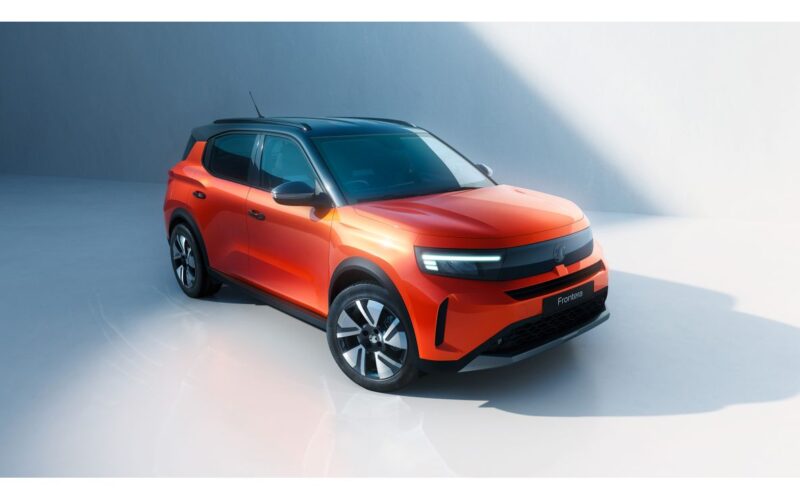
Vauxhall has anchored its 2026 UK comeback on a single commercial decision: list-priced parity between the Frontera Electric and the Frontera Hybrid, with the EV now the cheaper of the two once the UK government’s Electric Car Grant is applied. The Frontera Electric starts from £22,495 in Design trim after the £1,500 grant, against £24,855 for the equivalent 110hp mild hybrid, putting the battery-electric model £2,360 below its combustion sibling on like-for-like specification. The pricing structure inverts the cost logic that has defined the UK EV market for a decade and points to a manufacturing position that very few of Vauxhall’s competitors can replicate without absorbing substantial losses.
The decision matters far beyond a single nameplate. UK battery electric vehicle market share stood at 22.4% across the first quarter of 2026 against a Zero Emission Vehicle mandate target of 33%, according to Society of Motor Manufacturers and Traders data, and the Society of Motor Manufacturers and Traders has stated that manufacturers collectively subsidised EV sales by more than £5 billion in 2025, equivalent to roughly £11,000 per battery electric vehicle registered. Against that backdrop, a Stellantis brand offering an EV at parity with its mild hybrid is not a marketing flourish. It is evidence of where industrial cost structure, platform strategy, and regulatory arbitrage are converging, and it tells the rest of the market what the floor for a credibly priced European-built B-segment EV now looks like.
What is the actual price structure on the Vauxhall Frontera and how does the EV end up cheaper than the mild hybrid?
The Frontera Electric is offered in two battery sizes. The 44kWh entry version delivers 186 miles of WLTP range and starts from £22,495 after the Electric Car Grant in Design trim, with mid-spec GS at £24,895 and top-spec Ultimate at £25,695, according to RAC review data. The 54kWh version pushes range to 247 miles and starts around £27,500. The Frontera Hybrid, by contrast, uses a 1.2-litre three-cylinder turbo petrol mated to a 48V mild hybrid system with a 28bhp electric motor and a six-speed dual-clutch transmission. It is offered in 108bhp and 143bhp tunes, and the entry 110hp Design trim starts from £24,855, rising to £27,255 for GS and £28,055 for Ultimate.
The headline figure is the Design trim gap. The Frontera Electric Design undercuts the Frontera Hybrid Design by £2,360 once the grant is applied, and the EV remains cheaper than the hybrid at every trim level on the price sheet. This is the inversion. For most of the past five years, equivalent EVs have carried a premium over their internal combustion or hybrid siblings in the £4,000 to £8,000 range, reflecting battery cost loadings that the SMMT recently noted are still running roughly 30% above the levels assumed when the ZEV mandate trajectory was originally set.
Vauxhall described the original commercial proposition at launch as “price parity” between electric and petrol versions. The grant has since pushed the EV below parity, but the engineered parity sits underneath that grant adjustment and is the more important structural fact.

Which Stellantis platform decision allowed Vauxhall to engineer cost parity between an EV and a mild hybrid in the B-segment?
The Frontera sits on Stellantis’s Smart Car platform, an evolution of the former PSA Common Modular Platform developed with Tata Consultancy Services and engineered explicitly to compete on cost with Chinese B-segment EVs entering the European market. The Smart Car platform is multi-energy by design, capable of accepting both battery electric and combustion or mild hybrid powertrains on the same line, and it is being industrialised at the Trnava plant in Slovakia. The same platform underpins the Citroën C3, the Citroën C3 Aircross, the Fiat Grande Panda and the new Opel Frontera, the European-market sister to the Vauxhall.
A Stellantis published statement on its modular platform strategy quantified the savings precisely: shared platforms account for roughly 60% of vehicle material costs and reduce per-model development spend by 20 to 50% versus a clean-sheet predecessor. Spread across seven planned Smart Car derivatives, those savings allow Stellantis to amortise EV-specific costs, particularly the lithium iron phosphate battery, electric drive unit, and supporting electronics, across an unusually large fleet of B-segment volume. The hybrid and electric variants share floorpan, body-in-white, suspension geometry, interior architecture, and the bulk of the wiring harness. The substantive cost difference reduces to powertrain and energy storage. In a B-segment vehicle with a sub-50kWh LFP battery sourced through Stellantis’s broader procurement scale, that cost gap has compressed to the point where a £1,500 government grant is enough to flip the EV below the mild hybrid at retail.
A Bloomberg analysis of the European cost-down EV race has noted that LFP chemistry has been the principal lever for European manufacturers attempting to match Chinese price points, and the Frontera Electric’s powertrain configuration matches that pattern. Mild hybrid systems, by contrast, carry their own combined cost burden of an internal combustion engine, transmission, 48V architecture, integrated starter-generator, and emissions aftertreatment hardware, all of which scale in cost more linearly with regulatory tightening than LFP cells do at current European procurement volumes.
Why is the UK Electric Car Grant amplifying rather than creating the Frontera’s pricing advantage?
The £650 million UK Electric Car Grant launched in July 2025 and runs until 31 March 2029, with two bands. Band 1 offers £3,750 off vehicles with the strongest sustainability scoring on battery and assembly emissions, and Band 2 offers £1,500 for vehicles meeting baseline criteria with a list price below £37,000. According to Autocar’s compiled list of all Electric Car Grant-eligible models, Stellantis brands secured 20 of the roughly 35 qualifying models on launch, the largest single-group share of the scheme. The Frontera Electric qualifies for the £1,500 Band 2 discount.
The grant alone is not what creates the Frontera’s pricing position. The £1,500 grant is the same amount available to the Volkswagen ID.3, the Skoda Elroq, the SEAT Born, the Hyundai Ioniq 5, the Kia EV5, the Citroën ë-C5 Aircross and most other Band 2 vehicles. What separates the Frontera is the pre-grant list price. At a sub-£24,000 entry point before grant, only a handful of models occupy the same cost bracket, principally the Citroën ë-C3 at £21,990 after grant, the Citroën ë-C3 Aircross at £21,600, the Dacia Spring with its £1,500 Dacia-funded incentive, and the Hyundai Inster which qualifies for the full Band 1 £3,750 discount. Three of the four cheapest entries in that list are Stellantis Smart Car platform derivatives. The Vauxhall Frontera is the fourth.
The grant policy therefore acts as a multiplier on a cost position that Stellantis has engineered upstream. A manufacturer without that platform position cannot reproduce the Frontera’s outcome by accepting the same grant, because the grant-eligible price would still sit thousands of pounds above the equivalent hybrid.
How does the Frontera’s price parity reshape the competitive landscape in the UK B-segment SUV market?
The B-segment crossover is the single largest passenger car category in the UK. The Frontera’s pricing puts the Electric variant directly into the buyer consideration set of the petrol Renault Captur, the petrol Ford Puma, the Skoda Kamiq, and the petrol Dacia Duster, while undercutting most pure-electric alternatives in the same body size. Carwow review data places the Frontera Electric at £22,495 starting versus £27,000 for the Renault 4 E-Tech, with the Hyundai Inster, MG S5 EV, and BYD Atto 2 clustered in or above the £25,000 to £28,000 range.
The Ford Puma Gen-E, Vauxhall’s most direct UK volume competitor, lists at a higher starting point and trades on practicality through its 523-litre Gigabox boot, but the Frontera’s 460-litre boot and seven-seat hybrid option give it an interior packaging argument that Ford cannot match in the segment. The Volkswagen ID.3, while a class above on platform sophistication and range, sits comfortably above £30,000 even with the Band 2 grant applied. Hyundai’s Inster, with its full Band 1 £3,750 grant discount, is competitive on price but is significantly smaller than the Frontera and lacks SUV positioning.
The strategic implication for non-Stellantis European OEMs is uncomfortable. Volkswagen, Renault, Ford, and Hyundai-Kia are all attempting to land sub-£25,000 EVs in the UK market but are doing so on platforms that either lack the Smart Car’s hybrid-EV co-engineering or carry higher unit costs from lower platform-sharing volumes. Renault’s Ampere platform powers the Renault 5 and Renault 4 successfully, but the Renault 5 starts higher than the Frontera Electric and the Renault 4 sits notably above. Ford’s Gen-E proposition is structurally more expensive because it does not have a hybrid sibling on the same platform sharing tooling cost. The competitive squeeze is heaviest on legacy European volume brands trying to defend B-segment share without Stellantis’s multi-energy platform leverage or BYD’s vertically integrated battery cost base.
What does the Frontera pricing tell us about the UK ZEV mandate compliance economics for the rest of 2026?
The SMMT data for the first quarter of 2026 is unambiguous on the gap between regulation and demand. Battery electric market share at 22.4% sits 10.6 percentage points below the 33% ZEV mandate target. The same data shows total UK BEV registrations of 86,120 in March 2026, a record monthly figure, but still well below the volume curve required for full-year mandate compliance. SMMT chief executive Mike Hawes has called for an urgent review of the transition, citing battery costs running 30% above mandate-design assumptions, industrial energy prices 80% above 2021 levels, and public charging costs 140% higher than five years ago.
In that environment, every manufacturer in the UK market faces the same question: can I reach my ZEV percentage without subsidising every EV registration to a degree that erodes group margin? The £11,000 per BEV implied subsidy SMMT cited for 2025 is the answer most OEMs are currently giving, and it is unsustainable at scale. Stellantis’s Smart Car platform is one of the few European responses that begins to compress that figure structurally rather than tactically. If the Frontera achieves volume in the UK in 2026, it will do so with materially less per-unit subsidy than a Volkswagen ID.3 or a Ford Puma Gen-E, and that gap will widen Stellantis’s compliance flexibility while narrowing everyone else’s.
This has secondary consequences. UK manufacturers that cannot match Stellantis on B-segment EV pricing will increasingly rely on either fleet channel discounts, salary sacrifice schemes, or compliance pooling agreements to hit ZEV targets. Pooling allows a manufacturer falling short of its ZEV percentage to buy credits from a manufacturer running ahead. Stellantis, with the largest grant-eligible model count and the cheapest credible B-segment EV in the market, is well positioned to be a net seller of compliance credits in 2026 rather than a buyer. The financial value of that position scales with how far the broader market falls short of 33%.
What are the risks to the Frontera pricing strategy and where could it unwind?
The Frontera’s price position is not unconditional. Three structural risks could compress or reverse the EV-hybrid parity by 2027.
The first is grant policy revision. The £650 million Electric Car Grant has a fixed budget, and the SMMT and the Department for Transport have both signalled that funding could be exhausted before the scheme’s nominal 2029 end date if uptake accelerates. A reduction in the £1,500 Band 2 discount would push the Frontera Electric back above the Frontera Hybrid on retail price, removing the most visible part of the parity story even if the engineered cost position underneath remains.
The second is battery cost trajectory. SMMT data on 2026 battery costs running 30% above original mandate assumptions reflects raw material price volatility, particularly in lithium carbonate and LFP cathode supply, that has been compounded by the ongoing 2026 Iran conflict and its energy market spillover. If battery cell costs rise further in the second half of 2026, even Smart Car platform amortisation will struggle to hold the EV-hybrid parity without OEM-funded discounting eating into margin.
The third is competitive matching from Chinese manufacturers. BYD, MG, and Geely are pricing aggressively into the UK B-segment EV market, with the BYD Atto 2 and MG S5 EV both priced near or below the Frontera Electric on certain trim configurations. If Chinese manufacturers gain Electric Car Grant eligibility on additional models in 2026, the Frontera’s grant-adjusted price advantage narrows. The competitive relevance of the Frontera then depends on Vauxhall’s brand position and its UK fleet relationships rather than on absolute price leadership.
A Bloomberg analysis of European EV competitive dynamics has identified Stellantis’s Smart Car platform as the single most significant European response to the Chinese B-segment cost challenge, and the Frontera’s UK launch is the clearest commercial demonstration of whether that response is competitive in a developed European retail market.
What are the key takeaways from how Vauxhall priced the Frontera EV and mild hybrid identically?
- The Vauxhall Frontera Electric starts from £22,495 in Design trim after the UK Electric Car Grant, undercutting the equivalent 110hp mild hybrid by £2,360 and inverting the conventional EV cost premium in the B-segment SUV class.
- The pricing position is built on Stellantis’s Smart Car platform, an evolution of the PSA Common Modular Platform engineered for multi-energy compatibility and cost competitiveness against Chinese B-segment EVs.
- Stellantis has stated that platform sharing accounts for roughly 60% of vehicle material costs and saves 20 to 50% on per-model development spend, savings amortised across seven Smart Car derivatives including the Citroën C3, Citroën C3 Aircross, Fiat Grande Panda, and Opel Frontera.
- The £1,500 UK Electric Car Grant amplifies but does not create the Frontera’s pricing advantage, with Stellantis brands accounting for 20 of the roughly 35 grant-eligible models in market.
- UK battery electric market share stood at 22.4% in Q1 2026 against a 33% ZEV mandate target, leaving SMMT and OEMs publicly calling for an urgent transition review.
- SMMT data indicates manufacturers subsidised UK BEV sales by more than £5 billion in 2025, equivalent to roughly £11,000 per registration, a level the SMMT has described as unsustainable.
- Battery costs at the start of 2026 were running 30% above ZEV mandate design assumptions, industrial energy prices 80% above 2021 levels, and public charging costs 140% higher than five years ago, according to SMMT.
- The Frontera’s structural cost position gives Stellantis an advantage on UK ZEV compliance economics, with potential to be a net seller of pooled compliance credits in 2026 against weaker-positioned competitors.
- Risks to the pricing strategy include Electric Car Grant budget exhaustion, further battery cost inflation linked to the 2026 Iran conflict’s energy market effects, and competitive price matching from BYD, MG, and Geely.
- The broader competitive signal is that European B-segment EV pricing has reached a credible parity floor with mild hybrid alternatives on shared multi-energy platforms, ahead of every legacy European volume brand outside the Stellantis group.
Discover more from Business-News-Today.com
Subscribe to get the latest posts sent to your email.