


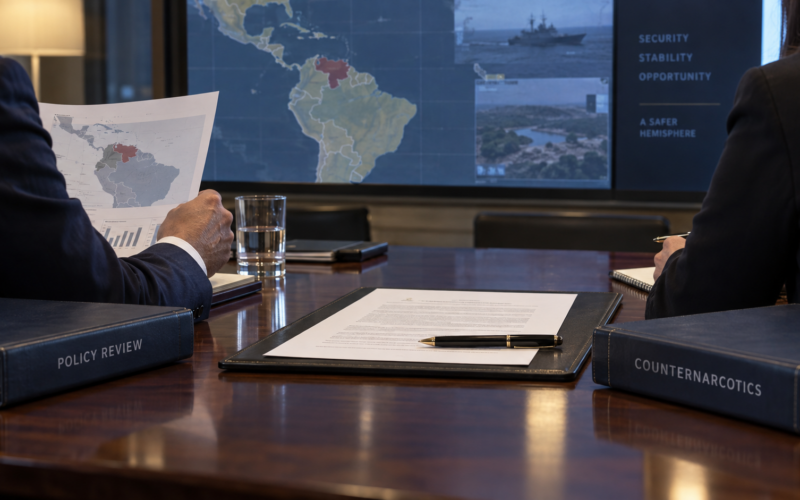
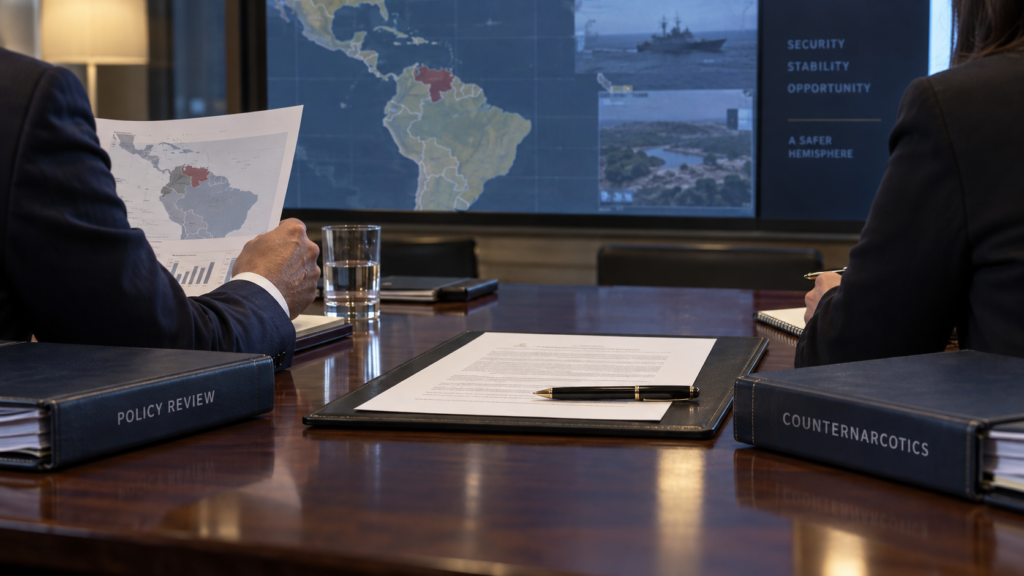
The United States has removed Venezuela from the group of countries it says have “failed demonstrably” to meet international counternarcotics obligations, marking the first time in more than two decades that Caracas has escaped that narrower designation. President Donald Trump’s fiscal 2027 determination leaves Afghanistan, Bolivia, Burma and Colombia in the failed-demonstrably category while crediting developments in Venezuela following the removal of Nicolás Maduro and cooperation with the interim government led by Delcy Rodríguez. The White House says it expects continued measurable progress from Caracas.
Venezuela has not, however, been removed from the broader US “Major’s List” of countries identified as significant drug-transit countries or major illicit drug producers. It remains among 23 countries on that list alongside Colombia, Mexico, Peru, Bolivia, China, India, Pakistan and others. The distinction is crucial because a headline saying Washington had simply removed Venezuela from its drug list would materially overstate what changed.
What is the difference between the Major’s List and the ‘failed demonstrably’ category?
The annual Major’s List identifies countries that the United States determines are major sources or transit points for illicit drugs affecting the United States. Presence on that list does not necessarily mean Washington believes the government concerned is refusing to cooperate because geography, commercial routes and production conditions can place a country on the list even when its authorities undertake substantial enforcement efforts.
A second determination identifies governments that the US president says have “failed demonstrably” during the previous 12 months to make substantial efforts to meet counternarcotics obligations. In the 2026 determination for fiscal 2027, only Afghanistan, Bolivia, Burma and Colombia received that designation. Venezuela was in the failed-demonstrably group a year earlier but is now absent from that smaller subset while remaining on the broader Major’s List.
Why did the Trump administration change Venezuela’s status?
Trump attributed the shift to changes following Maduro’s removal and arrest in January and to cooperation with the interim authorities led by Rodríguez. Reuters reported that the administration also cited recent security developments involving the Tren de Aragua criminal organisation as evidence of improving counternarcotics cooperation. These are assessments made by the Trump administration, and the annual determination does not by itself establish independently that trafficking from or through Venezuela has been eliminated.
The wording of the White House statement is deliberately conditional. Washington says Venezuela should no longer be classified as having failed demonstrably but expects continued measurable progress, meaning the designation could be reconsidered in a future annual review. Venezuela’s continued presence on the Major’s List also signals that the United States still regards the country as significant to regional drug flows.
Why does Colombia remain in the failed-demonstrably group?
Colombia remains one of four governments Washington says did not make sufficient counternarcotics progress during the review period. Trump’s determination nevertheless suggests that the designation could be reconsidered if President Abelardo De La Espriella’s government demonstrates stronger progress on coca eradication and dismantling trafficking organisations. That future possibility should not be confused with an existing decision to remove Colombia from the category.
The bilateral relationship is particularly important because Colombia has historically been one of Washington’s closest regional security partners and a central recipient of American counternarcotics assistance. Coca cultivation, cocaine production and armed groups involved in trafficking remain long-running policy challenges. The current designation therefore creates pressure on Bogotá while leaving Washington room to restore a more favourable assessment if measurable indicators improve.
Does Venezuela’s removal mean US sanctions and other restrictions automatically disappear?
The counternarcotics determination is separate from the wider network of US sanctions, immigration rules and other policies affecting Venezuela. Removal from the failed-demonstrably category therefore does not automatically cancel every economic or financial restriction associated with Venezuelan individuals, institutions or earlier US policies. Each sanctions programme operates under its own legal authority and would require separate action to change.
The diplomatic significance is nevertheless substantial because the annual determination provides an official measure of Washington’s view of Venezuelan cooperation. Moving out of the failed-demonstrably group signals that the Trump administration believes engagement with the current authorities is producing results worth recognising. Whether that eventually contributes to broader economic normalisation will depend on decisions extending well beyond the narcotics report.
Why are India and China still included on the 23-country Major’s List?
The list is based on whether a country is an important source, producer or transit location for illicit drugs or precursor chemicals rather than solely on an assessment of government intent. This explains why countries with very different relationships with Washington can appear in the same document. India, China and Pakistan remain on the 2027 Major’s List but are not among the four countries designated as having failed demonstrably.
That distinction prevents the list from being interpreted as a ranking of hostile governments. A country can cooperate extensively with US authorities while remaining strategically important to drug supply chains because of geography, chemical production or trafficking routes. The failed-demonstrably subsection is the part intended to identify what Washington considers inadequate government effort.
What changed from the 2026 determination to the 2027 determination?
The previous White House list identified Afghanistan, Bolivia, Burma, Colombia and Venezuela as five countries that had failed demonstrably to make substantial counternarcotics efforts. The new determination reduces that number to four by removing Venezuela while leaving the other four in place. Both years still include Venezuela within the larger group of major drug-transit or producing countries.
That year-to-year comparison provides the cleanest way to understand the policy shift. Washington has upgraded its assessment of the Venezuelan government’s performance without concluding that Venezuela no longer plays an important role in drug flows. Future annual determinations will reveal whether the change becomes durable or depends on continued cooperation with the current authorities.
What are the key takeaways from Washington’s Venezuela counternarcotics decision?
Venezuela has achieved a meaningful diplomatic improvement, but the scope is narrower than a complete removal from US narcotics designations. It is no longer one of the governments Washington says have failed demonstrably on counternarcotics, yet it remains one of 23 countries categorised as major drug-transit or illicit drug-producing states. Colombia, by contrast, remains in both groups for now.
The wording matters because the two lists answer different questions: one concerns the importance of a country to drug production or transit, while the other judges government effort. Venezuela’s change therefore reflects Washington’s assessment of cooperation rather than a conclusion that trafficking routes have disappeared. That makes the 2027 determination an important sign of improving US-Venezuela relations while preserving substantial policy pressure on Caracas.
Discover more from Business-News-Today.com
Subscribe to get the latest posts sent to your email.