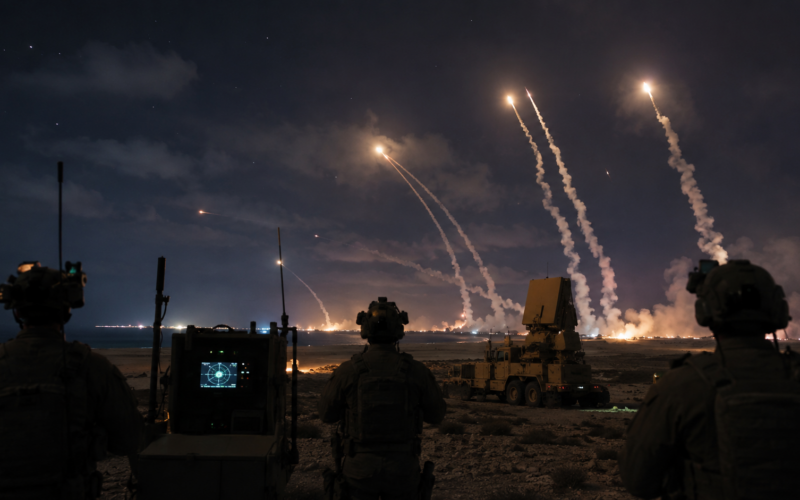
The United States has carried out a two-hour wave of strikes against dozens of Iranian military targets after Tehran launched ballistic missiles toward American forces in the Middle East, sharply escalating a conflict that had briefly appeared to be moving toward reduced hostilities. United States Central Command said the operation was completed at 10 p.m. Eastern Time on July 29, which was early July 30 in Iran, and targeted Islamic Revolutionary Guard Corps command centers, missile and drone facilities, coastal surveillance systems and maritime-defense capabilities. American officials said all missiles involved in Iran’s earlier attempted attack were intercepted, with the strike presented as a direct response intended to reduce threats to United States personnel, commercial shipping and neighboring Gulf countries. The renewed exchange has already spread beyond Iran, with Jordan intercepting additional missiles and Kuwait reporting a fatal strike, raising concern that a confrontation between Washington and Tehran is pulling more regional states directly into the conflict.
The latest attack was the first major direct United States strike inside Iran in nearly a week and followed several days of Iranian missile and drone operations against American and allied interests. President Donald Trump had publicly promised a forceful response after Iran fired missiles toward United States forces stationed in Jordan on July 28. Although the missiles were intercepted and did not cause reported American casualties, the administration treated the launch as an attempted surprise attack requiring retaliation.
Iranian state media reported explosions on Qeshm Island, Kish Island, in Bushehr and at several locations in Khuzestan province. Iranian authorities said a strike on a residential building on Qeshm Island killed a couple and their two-year-old child, while other people were pulled from the rubble. Those casualty claims had not been independently verified at the time of publication, and the United States military has not publicly acknowledged striking a residential target.
What United States forces targeted during the latest heavy wave of Iran strikes
United States Central Command said American forces struck dozens of sites connected to the Islamic Revolutionary Guard Corps. The target list included military command centers, ballistic-missile and drone infrastructure, coastal surveillance positions, defensive installations and capabilities supporting Iranian maritime operations. The command said the purpose was to weaken Iran’s ability to threaten American personnel, civilian shipping and Gulf countries.
The inclusion of coastal surveillance and maritime-defense sites is particularly significant because control of the Strait of Hormuz remains central to the conflict. Iran has used its position beside the waterway to pressure global shipping and strengthen its negotiating leverage, while the United States has imposed and enforced maritime restrictions intended to prevent Tehran from controlling or disrupting traffic through the strait. The channel carries a substantial share of internationally traded oil and gas, meaning even limited attacks or navigation disruptions can affect energy prices and insurance costs far beyond the Middle East.
The strikes also appear designed to reduce Iran’s ability to launch another large missile or drone attack against American bases. More than 50,000 United States service members are deployed across the Middle East, according to United States Central Command. American forces are positioned in countries including Jordan, Kuwait, Bahrain, Qatar, Saudi Arabia and the United Arab Emirates, creating multiple potential targets if Iran chooses to retaliate against Washington indirectly through regional bases.
United States officials have not released a complete damage assessment or identified the aircraft and weapons involved. The military described the operation as a precision strike, but the civilian casualty reports from Qeshm Island will increase pressure for additional information about target selection and whether any missiles or debris struck nearby homes.
Iran has previously accused the United States of minimizing civilian harm from its operations, while Washington has argued that Tehran places military infrastructure in or near populated areas. Without independent access to many of the affected locations, separating verified military damage from competing wartime claims remains difficult.
Iran retaliates across the Gulf as Jordan and Kuwait face direct consequences
The American operation did not bring the exchange to an immediate end. Iran’s Islamic Revolutionary Guard Corps said it launched further attacks against United States bases in Jordan and Kuwait, extending the latest cycle of retaliation into countries that host American personnel but have repeatedly called for de-escalation.
Jordan’s military said its air defenses intercepted five missiles entering from Iran and reported no casualties from that interception. Jordan has attempted to prevent its territory and airspace from becoming an active battlefield, but its role as a host for United States forces and its geographic position between Iran, Israel and other regional states have repeatedly exposed it to missiles and drones.
Kuwait reported that an Iranian strike hit a building belonging to a Chinese company in the northern part of the country, killing one worker. The casualty demonstrated how attacks aimed at military or strategic targets can affect civilians and foreign businesses located nearby. Kuwait also hosts American forces and has faced repeated security concerns as the war has expanded across the Gulf.
Egypt has also investigated an unidentified drone strike near Damietta Port that caused fires aboard vessels, adding another possible point of escalation near the Suez Canal. Responsibility for that incident had not been conclusively established, but its timing has intensified concern that attacks on shipping and ports are spreading from the Strait of Hormuz toward other critical trade routes.
The widening geography of the conflict creates a strategic problem for every Gulf government. Countries hosting United States forces depend on American security guarantees, yet their association with Washington can also make them targets for Iranian retaliation. Governments including Saudi Arabia, Jordan and Kuwait have therefore combined military cooperation with public calls for restraint.
Saudi Arabia’s direct participation in joint strikes against Iran-backed militia sites in Iraq earlier this week marked an important shift. Riyadh had previously supported American regional operations while attempting to avoid becoming an open combatant. Its decision to participate in strikes suggests that repeated attacks by Iranian-aligned groups have pushed the kingdom toward a more visible military role, even as Saudi officials continue warning against a broader war.
The latest US strikes weaken hopes that diplomacy can quickly end the Iran war
The renewed missile exchanges came after a brief reduction in direct attacks had raised hopes of a diplomatic opening. Pakistan and other intermediaries had been attempting to preserve communication between Washington and Tehran, while regional governments were pressing both sides to reduce violence around the Strait of Hormuz.
Those efforts now face a more difficult environment. The United States argues that Iran broke the period of relative calm by launching ballistic missiles toward American forces. Iran maintains that its military actions are responses to continuing United States pressure, strikes and maritime restrictions. Each side therefore presents retaliation as defensive while describing the other as the aggressor.
This cycle makes negotiated de-escalation harder because neither government wants restraint to appear like weakness. Washington believes that failing to respond to an intercepted attack could encourage Iran to launch additional missiles. Tehran believes that absorbing American strikes without retaliation could undermine deterrence and weaken the Islamic Revolutionary Guard Corps domestically and regionally.
Trump has continued to suggest that diplomacy remains possible, but his language before the latest strikes emphasized punishment rather than negotiation. The administration is attempting to combine military pressure, sanctions, maritime restrictions and the threat of further attacks to force Iran into an agreement addressing its nuclear program, ballistic missiles and support for regional armed groups.
Iran has resisted terms that it views as surrendering strategic independence or control over national territory and nearby waters. It has also rejected proposals that would substantially limit its missile capabilities or place the Strait of Hormuz under shared external management. The result is an increasingly unstable mixture of military escalation and intermittent negotiations.
The conflict has continued for approximately five months since the United States and Israel launched attacks on Iran on February 28, 2026. Repeated ceasefires, pauses and negotiating efforts have reduced violence temporarily but have not produced a lasting settlement.
Civilian casualties and economic pressure could reshape political support for the war
The humanitarian and economic consequences are becoming increasingly important to the political debate. Iranian civilians have faced airstrikes, displacement, infrastructure damage and restrictions on communications, while people across neighboring countries have been exposed to missile and drone attacks. United States personnel have also been killed and injured during earlier exchanges in Jordan and Iraq.
The latest reports from Qeshm Island will add to scrutiny of the American air campaign. Even where a military target is present, civilian deaths can undermine claims that precision weapons are containing the humanitarian impact. Iranian authorities are likely to use the reported deaths to build domestic support for retaliation and strengthen accusations that the United States is conducting an indiscriminate war.
Economic effects are also spreading. Oil prices have remained supported by fears that attacks could further disrupt the Strait of Hormuz or expand toward other shipping corridors. Higher crude prices eventually affect gasoline, aviation, manufacturing and transportation costs, placing additional pressure on households already concerned about inflation.
Public opinion presents a growing challenge for the Trump administration. Recent polling has shown weak approval for the president’s handling of the Iran war, with many Americans questioning whether the administration has explained its goals clearly or developed a credible plan for ending the conflict. Rising gasoline prices make the war more immediate for voters who might otherwise view military events in the Gulf as distant.
The administration may calculate that damaging Iran’s missile, drone and maritime infrastructure will create stronger negotiating leverage and reduce the risk to American forces. The opposing risk is that every new strike produces another round of retaliation, brings additional countries into the conflict and makes compromise politically harder for all sides.
The outcome will depend on whether the latest exchange is followed by another pause or becomes the beginning of a sustained campaign. The United States has demonstrated that it can strike Iranian targets at scale, while Iran has shown that it can continue launching missiles and drones across a wide regional area. Military capability has not yet translated into a durable political settlement for either side.
Key takeaways from the latest United States strikes on Iran
- United States Central Command completed the latest operation at 10 p.m. Eastern Time on July 29, which was early July 30 in Iran, making the heavy wave of strikes a fresh overnight development.
- American forces struck dozens of Islamic Revolutionary Guard Corps targets, including command centers, missile and drone facilities, coastal surveillance positions and maritime-defense infrastructure.
- The operation followed Iran’s July 28 launch of ballistic missiles toward United States forces in the Middle East, all of which American officials said were intercepted without reported casualties.
- Iran reported that a strike on Qeshm Island killed a couple and their two-year-old child, but the civilian casualty claim had not been independently verified and the United States had not confirmed hitting a home.
- Iran launched additional attacks after the American operation, while Jordan said its air defenses intercepted five missiles and Kuwait reported one worker killed when a building was struck.
- The conflict is spreading beyond direct exchanges between Washington and Tehran as Jordan, Kuwait, Saudi Arabia, Iraq and potentially Egypt confront attacks, interceptions or military involvement.
- Saudi Arabia’s participation in earlier joint strikes against Iran-backed groups in Iraq signals a deeper regional military alignment, even as Gulf governments continue calling for de-escalation.
- The targeting of coastal and maritime capabilities shows that the Strait of Hormuz remains central to the conflict because disruption there could raise oil, shipping and insurance costs worldwide.
- Repeated military pauses and diplomatic contacts have failed to produce a lasting settlement, with both the United States and Iran treating retaliation as necessary to preserve deterrence.
- Further escalation could deepen civilian suffering, strain American missile-defense resources and increase political pressure on the Trump administration as fuel prices and public dissatisfaction rise.
Discover more from Business-News-Today.com
Subscribe to get the latest posts sent to your email.