
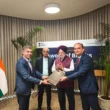


UroGen Pharma Ltd. (Nasdaq: URGN) is expanding beyond its established bladder-cancer franchise through a strategic collaboration with IntraGel Therapeutics, Ltd. that gives the commercial-stage biotechnology company access to another sustained-release local drug-delivery platform. UroGen will invest up to $7 million in IntraGel equity while receiving a research license and options to obtain exclusive worldwide rights to as many as three additional oncology products combining IntraGel’s SRGel technology with compounds selected by UroGen. The agreement separately gives UroGen an exclusive option to license TumoCure, an investigational intratumoral cisplatin therapy for advanced head and neck cancer, following completion of an IntraGel Phase 2 study. The transaction therefore gives UroGen relatively capital-light access to several potential programs without requiring it to acquire IntraGel outright or immediately assume full development responsibility for TumoCure.
The strategic logic is closely aligned with UroGen’s existing expertise. Its approved products and pipeline already use local drug delivery to prolong therapeutic exposure within the urinary tract, particularly through the company’s proprietary RTGel reverse-thermal hydrogel technology. IntraGel’s SRGel takes a different formulation approach but pursues the same broad objective: retaining therapeutics at or near a tumor for an extended period while potentially reducing systemic exposure. If that principle translates successfully into solid tumors outside the urinary tract, the collaboration could give UroGen a route into oncology markets that are much broader than its current urothelial focus.
How does UroGen’s agreement with IntraGel actually work?
The first component gives UroGen a research license to evaluate IntraGel’s SRGel platform and options for exclusive worldwide licenses covering up to three oncology products. UroGen would designate the therapeutic compounds to be combined with SRGel, allowing the company to test whether sustained localized delivery can improve medicines it identifies as suitable candidates. The structure preserves flexibility because UroGen can conduct research before committing the larger development resources that would follow exercise of an option.
The second component concerns TumoCure, IntraGel’s lead clinical asset. UroGen gains an exclusive option to obtain worldwide development and commercialization rights after IntraGel completes a Phase 2 clinical study, meaning UroGen is not yet acquiring the drug outright. Separately, UroGen has agreed to invest up to $7 million in IntraGel equity, creating economic exposure to the private company while the collaboration develops. No broader acquisition price or guaranteed downstream licensing payment was disclosed in the announcement, so the $7 million figure should not be treated as the total potential economic value of the relationship.
What is SRGel and why does it interest UroGen Pharma?
SRGel is an injectable, hydrophobic gel-like platform based on a water-free and solvent-free fatty-acid polymer matrix. IntraGel designed the formulation so a therapeutic can be injected directly into solid tumor tissue and released gradually over an extended period rather than dispersing rapidly throughout the body. The company says the platform has demonstrated compatibility with several therapeutic modalities, including small molecules, peptides and biologics.
That delivery concept fits naturally with UroGen’s corporate experience. UroGen built its commercial franchise around the idea that longer local exposure can change the therapeutic profile of medicines that are otherwise cleared too quickly from the treatment site. ZUSDURI and JELMYTO both use mitomycin in localized urothelial disease, while UroGen’s RTGel technology enables sustained drug exposure within urinary anatomy. SRGel could potentially extend the same strategic philosophy into tumors where direct intratumoral injection is feasible, although each combination would require its own preclinical, clinical and regulatory evidence.
Why is TumoCure the most advanced opportunity in the collaboration?
TumoCure combines cisplatin with the SRGel matrix and is administered through a single intratumoral injection. IntraGel is developing the therapy for locally advanced, inoperable head and neck cancers in patients who are not eligible for systemic cisplatin-based chemoradiation. The concept is intended to maintain high cisplatin exposure inside the tumor over several months while limiting the systemic exposure associated with conventional administration.
Early Phase 1b evidence presented at the 2026 American Society of Clinical Oncology Annual Meeting involved only eight patients, making the dataset exploratory rather than confirmatory. IntraGel reported that treatment was generally well tolerated, produced low systemic cisplatin exposure and generated preliminary signs of antitumor activity in a heavily pretreated population that included patients with cisplatin-resistant disease. Investigators also observed improvements in some tumor-related symptoms. Those findings justify further study but are not sufficient to establish clinical effectiveness, particularly given the very small patient population.
IntraGel describes TumoCure as Phase 2-ready and is pursuing development under the FDA’s 505(b)(2) regulatory pathway. That pathway can permit an applicant to rely partly on existing information about an already studied active ingredient, but the final evidence requirements still depend on the proposed product, formulation and indication. UroGen’s decision to make the licensing option exercisable after Phase 2 therefore allows the company to see substantially more clinical evidence before committing to worldwide development.
Why can UroGen afford to broaden its oncology pipeline now?
The timing is supported by a rapidly changing commercial profile. UroGen reported second-quarter 2026 revenue of $72.5 million compared with $24.2 million a year earlier, driven primarily by the launch of ZUSDURI. ZUSDURI alone generated $50.4 million during the quarter, representing 73% sequential growth, while established product JELMYTO contributed another $22 million. UroGen’s quarterly net loss narrowed to $14.4 million from $49.9 million a year earlier.
Cash, cash equivalents and marketable securities stood at $108 million at June 30. The company expects JELMYTO to produce $97 million to $101 million of 2026 product revenue and has increased full-year operating expense guidance to $260 million to $270 million as it invests behind commercialization and pipeline development. UroGen has not yet provided full-year ZUSDURI guidance because that launch remains relatively early, but the first two quarters are already shifting the company away from the financing profile of a traditional pre-revenue biotechnology developer.
Does the IntraGel deal change the investment case for URGN?
The collaboration does not immediately add meaningful revenue or late-stage value, but it broadens the range of future assets that could emerge from UroGen’s local-delivery expertise. That matters because ZUSDURI and the related UGN-103 lifecycle program remain heavily concentrated in non-muscle invasive bladder cancer. Adding solid-tumor programs could diversify the company if even one SRGel collaboration progresses beyond early development.
UroGen shares recently closed around $46.80, with the stock up about 10.1% over the preceding four weeks according to market data published on August 21. The stronger sentiment has coincided with ZUSDURI’s early commercial performance and broader pipeline progress rather than the IntraGel agreement alone. The more important long-term test for this collaboration will be whether Phase 2 TumoCure evidence gives UroGen sufficient confidence to exercise its option, followed by whether the company can successfully transfer its local-delivery expertise into cancers outside the urinary tract.
Discover more from Business-News-Today.com
Subscribe to get the latest posts sent to your email.