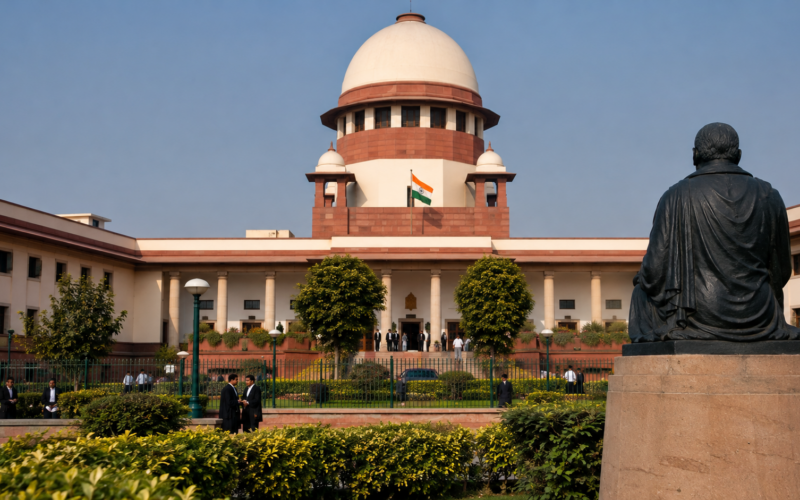
The Supreme Court has delivered a significant judgment on the Uttar Pradesh Gangsters and Anti-Social Activities (Prevention) Act, 1986, holding that the legislation as presently framed fails to create a distinct criminal offence even though it allows people classified as gangsters to be prosecuted and punished.
A bench comprising Justices J. B. Pardiwala and K. Vinod Chandran delivered the judgment on August 20, 2026 while deciding appeals brought by advocates Shiv Pratap Singh alias Chinu and Himanshu Srivastava. The court quashed Gangsters Act proceedings against both appellants and directed their release if they were in custody and not required in any other case.
The ruling has potentially wide consequences for the way the Uttar Pradesh law is applied, but its scope requires careful distinction. The Supreme Court did not strike down the Act on constitutional grounds and expressly left those wider questions open. Instead, it identified what it regarded as a foundational defect in the existing statutory structure: the legislation defines a “gang” and a “gangster” and provides punishment, but does not separately create the criminal offence for which that punishment is imposed.
Why did the Supreme Court describe the Uttar Pradesh Gangsters Act as legally defective?
Section 2 of the Uttar Pradesh law defines gangs and gangsters by referring to a wide range of conduct already punishable under other criminal statutes. Those activities range from violent and property offences to narcotics, illegal arms, human trafficking, extortion-related conduct, tender interference and crimes affecting public order.
Section 3 then prescribes imprisonment for a person classified as a gangster. For most cases, the minimum term is two years and the maximum is 10 years, together with a fine, while enhanced minimum punishment can apply to offences involving public servants or their family members.
The Supreme Court’s difficulty was with the link between those provisions. It concluded that the Act effectively assigns the status of “gangster” based on underlying allegations or offences covered elsewhere in criminal law and then imposes an additional punishment without independently defining the crime being committed under the Gangsters Act itself.
The bench treated that omission as incompatible with the basic principle that criminal punishment must follow an offence created by law. It consequently concluded that the current legislation could not sustain the proceedings brought before it.

Why did gang charts become central to the Supreme Court’s concerns?
The judgment also examined the role of gang charts, administrative records prepared under the Uttar Pradesh Gangsters and Anti-Social Activities Rules that identify individuals alleged to be members or participants in gangs.
The court was concerned that inclusion in such a chart could trigger serious consequences, including arrest and extended investigation, even though the Act did not independently define the offence ultimately being tried. It noted that an investigation under the legislation could remain open for as long as a year while an accused person faced restrictions on liberty.
That structure raised a broader rule-of-law problem for the bench. Administrative and police authorities could effectively determine an individual’s alleged status as a gangster, while criminal punishment flowed from that status despite the absence of a separately formulated offence in the statute.
The Supreme Court also warned that laws addressing serious organised crime still require safeguards against malicious or vindictive use. Its reasoning was not that governments cannot enact strong legislation against gangs, but that extraordinary enforcement powers must remain tied to clearly defined criminal offences and judicially manageable standards.
What happened in the two cases that reached the Supreme Court?
The first appeal involved advocate Shiv Pratap Singh, whose case emerged from disputes surrounding elections to the Bar Association at Fatehgarh in Farrukhabad. A Gangsters Act FIR was registered in February 2024 and included a gang chart identifying three people, while subsequent proceedings reached the Allahabad High Court and ultimately the Supreme Court.
The connected appeal involved Himanshu Srivastava and proceedings originating in Ghaziabad. An earlier criminal case was followed by a separate FIR under Sections 2 and 3 of the Gangsters Act.
The Supreme Court stressed that allegations arising under the Indian Penal Code or other penal legislation were distinct from the Gangsters Act issue before it. Its decision does not erase or invalidate legitimate charges under other criminal laws merely because related proceedings under the Gangsters Act have failed.
That distinction protects conventional criminal prosecutions while challenging the additional punishment structure created by the Uttar Pradesh legislation.
Does the Supreme Court ruling strike down the entire UP Gangsters Act?
The judgment should not be described simply as a declaration that the statute is unconstitutional. The bench specifically said it had not decided the constitutional arguments that had previously been considered by a Full Bench of the Allahabad High Court.
Instead, the Supreme Court found the Act incapable of sustaining the proceedings before it because the existing provisions did not create the necessary distinct offence. It also clarified that its comparison with organised-crime laws in Maharashtra and Gujarat should not be understood as judicial approval of those statutes.
The immediate impact is therefore substantial but legally specific. Proceedings relying on the same statutory architecture could now face serious challenges, while the Uttar Pradesh government will have to assess how the judgment affects pending Gangsters Act investigations and prosecutions.
Legislative action is another possibility. If Uttar Pradesh intends to preserve a separate anti-gang statute, lawmakers could seek to address the defect identified by the Supreme Court by defining a distinct organised-crime offence and linking punishment to clearly specified elements that prosecutors must prove.
Why could the judgment have consequences beyond the two appellants?
The Uttar Pradesh Gangsters Act has long been an important enforcement tool in the state’s response to organised crime and has been invoked in cases involving violent groups, property offences and other alleged criminal networks.
A Supreme Court judgment questioning the law’s basic offence-and-punishment structure therefore carries consequences beyond the two advocates whose proceedings were quashed. Defence lawyers in pending cases are likely to examine whether the reasoning applies directly to their clients, while lower courts will have to interpret the judgment when similar challenges arise.
At the same time, the ruling does not prevent Uttar Pradesh Police from prosecuting murder, extortion, trafficking, arms offences, property crimes or other underlying conduct under statutes that clearly create those offences.
The central issue is narrower but fundamental: governments can deploy stringent legislation against organised criminal activity, but the offence being punished must itself exist in law. How Uttar Pradesh responds legislatively and how courts apply the judgment to pending cases will determine whether August 20 becomes a temporary disruption to the state’s anti-gang framework or a more fundamental reset.
Discover more from Business-News-Today.com
Subscribe to get the latest posts sent to your email.