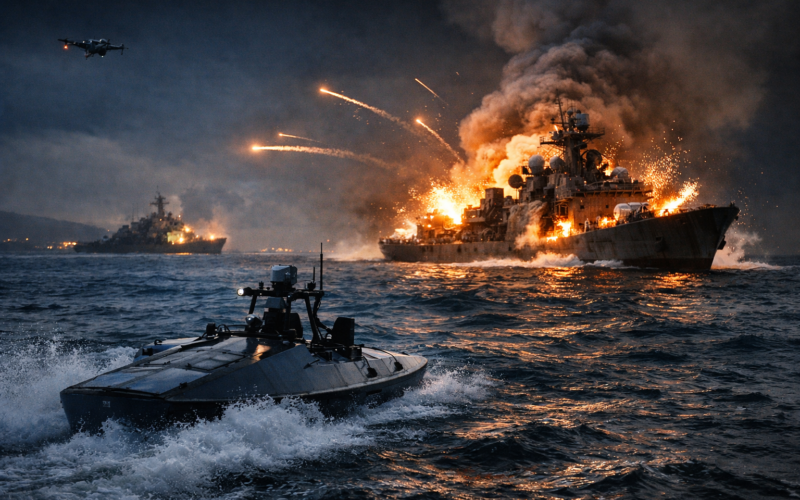
Ukraine entered the war in February 2022 without a meaningful navy. Russia’s Black Sea Fleet, by contrast, was the dominant maritime force in that theater, equipped with cruise-missile-capable warships and positioned to enforce a coastal blockade that strangled Ukraine’s grain exports and devastated its economy. By 2024, Britain’s Defence Ministry had declared the Russian Black Sea Fleet functionally inactive. Ukraine had destroyed or severely damaged more than a third of it using domestically built unmanned surface vessels costing as little as $250,000 each, achieved sea denial against a peer-level adversary, and forced the survivors to retreat from Sevastopol to Novorossiysk, 300 nautical miles away. The implications of that campaign for how the United States Navy is designing, procuring, and planning to deploy its own autonomous surface vessel fleet are direct, specific, and accelerating: the $2.1 billion MUSV marketplace announced in March 2026, the Golden Fleet initiative, and Admiral Daryl Caudle’s containerised capability campaign plan are all, in different degrees, institutionalised responses to lessons learned on the Black Sea.
How did Ukraine build an effective naval drone campaign from scratch, and what made the Sea Baby and Magura series so operationally disruptive?
Ukraine’s maritime drone programme did not emerge from a defence acquisition process. It grew out of necessity after the scuttling of the frigate Hetman Sahaidachny in the war’s opening hours left the country with no conventional naval capability at all. In the summer of 2022, Ukraine’s Security Service began prototyping fast, uncrewed attack boats from commercially available components, including parts from jet skis, off-the-shelf electronics, and Starlink satellite terminals. Within eighteen months, these improvised systems had evolved into two primary platforms with distinct tactical roles. The Sea Baby, developed by the Security Service of Ukraine, is a 6-metre kamikaze vessel capable of 49 knots, carrying up to 850 kilograms of explosives over a range of up to 1,000 kilometres. It was designed primarily for port attacks and strikes against static infrastructure, and used precisely for those purposes at Novorossiysk in August 2023 when Ukrainian drones struck one of Russia’s most important naval bases on the Black Sea.
The Magura V5, developed by Ukrainian military intelligence through a unit called Group 13, took a different design philosophy. At 5.5 metres and carrying 320 kilograms of payload, the Magura was optimised for engagement of moving targets at sea rather than static strikes. This distinction matters doctrinally: the Magura demonstrated that low-cost unmanned surface vessels were not merely useful for one-way suicide attacks on anchored ships but could function as active sea-denial weapons capable of pursuing, tracking, and engaging warships underway. The Magura V7, a later variant, extended the mission envelope further still, reportedly shooting down two Russian Su-30 fighter jets over the Black Sea in May 2025, marking what Ukrainian officials described as the first instance of military aircraft being destroyed by unmanned maritime platforms. The operational evolution from port-attack kamikaze to anti-aircraft surface vessel within three years of the programme’s founding is the most striking indicator of how rapidly autonomous maritime systems can be adapted under operational pressure.
Ukraine deployed these systems not as independent weapons but as components of a layered strike architecture integrating commercial satellite imagery, uncrewed aerial surveillance, Starlink communications, and coastal missile systems. This combination allowed a small number of operators to achieve targeting precision against heavily defended naval assets while maintaining the standoff distance that kept Ukrainian personnel out of danger. The economic logic was equally compelling: an attack that consumed one Magura V5 valued at roughly $250,000 could sink or disable a Russian warship worth tens or hundreds of millions of dollars. That cost exchange ratio is the single most important lesson the Black Sea campaign has transmitted to naval planners in Washington, London, Canberra, and beyond.

What specific tactical and strategic lessons from the Black Sea are US Navy planners incorporating into unmanned surface vessel doctrine?
The US Navy’s Distributed Maritime Operations concept, drafted in 2019 and refined in subsequent years, called for spreading sensors and weapons across a larger number of dispersed platforms to complicate adversary targeting and reduce the catastrophic risk of losing a single high-value asset such as a carrier strike group. The Black Sea campaign validated that concept in live combat in ways that a decade of wargames and exercises had not. The Ukrainian experience demonstrated that distributed, low-cost, attritable platforms could achieve sea denial against a conventionally superior fleet, that swarm tactics using decoy vessels to overwhelm point defences before strike drones arrive are effective, and that autonomous systems operated by a small crew of human controllers can substitute for naval presence that a small or medium power could never afford to generate with manned warships.
The Navy’s response has been to accelerate procurement across the small, medium, and large unmanned surface vessel tiers simultaneously. In fiscal year 2025, the Navy’s inventory of small USVs grew from roughly four vessels to close to 400, an expansion rate that would have been politically and financially difficult to justify before the Black Sea demonstrated the operational value of autonomous maritime mass. The $7 billion unmanned systems investment in fiscal year 2026, with $3.7 billion directed toward the surface force, reflects institutional acceptance at the highest levels that the future hybrid fleet requires not just prototype experimentation but production-scale deployment. The MUSV marketplace opened in March 2026 is in direct doctrinal lineage from the Black Sea lessons: it is designed to put production-ready, multi-mission autonomous vessels into fleet hands quickly, without the protracted development cycles that would have delayed fielding by years.
The containerised capability campaign plan announced by Chief of Naval Operations Admiral Daryl Caudle in March 2026 draws a further Black Sea lesson: the ability to rapidly reconfigure a platform’s payload for a different mission without engineering overhaul is a force multiplier that low-cost autonomous vessels are better positioned to exploit than large manned combatants. Ukraine’s teams adapted their drone designs repeatedly over the course of the campaign, modifying hull configurations, payload types, and communications architectures in response to Russian countermeasures on timelines measured in weeks. The Navy’s containerised payload doctrine attempts to institutionalise that adaptability into a procurement framework, allowing the same autonomous hull to carry anti-ship missiles, electronic warfare suites, sensor packages, or logistics loads depending on the combatant command’s operational requirements.
What are the limitations of the Black Sea model, and where does the South China Sea operating environment create fundamentally different constraints for USV doctrine?
The Black Sea is a constrained maritime environment roughly 1,100 kilometres at its longest axis, with shallow coastal margins, predictable choke points, and limited Russian fleet manoeuvre room once the Black Sea Fleet was pushed eastward from Crimea. These geographic characteristics amplified the effectiveness of Ukrainian sea drones in ways that may not transfer directly to the Indo-Pacific, where the distances are oceanic rather than littoral, the Chinese People’s Liberation Army Navy operates far more capable and numerous warships than the Russian Black Sea Fleet, and the threat environment includes layered anti-access and area denial systems designed explicitly to counter exactly the kind of distributed autonomous operations the US Navy is planning. Naval analysts writing in the Proceedings of the United States Naval Institute have noted that while Ukrainian USVs successfully targeted Russia’s less capable patrol boats and landing craft, the Admiral Makarov frigate, a significantly more capable platform, destroyed an attacking swarm while taking only minor damage, which suggests that the kill chain advantages of low-cost sea drones narrow considerably against well-defended major surface combatants.
Range is the second structural constraint. Ukraine’s Magura and Sea Baby platforms operate at ranges measured in hundreds of kilometres, which is adequate for the Black Sea theater but insufficient for the thousands of nautical miles that separate potential conflict zones in the Indo-Pacific from American bases and logistics nodes. This is precisely why the US Navy’s MUSV specifications emphasise transoceanic range capability, and why platforms like the Magnet Defense M48, with its 17,000-nautical-mile autonomous range, and the Blue Water Autonomy Liberty class, with a 10,000-nautical-mile capability, represent a different tier of operational ambition from the Ukrainian precedent. The American challenge is not to replicate Ukraine’s improvised campaign but to systematise its core insight, that autonomous platforms can generate disproportionate sea denial effects relative to their cost, and extend it to operate at oceanic scale against a peer adversary with comprehensive air and missile defence capabilities.
The magazine depth problem adds another layer of complexity absent from the Black Sea context. The Center for International Maritime Security has assessed that the US Seventh Fleet’s roughly 1,600 Vertical Launch System cells in the western Pacific provide a surprisingly thin offensive strike margin once defensive requirements are factored out. In a high-intensity Indo-Pacific conflict, ships risk reaching what naval planners call Winchester, the state of having expended all weapons, within days. Unmanned surface vessels carrying containerised Vertical Launch System payloads represent a partial solution to this problem by distributing magazine depth across a larger number of harder-to-target platforms. Each MUSV added to the fleet as a floating weapons node expands the adversary’s targeting problem and extends the fleet’s offensive endurance without requiring additional crewed hulls.
How is China interpreting the Black Sea precedent, and does Beijing’s own unmanned maritime programme change the strategic calculus for US naval planning?
China has been studying the Black Sea campaign with at least as much attention as the US Navy. The People’s Liberation Army Navy operates the world’s largest naval force by hull count and has invested heavily in anti-ship ballistic missiles, long-range cruise missiles, and the surveillance architecture necessary to target American carrier strike groups at distances of over 1,500 kilometres. The Black Sea lessons suggest that this concentration on defeating large, exquisite platforms may be strategically incomplete: distributed, low-cost autonomous systems operating in swarms create a targeting problem that large-investment precision weapons are poorly optimised to solve. A defensive posture based on launching multiple $500,000 anti-ship missiles at $250,000 drone boats is arithmetically unsustainable at scale.
China is not a passive student of the conflict. The People’s Liberation Army is developing its own autonomous maritime capabilities, including unmanned surface vessels intended for both offensive and surveillance roles. Heritage Foundation research fellow Brent Sadler noted publicly in early 2026 that China’s accelerating shipbuilding output across all classes, manned and unmanned, means the United States needs to get autonomous maritime capability to sea quickly to avoid falling further behind in the relevant force ratio. The 2026 National Defense Strategy’s explicit prioritisation of China deterrence as the primary military objective above all other commitments reflects a policy conclusion that the window for establishing credible deterrence in the Indo-Pacific is finite and may be narrowing. The MUSV marketplace’s compressed test-and-produce timeline, the Navy’s fiscal year 2026 unmanned investment surge, and the Golden Fleet’s emphasis on hull count alongside capability are all institutional responses to that urgency.
The second-order implication of China’s unmanned programme for American procurement strategy is symmetry risk. A US Navy that becomes heavily dependent on medium autonomous surface vessels for distributed maritime operations faces an adversary that understands precisely how those vessels operate, what their communications dependencies are, and how to disrupt or destroy them at scale. The Black Sea experience demonstrated that Russia learned, adapted, and improved its countermeasures against Ukrainian sea drones over the course of the campaign. China, with vastly greater technical resources and a strategic planning horizon measured in decades, will apply the same learning process to any American autonomous fleet architecture it can study. This argues for maintaining autonomy stack diversity across vendors rather than standardising on a single platform, which is exactly the architecture the MUSV marketplace’s recurring, multi-vendor qualification model is designed to produce.
What does the Ukraine sea drone precedent mean for the investment case in US autonomous maritime defence companies and the broader industrial thesis?
The Black Sea campaign has functioned as the most effective commercial validation event in the history of the autonomous maritime sector. Before February 2022, unmanned surface vessels were a niche technology used primarily for oceanographic research and narcotics interdiction. Within three years, they had sunk or disabled warships, shut down a peer adversary’s port access, demonstrated anti-aircraft capability, and generated a global policy consensus that any credible naval force requires a substantial autonomous component. The investment that followed has been correspondingly large. Saronic Technologies has raised nearly $1 billion in private capital and secured a $392 million US Navy production contract. Blue Water Autonomy developed a 190-foot autonomous ship entirely with private funding and entered a Navy programme of record within two years of founding. Anduril Industries built and delivered the Ghost Shark autonomous undersea vehicle on budget and ahead of schedule under a $1.1 billion Australian contract. Magnet Defense invested more than $50 million privately across a six-year prototype programme before beginning production.
The industrial thesis underlying all of these investments is that the Black Sea’s cost exchange ratio, where a cheap autonomous attacker creates a disproportionate defensive burden on its target, will persist and arguably worsen as autonomous systems scale. A Navy that can put 400 small USVs and dozens of medium USVs into operation is geometrically more difficult to target than one that concentrates its capability in a handful of carrier strike groups. The distributed fleet does not replace the carrier but it changes the adversary’s targeting mathematics in ways that are genuinely deterring. For investors and defence industry analysts, the most significant commercial signal from the current US procurement cycle is not any individual platform contract but the Navy’s structural shift to a recurring, open marketplace model for autonomous vessels. A market where qualification earns recurring revenue across multiple procurement rounds, rather than a single winner-take-all contract, is a more durable commercial foundation than the traditional defence prime model and may attract a broader range of private capital over the coming decade.
Key takeaways on what Ukraine’s Black Sea drone campaign means for US naval doctrine, the MUSV procurement cycle, and the long-term autonomous maritime investment thesis
- Ukraine neutralised more than a third of the Russian Black Sea Fleet using unmanned surface vessels costing as little as $250,000 each, establishing the core asymmetric cost exchange ratio that has driven US autonomous maritime procurement policy since 2022.
- The Magura V5 and Sea Baby platforms demonstrated that low-cost sea drones can achieve both port strikes and open-water ship engagements, and that the mission envelope expands rapidly under operational pressure, with later variants reportedly engaging and downing fixed-wing aircraft.
- The US Navy’s response, including the $7 billion fiscal year 2026 unmanned systems investment, the MUSV Golden Fleet marketplace, and Admiral Caudle’s containerised capability campaign plan, is a direct institutional translation of Black Sea lessons into procurement architecture.
- The Black Sea model has genuine transferability limits in the Indo-Pacific: the South China Sea’s oceanic distances require transoceanic-range autonomous vessels rather than the hundreds-of-kilometres range of Ukrainian systems, and the People’s Liberation Army Navy presents a far more capable and layered anti-drone defence than the Russian Black Sea Fleet offered.
- Magazine depth economics make the MUSV’s role as a distributed weapons node as strategically significant as its sensor or logistics roles: each autonomous vessel carrying containerised Vertical Launch System payloads expands the adversary’s targeting problem and extends fleet offensive endurance without additional crewed hulls.
- China is developing its own autonomous maritime programme and studying American procurement patterns closely, which argues for the MUSV marketplace’s multi-vendor, diverse-platform architecture over standardisation on a single hull as a hedge against Chinese countermeasure development.
- The Navy’s Distributed Maritime Operations doctrine, drafted in 2019, was validated in live combat by Ukraine’s Black Sea campaign in ways that years of wargaming had not achieved, accelerating the policy consensus required to fund autonomous systems at production scale.
- Ukraine’s three-year evolution from improvised jet ski drones to anti-aircraft capable autonomous vessels is the clearest evidence that autonomous maritime systems improve rapidly under real operational pressure, a dynamic that procurement timelines must account for if fleets are to field relevant rather than obsolescent capability.
- The investment case for US autonomous maritime companies rests on a structural shift from prototype experimentation to production-scale recurring procurement, with the Navy’s marketplace model providing a more durable commercial foundation than traditional single-round defence contracts.
- The Black Sea precedent has already globalised: Denmark deployed Saildrone USVs in the Baltic to monitor Russia’s shadow fleet in June 2025, Netherlands, UK, and Australia announced MUSV procurements in March 2026, and allied navies from Singapore to Japan are integrating autonomous vessels into operational patrol schedules, validating the commercial opportunity well beyond the US market.
Discover more from Business-News-Today.com
Subscribe to get the latest posts sent to your email.