


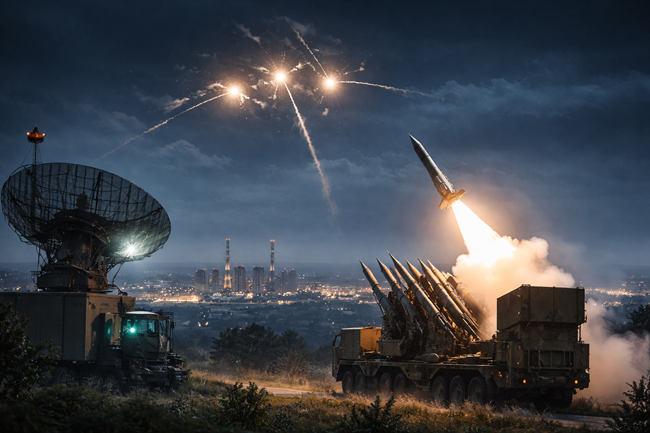
The United Kingdom announced on 12 February 2026 that it will urgently provide a new air defence package for Ukraine valued at more than £500 million. The announcement was made by the Ministry of Defence as the United Kingdom Defence Secretary co-chaired the 33rd meeting of the Ukraine Defence Contact Group at the North Atlantic Treaty Organization headquarters in Brussels.
The Ministry of Defence stated that the package is intended to strengthen Ukraine’s ability to defend against continued Russian missile and drone attacks, particularly those targeting energy infrastructure and residential areas. The announcement comes as Ukraine enters another winter period under sustained aerial pressure, with air defence identified by allied governments as a critical capability gap.
The package combines direct missile deliveries, financial contributions to NATO-coordinated procurement mechanisms, and expanded industrial cooperation between the United Kingdom and Ukraine. Officials described the measures as part of a broader effort to stabilise Ukraine’s air defence posture as the conflict approaches its fifth year.
Why the United Kingdom’s £500 million air defence commitment marks a shift in allied support priorities
The scale and structure of the United Kingdom’s commitment reflects a clear prioritisation of air defence over other categories of military assistance. Rather than focusing exclusively on offensive systems or short-term battlefield effects, the package is designed to support Ukraine’s long-term ability to protect civilian infrastructure and urban centres from aerial attacks.
The Ministry of Defence framed the package as an urgent response to Russia’s continued use of missiles and unmanned aerial systems against power grids, housing, and transport networks. These attacks have placed sustained pressure on Ukraine’s existing interceptor stocks and radar coverage, prompting allies to focus on replenishment and resilience rather than one-off transfers.
By announcing the package during a meeting of the Ukraine Defence Contact Group, the United Kingdom positioned the commitment within a coordinated allied framework rather than as a standalone national initiative. This approach reinforces the role of multilateral coordination in shaping military assistance for 2026.
How the NATO Prioritised Ukraine Requirements List initiative shapes air defence delivery
A central element of the package is the United Kingdom’s decision to contribute £150 million to the NATO Prioritised Ukraine Requirements List initiative. This marks the first time the United Kingdom has directly funded the initiative, which is designed to accelerate the delivery of high-priority military equipment to Ukraine.
The Ministry of Defence explained that the NATO Prioritised Ukraine Requirements List initiative enables the North Atlantic Treaty Organization to coordinate the purchase of defence equipment, primarily from the United States, on behalf of Ukraine. The initiative focuses on identifying the most urgent capability gaps and aligning allied procurement to address them efficiently.
By contributing financially rather than solely through equipment transfers, the United Kingdom is supporting a procurement model intended to reduce delays caused by production backlogs and fragmented bilateral negotiations. This reflects a broader allied effort to institutionalise military assistance rather than relying on ad hoc pledges.
What the delivery of United Kingdom-manufactured Lightweight Multirole Missiles adds to Ukraine’s defence
In addition to the funding contribution, the United Kingdom confirmed that it will deliver an additional 1,000 Lightweight Multirole Missiles manufactured in Belfast. These missiles are designed for flexible use against a range of aerial threats, including low-flying drones and cruise missiles.
The Ministry of Defence stated that the missiles will play a critical role in defending Ukrainian infrastructure and cities from escalating aerial attacks. Lightweight Multirole Missiles are typically deployed as part of short-range air defence systems and are valued for their mobility and adaptability.
The inclusion of domestically manufactured missiles also highlights the United Kingdom’s emphasis on sustaining its defence industrial base while supporting Ukraine. Officials described the deliveries as part of a broader £390 million arrangement that links equipment supply with industrial cooperation.
How industrial cooperation with Ukraine is being expanded through air defence systems
The £390 million deal associated with the missile deliveries includes expanded collaboration between United Kingdom and Ukrainian defence industries. According to the Ministry of Defence, this cooperation involves transferring production and support capabilities for Rapid Ranger launchers and associated command and control vehicles to Ukraine.
This industrial dimension reflects a shift toward enabling Ukraine to maintain and support its air defence systems locally. Allied governments have increasingly emphasised the importance of sustainment and repair capacity as the conflict continues, recognising that operational readiness depends on more than initial equipment delivery.
For the United Kingdom, industrial cooperation also aligns with broader defence policy objectives focused on long-term partnerships and capability development rather than short-term assistance alone.
What additional air defence and artillery support will be delivered through allied frameworks
Beyond the immediate missile package, the Ministry of Defence confirmed that the United Kingdom will deliver an additional 1,200 air defence missiles and 200,000 rounds of artillery ammunition in the coming months. These supplies will be delivered through the Air Defence Consortium, a multilateral mechanism coordinating allied contributions.
The Air Defence Consortium operates alongside the NATO Prioritised Ukraine Requirements List initiative and focuses on aligning equipment deliveries among participating countries. The inclusion of artillery ammunition alongside air defence missiles reflects recognition of Ukraine’s broader battlefield requirements.
The Ministry of Defence described the upcoming deliveries as part of sustained support rather than a single tranche, reinforcing the view that allied assistance is being planned on a multi-year basis.
How the Ukraine Defence Contact Group continues to shape military planning for 2026
The 33rd meeting of the Ukraine Defence Contact Group brought together representatives from 50 countries at North Atlantic Treaty Organization headquarters in Brussels. The meeting was co-chaired by the United Kingdom and German Defence Minister Boris Pistorius, underscoring the two countries’ leadership roles.
Attendees included Ukrainian Defence Minister Mykhailo Fedorov, North Atlantic Treaty Organization Secretary General Mark Rutte, and Australian Deputy Prime Minister Richard Marles. According to the Ministry of Defence, discussions focused on Ukraine’s key military needs for 2026, battlefield assessments, equipment delivery timelines, and capability gaps.
The Ukraine Defence Contact Group has become the primary forum for coordinating military assistance to Ukraine, enabling allied governments to align strategy and logistics across multiple theatres and domains.
What Defence Secretary John Healey MP said about the United Kingdom’s role
Defence Secretary John Healey MP stated that as the conflict approaches its fifth year, the United Kingdom and its allies remain committed to supporting Ukraine. He confirmed that the new package includes more than half a billion pounds of air defence support, including funding for the NATO Prioritised Ukraine Requirements List initiative.
The Defence Secretary emphasised the United Kingdom’s leadership role and described the package as a response to continued drone and missile attacks. His remarks reinforced the government’s position that supporting Ukraine is integral to broader European security objectives.
Why the United Kingdom links its national security directly to Ukraine
The Ministry of Defence reiterated that both the Prime Minister and the Defence Secretary have stated that the United Kingdom’s national security starts in Ukraine. This framing positions military assistance as a matter of domestic security rather than solely foreign policy.
The United Kingdom stepped up last year to co-lead the Ukraine Defence Contact Group with Germany and also co-leads the Coalition of the Willing alongside France. These roles reflect a sustained commitment to coordinating allied responses and shaping long-term strategy.
By embedding its assistance within NATO and allied frameworks, the United Kingdom has reinforced the view that developments in Ukraine have direct implications for the credibility and stability of the Euro-Atlantic security architecture.
Key takeaways: What the United Kingdom’s latest air defence package means for Ukraine and allied coordination
- The United Kingdom has announced a new air defence support package for Ukraine valued at more than £500 million, confirmed on 12 February 2026 during the 33rd meeting of the Ukraine Defence Contact Group at North Atlantic Treaty Organization headquarters in Brussels.
- The package includes a £150 million contribution to the NATO Prioritised Ukraine Requirements List initiative, marking the first time the United Kingdom has directly funded this NATO-coordinated procurement mechanism to accelerate the delivery of high-priority air defence interceptors.
- As part of the package, the United Kingdom will deliver an additional 1,000 Lightweight Multirole Missiles manufactured in Belfast, alongside expanded industrial cooperation to support Rapid Ranger launchers and associated command and control systems in Ukraine.
- Further support will be provided through allied frameworks, with the United Kingdom confirming upcoming deliveries of 1,200 additional air defence missiles and 200,000 rounds of artillery ammunition via the Air Defence Consortium.
- The announcement reinforces the United Kingdom’s leadership role within the Ukraine Defence Contact Group and reflects the government’s stated position that United Kingdom national security is directly linked to developments in Ukraine and the wider Euro-Atlantic security environment.
Discover more from Business-News-Today.com
Subscribe to get the latest posts sent to your email.