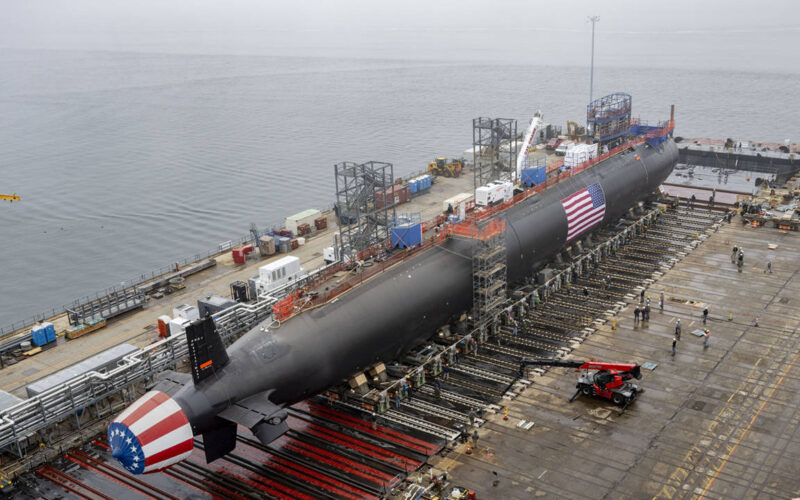
General Dynamics Corporation, listed on the New York Stock Exchange as GD, and HII, listed on the New York Stock Exchange as HII, have secured a combined $76.6 billion United States Navy submarine construction and industrial-base package that locks in major work across the Columbia-class and Virginia-class programmes. The awards cover a five-ship contract modification to General Dynamics Electric Boat for Columbia-class ballistic missile submarines, a nine-ship Virginia-class contract involving General Dynamics Electric Boat and HII’s Newport News Shipbuilding, and previously awarded shipyard productivity investments. The package strengthens long-term revenue visibility for two of the most strategically important U.S. shipbuilders while reinforcing the Navy’s effort to recapitalise its sea-based nuclear deterrent and attack-submarine fleet. General Dynamics closed at $384.08 on August 5, near the top of its 52-week range, while HII closed at $317.70 after a strong July rally but still far below its March high. The strategic question is not whether the Navy wants more submarines, but whether the U.S. industrial base can deliver them fast enough, affordably enough and with enough skilled labour to support both deterrence and allied commitments.
The contract package is one of the clearest signals that undersea warfare has moved from a procurement priority into an industrial-policy problem. Ballistic missile submarines are central to nuclear deterrence, attack submarines are central to operations in contested waters, and both classes rely on a narrow and highly specialised industrial base. The Navy has given General Dynamics Electric Boat and HII a long demand signal. Now the difficult work shifts to workforce growth, supplier throughput, shipyard modernisation, reactor components, specialised valves, skilled trades and schedule discipline.
Why does the $76.6 billion U.S. Navy submarine award matter beyond the headline value?
The $76.6 billion value is striking, but the deeper importance lies in the combination of strategic deterrence, attack-submarine production and shipyard productivity support. The award does not fund only one class of vessel or one company’s backlog. It connects the United States Navy’s nuclear deterrent recapitalisation plan with its tactical undersea force and the industrial base needed to build both.
The Columbia-class portion supports five additional ballistic missile submarines. These submarines are intended to replace the Ohio-class fleet and preserve the sea-based leg of the United States nuclear triad. That makes Columbia one of the Navy’s most sensitive and highest-priority acquisition programmes because delays would directly affect strategic deterrence planning.
The Virginia-class portion covers nine Block VI attack submarines for fiscal years 2025 through 2029. These vessels support intelligence, surveillance, strike, anti-submarine warfare, special operations and sea-denial missions. In a potential Indo-Pacific contingency, Virginia-class submarines would be among the most valuable assets available to U.S. commanders.
The package also includes shipyard productivity efforts, which is not a side detail. Submarine delays have often been driven by industrial capacity rather than a lack of demand. Infrastructure, workforce, supplier readiness and production efficiency can be just as important as hull orders.
For investors, the award provides long-cycle visibility. For policymakers, it tests whether large funding commitments can repair a strained shipbuilding base. For suppliers, it gives a demand signal strong enough to justify hiring, training and capital investment.
The risk is that a larger contract does not automatically create faster production. If shipyards and suppliers remain constrained, the award could increase backlog without immediately solving the Navy’s submarine delivery problem.

How do Columbia-class and Virginia-class submarines serve different strategic missions?
The Columbia-class ballistic missile submarine is designed for strategic deterrence. Its role is to remain hidden at sea while carrying Trident II D5 ballistic missiles, making it the most survivable leg of the United States nuclear triad. Because these submarines operate as strategic assets, schedule reliability is not simply a budget issue. It is tied to national nuclear-force planning.
The Virginia-class attack submarine serves a different mission set. It is designed for conventional operations, including anti-submarine warfare, anti-surface warfare, intelligence collection, special operations support and land-attack missions. Block VI boats are expected to deepen that capability as the Navy adapts to more contested maritime environments.
The two programmes are linked because they rely on the same limited shipbuilding ecosystem. General Dynamics Electric Boat and HII’s Newport News Shipbuilding are the two industrial anchors for U.S. nuclear submarine construction. Skilled welders, engineers, pipefitters, designers, suppliers and nuclear-qualified components are scarce resources.
This creates a capacity tension. The Columbia-class programme has priority because of the nuclear deterrence mission, but the Navy also needs enough Virginia-class attack submarines to maintain operational presence and meet future fleet goals. If one programme absorbs too much industrial capacity, the other can suffer.
The award attempts to reduce that tension by providing stable demand across both classes. Continuous production can help suppliers plan, avoid stop-start inefficiency and support workforce retention. However, continuous demand only works if the workforce and supply chain can keep up.
The industrial challenge is therefore as strategic as the submarines themselves. The United States is not only buying hulls. It is trying to preserve a specialised national capability that cannot be rebuilt quickly once lost.
Why are General Dynamics Electric Boat and HII central to America’s undersea industrial base?
General Dynamics Electric Boat is the prime contractor and lead design yard for both Columbia-class and Virginia-class submarines. Its shipyards in Groton, Connecticut, and Quonset Point, Rhode Island, sit at the centre of U.S. submarine construction and design.
HII’s Newport News Shipbuilding is the other essential partner. It participates in Virginia-class construction and builds major Columbia-class modules under contract to General Dynamics Electric Boat. The company manufactures large assemblies including bow, stern, auxiliary machinery room, superstructure and weapons modules for the Columbia programme.
This division of labour reflects the scale and complexity of nuclear submarine construction. No ordinary shipyard can simply enter the market and start building nuclear-powered submarines. The work requires decades of experience, nuclear quality standards, classified systems integration, specialised tooling and a cleared industrial workforce.
The partnership between General Dynamics Electric Boat and HII is therefore not optional. It is the core of the U.S. submarine production system. That creates strategic stability, but also concentration risk. If either company faces workforce or supplier bottlenecks, the Navy has few near-term alternatives.
For General Dynamics, the award strengthens the Marine Systems segment, which already benefits from Columbia and Virginia activity. For HII, the award supports Newport News Shipbuilding, a division that is critical to both submarine and aircraft carrier production.
The two companies may compete in some areas, but in nuclear submarines they are structurally interdependent. The Navy’s challenge is to keep that partnership productive while maintaining enough oversight to control cost, schedule and quality.
What does the award mean for General Dynamics’ backlog and 2026 financial outlook?
General Dynamics reported second-quarter 2026 revenue of $14.1 billion, up 8.1% year over year, with diluted earnings per share rising 13.4% to $4.24. The company also reported $20 billion of orders, a company-wide book-to-bill ratio of 1.4 times and backlog of $136.5 billion at quarter end.
The $76.6 billion Navy package is larger than half of General Dynamics’ reported quarter-end backlog, although the full amount should not be treated as an immediate backlog addition to General Dynamics alone. Part of the package involves HII, part involves previously awarded productivity efforts, and revenue recognition will stretch over many years.
Even with that caveat, the award is highly significant for Marine Systems. The segment was already benefiting from higher productivity as it recovered from supply-chain disruptions and labour shortages. Marine Systems revenue rose 10.4% year over year in the second quarter, and the company expects the segment to generate around $18 billion of revenue in 2026.
The submarine awards also complement General Dynamics’ broader financial momentum. The company raised full-year earnings guidance after Q2 results, reflecting stronger performance across aerospace and defence. Its Gulfstream aircraft business remains important to valuation, but the submarine award deepens the defence side of the investment case.
General Dynamics shares closed at $384.08 on August 5, slightly below the prior close and within a 52-week range of about $306.77 to $400.00. The stock remains close to the high end of its annual range, suggesting investors have already priced in confidence around execution and defence backlog quality.
The market issue is now conversion. General Dynamics has demand visibility. Investors will want to see whether submarine orders translate into revenue, margin and cash flow without further schedule friction.
What does the submarine package mean for HII’s Newport News Shipbuilding business?
HII’s Newport News Shipbuilding is one of the few industrial sites in the United States capable of building nuclear-powered submarines. That makes the company an essential beneficiary of the Navy’s submarine production strategy, even though General Dynamics Electric Boat remains the prime and lead design yard on key submarine programmes.
HII reported second-quarter 2026 revenue of $3.4 billion, net earnings of $208 million and diluted earnings per share of $5.27. The company also raised its 2026 shipbuilding revenue guidance range to $10.2 billion to $10.4 billion and raised the low end of its shipbuilding operating-margin guidance.
The timing matters. HII’s stock had been under pressure earlier in 2026 after concerns about cash flow and shipbuilding execution. The latest submarine package and improved shipbuilding guidance help support a recovery narrative, but they do not remove execution risk.
HII closed at $317.70 on August 5, down 1.69% on the session, with a market capitalisation of about $12.55 billion. The stock remained more than 30% below its 52-week high of $460.00, which shows that investors still apply a meaningful discount for shipyard execution, margin pressure and cash-flow uncertainty.
The award strengthens HII’s long-term revenue base because Newport News Shipbuilding participates in both Columbia and Virginia-class construction. It also reinforces the value of HII’s distributed shipbuilding strategy, which pushes selected module and unit fabrication to partner facilities outside its main shipyards.
That strategy is not cosmetic. HII has said distributed shipbuilding expanded capacity by the equivalent of more than 1,000 additional jobs across 11 states and 25 locations. The company planned to outsource more than 2.5 million hours of shipbuilding work in 2026, a 30% increase from 2025.
For HII, the submarine award is therefore both an opportunity and a test. It provides demand, but investors will judge whether Newport News can increase throughput without sacrificing margin discipline.
Why is shipyard productivity as important as submarine procurement itself?
The Navy’s award includes shipyard productivity efforts because submarine procurement has repeatedly run into the same practical limitation: there are not enough specialised people, suppliers, facilities and production buffers to meet ideal delivery rates.
Nuclear submarine construction is one of the most complex manufacturing tasks in the defence economy. It involves nuclear propulsion systems, pressure hulls, acoustic stealth, weapons integration, classified electronics, specialised coatings, precision welding, cable routing, combat systems and extensive testing.
A delay in a supplier-provided valve, pump, casting, electrical component or pressure hull module can affect the entire schedule. A shortage of experienced welders or pipefitters can delay work even when funding is available. A lack of shipyard space can create bottlenecks even if suppliers deliver parts on time.
This is why productivity investments matter. They can support better facilities, improved workflow, automation, supplier development, training pipelines and digital planning tools. These investments are less visible than submarine names or hull numbers, but they often determine whether the programme succeeds.
The productivity element also supports AUKUS indirectly. Australia’s future nuclear-powered submarine pathway depends partly on whether the U.S. submarine industrial base can produce enough Virginia-class submarines for U.S. needs while still supporting future allied transfer commitments. If the U.S. cannot lift production rates, AUKUS schedules become harder to defend.
The Navy’s problem is not demand. It is throughput. The new award gives industry a clearer signal, but the signal must translate into workers trained, suppliers qualified, modules built and submarines delivered.
How does the award affect the AUKUS submarine timetable and allied confidence?
The submarine package has direct relevance for allied confidence because the United States is expected to support Australia’s nuclear-powered submarine transition under AUKUS. Australia’s pathway includes the planned acquisition of Virginia-class submarines before the later SSN-AUKUS design enters service.
That plan depends on U.S. production capacity. If American shipyards struggle to build enough Virginia-class boats for the United States Navy, transferring submarines to Australia becomes politically and operationally more difficult.
The new award can be read as an attempt to stabilise the production base before that pressure becomes more acute. Nine Block VI Virginia-class submarines and productivity investments provide a stronger framework for continuous construction, supplier planning and workforce growth.
However, allied confidence will depend on actual output rather than contract value. Australia, the United Kingdom and other partners will watch delivery cadence, workforce hiring, infrastructure progress and whether the United States can move closer to its target production tempo.
The award also matters for deterrence in the Indo-Pacific. Attack submarines are among the most relevant platforms for operating in contested waters, and the U.S. Navy needs enough hulls to sustain presence, training, maintenance cycles and surge capacity.
The Columbia-class portion is less directly tied to AUKUS but still affects the same shipbuilding ecosystem. Because Columbia has nuclear-deterrence priority, any delay or capacity strain can crowd out Virginia-class work.
The central AUKUS question remains unchanged: can the United States expand submarine output while managing two nuclear-submarine programmes at once? The $76.6 billion award helps answer the funding part. It does not fully answer the industrial part.
Why does the submarine award create supplier opportunities beyond General Dynamics and HII?
Submarine programmes support thousands of suppliers across the United States. These include companies producing pumps, valves, castings, electrical systems, sensors, cabling, forgings, propulsion components, acoustic materials, precision tools, coatings, machine parts and specialised software.
The award gives suppliers a stronger long-term demand signal. This is important because smaller suppliers often hesitate to invest in capacity when orders are uncertain or uneven. A multiyear production framework reduces that uncertainty and can make it easier to justify hiring, equipment purchases and facility expansion.
Supplier stability matters because the submarine industrial base is narrow. Many components require qualification, certification and specialised processes. If one supplier exits the market or fails to scale, replacing it can take years.
The award may also support regional economic development in Connecticut, Rhode Island, Virginia and supplier states across the country. General Dynamics Electric Boat has been pursuing a major hiring plan, while HII has been pushing work to distributed shipbuilding partners.
The risk is that the same suppliers are being asked to support multiple defence growth areas at once. Shipbuilding, missiles, aircraft, munitions and space systems are all competing for skilled labour, machine tools, electronic components and industrial materials.
A strong demand signal can therefore create both opportunity and strain. Suppliers may win more work, but they also face delivery pressure, working-capital needs and quality expectations. The Navy’s success will depend on whether the entire supplier network scales, not only the two prime shipyards.
How should investors compare General Dynamics and HII after the submarine package?
General Dynamics and HII both benefit from the submarine package, but the market reads the two stocks differently. General Dynamics is larger, more diversified and supported by Gulfstream aerospace, combat systems, technologies and marine systems. HII is more concentrated in shipbuilding, which gives it greater direct exposure to naval construction but also more concentrated execution risk.
General Dynamics closed at $384.08 on August 5, near the upper end of its 52-week range of about $306.77 to $400.00. That shows strong investor confidence in the company’s broader portfolio, Q2 performance and raised earnings outlook.
HII closed at $317.70 on August 5, well below its 52-week high of $460.00 but above early-July levels. The stock has more recovery potential if shipbuilding margins and cash flow improve, but it also carries more visible sensitivity to shipyard labour, productivity and programme timing.
For General Dynamics, the submarine package deepens an already strong backlog and reinforces Marine Systems. For HII, the package helps validate a shipbuilding turnaround story and supports Newport News Shipbuilding’s long-term workload.
The valuation gap reflects business mix. General Dynamics offers diversified aerospace and defence exposure. HII offers a purer naval shipbuilding thesis, with more upside if execution improves and more downside if schedule or margin pressure returns.
Investors should not treat the $76.6 billion headline as an equal benefit to both companies. Workshare, timing, margin structure and accounting treatment will determine the actual financial impact. The stronger immediate winner is long-term industrial visibility, not necessarily near-term earnings.
What execution risks could weaken the impact of the U.S. Navy submarine award?
The first risk is workforce availability. Submarine construction depends on skilled trades that require training, security standards and experience. Hiring thousands of employees is only the first step. Converting new hires into productive shipbuilders takes time.
The second risk is supplier throughput. Nuclear submarine components require qualification and precision. Bottlenecks in pumps, valves, castings, electronics, propulsion equipment or specialised materials can slow entire boats.
The third risk is cost growth. Long programmes are exposed to inflation in labour, materials and supplier pricing. Large multiyear contracts can provide stability, but they do not eliminate cost pressure.
The fourth risk is schedule conflict between Columbia and Virginia programmes. Columbia has top strategic priority, while Virginia demand remains high for operational and AUKUS reasons. Managing capacity between the two programmes will remain difficult.
The fifth risk is infrastructure execution. Shipyard productivity investments must produce measurable gains. Buildings, tools and digital systems help only if they reduce bottlenecks and improve build sequence discipline.
The sixth risk is political funding continuity. The award benefits from congressional support, but future budgets, reconciliation funding and procurement priorities can still influence the pace of execution.
The seventh risk is quality. Nuclear submarine construction has little tolerance for shortcuts. Faster output cannot come at the expense of inspection, safety, survivability or acoustic performance.
The Navy, General Dynamics and HII have received the demand signal they needed. The hard part is converting that signal into a reliable submarine production rhythm.
What should executives and investors watch after the $76.6 billion submarine award?
The first signal will be production cadence. Investors should watch whether General Dynamics Electric Boat and HII can move toward the long-discussed target of building two Virginia-class submarines and one Columbia-class submarine per year.
The second signal will be workforce progress. Hiring numbers matter, but retention, training completion and productivity per employee will matter more.
The third signal will be supplier expansion. Announcements involving long-lead materials, reactor components, valves, pumps, castings and module fabrication will show whether the supply base is scaling.
The fourth signal will be Marine Systems margin performance at General Dynamics. Strong revenue growth without margin improvement would suggest capacity strain.
The fifth signal will be HII shipbuilding guidance. The company has raised its 2026 shipbuilding revenue guidance and improved the lower end of margin expectations. Delivery against that guidance will shape investor confidence.
The sixth signal will be AUKUS alignment. Any indication that U.S. Virginia-class delivery schedules can support Australian transfer plans would strengthen allied confidence.
The seventh signal will be Columbia-class milestones. Because Columbia is central to nuclear deterrence, schedule performance on early boats will shape the entire programme’s credibility.
The $76.6 billion award gives General Dynamics and HII one of the strongest long-term demand signals in the global defence sector. It also gives them one of the hardest industrial assignments. Submarine dominance is not built in a press release. It is built by shipyards, suppliers and workers who have to turn decades of funding into boats that leave the pier on time.
Key takeaways on the $76.6 billion U.S. Navy submarine package for General Dynamics and HII
- The United States Navy awarded a combined $76.6 billion submarine construction and industrial-base package to General Dynamics Electric Boat and HII’s Newport News Shipbuilding.
- The package covers five Columbia-class ballistic missile submarines, nine Virginia-class Block VI attack submarines and shipyard productivity investments.
- Columbia-class submarines are central to the sea-based leg of the United States nuclear triad and remain one of the Navy’s top acquisition priorities.
- Virginia-class submarines support attack, strike, intelligence, surveillance, anti-submarine warfare and special-operations missions.
- General Dynamics reported Q2 2026 revenue of $14.1 billion, diluted EPS of $4.24 and backlog of $136.5 billion before the submarine award’s full long-term effect is reflected.
- HII reported Q2 2026 revenue of $3.4 billion, net earnings of $208 million and raised its 2026 shipbuilding revenue guidance.
- General Dynamics shares closed at $384.08 on August 5, close to their 52-week high, while HII closed at $317.70, still far below its March peak.
- The award provides long-term visibility, but revenue recognition and cash conversion will depend on workshare, milestones and delivery schedules.
- The main execution risks are workforce shortages, supplier bottlenecks, shipyard productivity, cost inflation and competition between Columbia and Virginia production priorities.
- Investors should watch production cadence, supplier expansion, HII shipbuilding margins, General Dynamics Marine Systems performance and AUKUS-related delivery implications.
Discover more from Business-News-Today.com
Subscribe to get the latest posts sent to your email.