


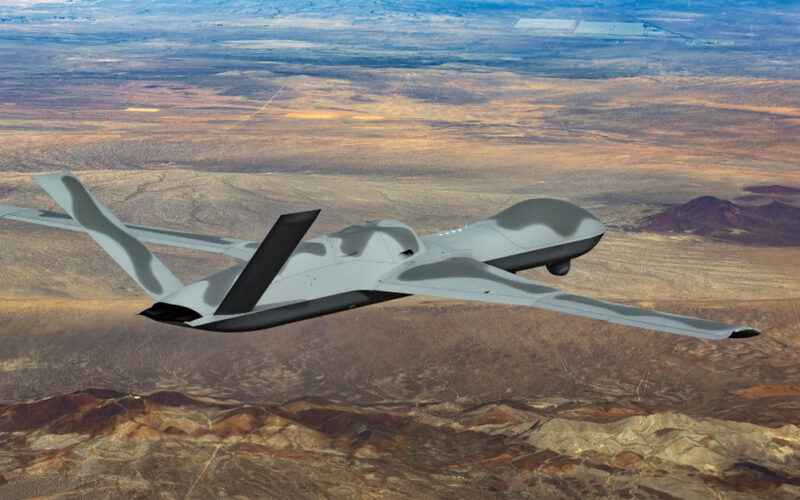
The United States Air Force and General Atomics Aeronautical Systems, Inc. conducted two distinct autonomy flight demonstrations in late February 2026, each testing separate but complementary capabilities for the Collaborative Combat Aircraft program. The exercises, carried out on February 23 and February 24, 2026, used the MQ-20 Avenger uncrewed jet as a surrogate testbed and produced the most advanced public demonstration to date of autonomous combat aircraft behaviors, passive infrared targeting, and manned-unmanned teaming between crewed fighters and autonomous platforms.
The February 23 demonstration took place at Edwards Air Force Base in Southern California. In that exercise, a United States Air Force F-22 Raptor, flown by an onboard human pilot, served as the command aircraft and used the latest government reference autonomy software and a tactical data link to issue mission-level instructions to an MQ-20 Avenger operating as an autonomous system. General Atomics Aeronautical Systems announced the results of the exercise in a public statement released the same day.
According to General Atomics Aeronautical Systems, the F-22 pilot transmitted autonomy commands to the MQ-20 via the Autonodyne Bashi Pilot Vehicle Interface, a tablet-based control system. The MQ-20 received and executed those commands, performing tactical maneuvers, adjusting waypoints, flying Combat Air Patrol patterns, and carrying out simulated airborne threat engagement tasks. The demonstration validated rapid software integration between the two platforms and confirmed that the tactical data link could sustain communication and coordination between a fifth-generation crewed fighter and an autonomous uncrewed aircraft in a realistic operational scenario.
David R. Alexander, President of General Atomics Aeronautical Systems, stated that the mission featured the integration of mission elements and the ability of the autonomy software to utilize onboard sensors to make independent decisions and execute commands from the F-22.
What autonomous capabilities did the MQ-20 Avenger demonstrate in the February 24 large-force exercise using the Autonomy Start Kit?
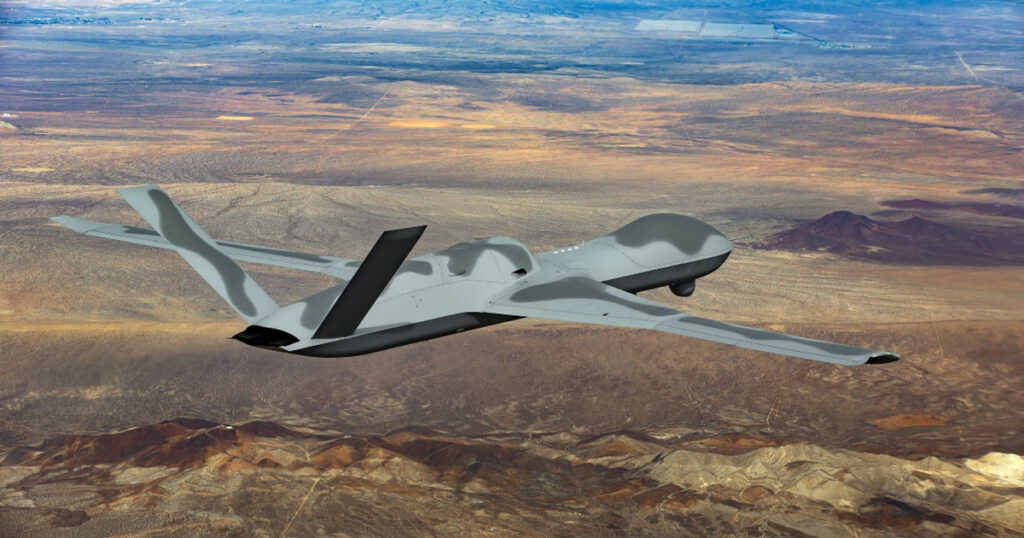
The second demonstration, conducted on February 24, 2026, was part of a large-force exercise and tested a different set of autonomous capabilities centered on passive infrared sensing and cooperative targeting. General Atomics Aeronautical Systems announced those results on March 17, 2026. The exercise incorporated the latest government Autonomy Start Kit, which the United States Air Force provides as a reference architecture for autonomous systems development, and used the MQ-20 Avenger as the testbed Collaborative Combat Aircraft.
During the February 24 exercise, the MQ-20 used a tactical proliferated low-earth orbit data link to maintain coordination with autonomy behaviors across the exercise environment. The aircraft performed infrared sensing operations using a method designated Single Ship Ranging and conducted engagement functions through the TacPad Pilot Vehicle Interface. General Atomics Aeronautical Systems’ TacACE, or Tactical Autonomy Ecosystem, which is designed to align with the Autonomy Start Kit framework, managed the mission execution layer during the exercise.
TacACE demonstrated passive target localization by pairing Single Ship Ranging with an Infrared Search and Track sensor. The system enabled the MQ-20 to autonomously estimate the range of airborne threats and maintain tracking without emitting active radar signals. According to General Atomics Aeronautical Systems, this configuration allows the aircraft to detect, classify, and localize targets while remaining fully passive, a capability the company describes as essential for operations in denied and contested electromagnetic environments.
Mike Atwood, Vice President of Advanced Programs at General Atomics Aeronautical Systems, stated that Single Ship Ranging, integrated within the TacACE modular skills library, supports autonomous mission execution, cooperative targeting, and distributed kill chains, advancing the role of autonomous aircraft in future air combat and Collaborative Combat Aircraft operations. Atwood added that the flight allowed internal investment to showcase the company’s capabilities.
How has the MQ-20 Avenger been used as a surrogate platform for U.S. Air Force Collaborative Combat Aircraft development over the past five years?
The MQ-20 Avenger has served as a surrogate Collaborative Combat Aircraft platform for General Atomics Aeronautical Systems for more than five years, accumulating test experience before and after the introduction of purpose-built Collaborative Combat Aircraft designs. The Avenger is a jet-powered uncrewed combat aerial vehicle with an internal weapons bay, six external hardpoints, and compatibility with a range of precision munitions and sensors. It was designed as a higher-speed, lower-signature evolution of earlier General Atomics platforms and has been used to develop and validate autonomy software, sensor architectures, and control interfaces that the United States Air Force intends to apply to future operational systems.
In early 2025, the MQ-20 participated in the Orange Flag 25-1 exercise, where it flew with a government-provided autonomy stack before transitioning control in flight to alternative autonomy software. Subsequent exercises in 2025 included demonstrations of cooperative patrol behaviors, autonomous formation flying, and live aerial intercept scenarios against crewed aggressor aircraft using passive Infrared Search and Track sensors. A January 18, 2026, company-funded test demonstrated that the MQ-20 could complete a live aerial intercept against a crewed aircraft with the autonomy stack managing the engagement sequence from mission planning through execution.
General Atomics Aeronautical Systems has also introduced purpose-built platforms. The XQ-67A Off-Board Sensing Station and the YFQ-42A, which the company has named Dark Merlin, represent the company’s dedicated Collaborative Combat Aircraft entries. The United States Air Force selected both the YFQ-42A and Anduril Industries’ YFQ-44 for Increment 1 of the Collaborative Combat Aircraft program. Both aircraft completed their first flights in late 2025. The MQ-20 continues to serve as a development testbed even after those selections, enabling the United States Air Force and General Atomics Aeronautical Systems to validate autonomy software on a mature platform before migrating proven capabilities to newer designs.
Why is the F-22 Raptor the threshold platform for Collaborative Combat Aircraft integration and how does that affect the program timeline?
The United States Air Force has designated the F-22 Raptor as the threshold platform for initial Collaborative Combat Aircraft integration, meaning that manned-unmanned teaming will be fielded with the F-22 before extending to other fighters. The Air Force planned to purchase tablet-based control systems and make related modifications to the 143 combat-coded F-22 Raptors available to the service beginning in fiscal year 2026. The Air Force requested approximately 870 million United States dollars in its fiscal year 2026 budget submission to continue Collaborative Combat Aircraft development.
The F-22 Raptor was introduced in the early 2000s and was not originally designed to control uncrewed teammates, which makes its adaptation as a command aircraft for autonomous systems a significant integration challenge. The February 23, 2026, demonstration at Edwards Air Force Base validated that the F-22 can exchange autonomy commands with the MQ-20 using the Autonodyne Bashi Pilot Vehicle Interface and a tactical data link without fundamental modifications to the fighter’s core systems. Integration with other platforms, including the F-35 Lightning II and the F-15EX Eagle II, is under consideration for subsequent phases.
A previous manned-unmanned teaming test conducted on October 21, 2025, demonstrated cooperation between an F-22 and an MQ-20 using L3Harris BANSHEE Advanced Tactical Datalinks paired with Pantera software-defined radios from L3Harris, integrated through Lockheed Martin open radio architectures and shared from the Raptor. That test used the F-22’s Government Reference Architecture Compute Environment module. The February 2026 exercise built on that foundation by incorporating updated government reference autonomy software and demonstrating the MQ-20’s ability to execute a broader range of mission tasks under autonomous control.
What is the significance of passive infrared sensing and electromagnetic silence for autonomous combat aircraft operating against peer adversaries?
The passive infrared sensing capability demonstrated on February 24, 2026, addresses one of the central tactical problems associated with operating autonomous aircraft against a peer adversary equipped with dense electronic surveillance networks, long-range surface-to-air missiles, and counter-air systems. Active radar emissions can betray an aircraft’s position to enemy electronic intelligence systems, providing adversaries with targeting data. By using an Infrared Search and Track sensor and Single Ship Ranging to detect, classify, and localize airborne threats without emitting radar signals, the MQ-20 demonstrated that an autonomous platform can generate target-quality data while remaining electronically quiet.
General Atomics Aeronautical Systems describes this configuration as a stealthy sensor-to-shooter kill chain, in which the autonomous aircraft detects and tracks a threat passively, coordinates that data through the tactical data link, and supports engagement decisions without exposing itself to electronic detection. The company’s TacACE autonomy layer manages this sequence, translating operator intent into aircraft behaviors and mission execution. In a conflict scenario where electromagnetic emission control is enforced, such passive ranging capability increases the survivability of the autonomous aircraft while preserving its combat effectiveness.
The government Autonomy Start Kit provides the underlying reference architecture used in the February 24 exercise. General Atomics Aeronautical Systems has designed TacACE to align with that government framework, meaning the autonomy software demonstrated on the MQ-20 is intended to be portable to other autonomous platforms rather than tied to a single airframe. The use of a tactical proliferated low-earth orbit data link during the exercise is also notable, as it reflects United States military interest in communication architectures that can sustain command and control for autonomous systems in contested environments where traditional satellite links may face interference.
How do the February 2026 MQ-20 exercises fit within the broader U.S. Air Force strategy for deploying autonomous combat aircraft alongside crewed fighters?
The United States Air Force’s Collaborative Combat Aircraft program aims to field affordable, attritable autonomous aircraft that can operate as force multipliers alongside crewed fighters, extending sensor coverage, carrying weapons, performing electronic warfare functions, and executing missions that would otherwise place human pilots at risk. The program is structured so that autonomous platforms treat mission-level instructions from a crewed command aircraft as tasking rather than detailed flight control input, preserving the human pilot’s situational awareness and decision-making role while delegating lower-level execution to the autonomous system.
The two February 2026 exercises validated different aspects of that operational concept. The February 23 demonstration confirmed that an F-22 Raptor pilot can issue and receive execution confirmation for tactical mission tasks from an MQ-20 operating autonomously, establishing the manned-unmanned teaming interface at the mission level. The February 24 demonstration confirmed that the autonomous aircraft can generate its own target data using passive sensors, meaning the uncrewed platform does not necessarily depend on the crewed aircraft or a ground station to identify and track threats.
Beyond the MQ-20, the United States Air Force has been using additional platforms to develop Collaborative Combat Aircraft doctrine and autonomy software. The XQ-58 Valkyrie has been employed as a separate testbed, and the United States Marine Corps has selected the XQ-58 for its own counterpart to the Air Force program. The F-47, Boeing’s sixth-generation fighter selected by the Air Force, is being designed from its inception to operate with Collaborative Combat Aircraft as a command center, with the aircraft intended to direct multiple autonomous teammates across a contested battlespace.
Key takeaways on what the February 2026 MQ-20 Avenger exercises mean for U.S. Air Force Collaborative Combat Aircraft development and autonomous combat capabilities
- The United States Air Force and General Atomics Aeronautical Systems conducted two separate MQ-20 Avenger autonomy demonstrations on February 23 and February 24, 2026, each validating distinct capabilities: manned-unmanned teaming between an F-22 Raptor and the MQ-20 at Edwards Air Force Base, and passive infrared sensing with cooperative targeting during a large-force exercise using the government Autonomy Start Kit and the TacACE Tactical Autonomy Ecosystem.
- The February 23 exercise confirmed that an F-22 pilot can command an autonomously operating MQ-20 to conduct tactical maneuvers, adjust waypoints, execute Combat Air Patrol patterns, and carry out simulated threat engagement tasks via the Autonodyne Bashi Pilot Vehicle Interface and a tactical data link, with the F-22 designated as the threshold platform for initial Collaborative Combat Aircraft integration.
- The February 24 exercise demonstrated that an autonomous MQ-20 can detect, classify, and localize airborne threats without active radar emissions by using an Infrared Search and Track sensor paired with Single Ship Ranging, enabling what General Atomics Aeronautical Systems describes as a passive sensor-to-shooter kill chain suitable for contested and denied electromagnetic environments.
- The United States Air Force has selected General Atomics Aeronautical Systems’ YFQ-42A and Anduril Industries’ YFQ-44 as the two Increment 1 Collaborative Combat Aircraft platforms; both completed their first flights in late 2025, while the MQ-20 Avenger continues to serve as a surrogate testbed for autonomy software and sensor integration applicable to those purpose-built designs.
- The Air Force requested approximately 870 million United States dollars for fiscal year 2026 to advance the Collaborative Combat Aircraft program, with planned procurement of tablet-based control systems and modifications to 143 combat-coded F-22 Raptors, and future integration with F-35 Lightning II and F-15EX Eagle II platforms under consideration for subsequent program increments.
Discover more from Business-News-Today.com
Subscribe to get the latest posts sent to your email.