



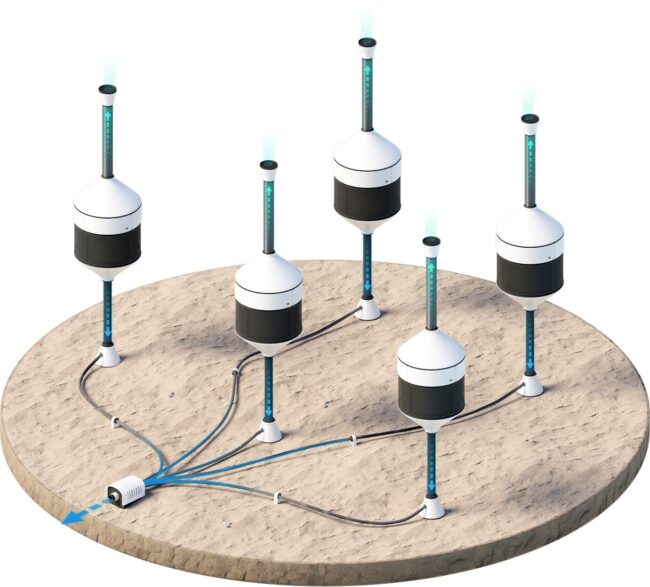
OceanWell and Eau d’Azur have signed a memorandum of understanding to deploy France’s first subsea water farm off the coast of Nice, marking the European debut of a modular, deep-sea desalination system designed to reshape water security strategies in drought-prone coastal regions. The pilot program, set to begin in 2026, will evaluate the energy efficiency, ecological viability, and scalability of OceanWell’s reverse-osmosis technology that operates at depths of over 400 meters.
This collaboration, which also establishes OceanWell’s European headquarters in Nice, signals a strategic pivot toward offshore infrastructure models in the global desalination sector. With climate stress increasing across Southern Europe, the Côte d’Azur pilot will serve as a critical test case for subsea freshwater harvesting systems that promise to bypass the environmental and cost constraints of land-based desalination plants. If successful, the platform could lay the groundwork for commercial deployments across the Mediterranean by 2030 and challenge long-standing assumptions about how utilities manage water scarcity.

How does OceanWell’s subsea water farm technology differ from conventional desalination approaches?
OceanWell’s modular desalination pods operate by harnessing natural hydrostatic pressure at extreme depths to drive the reverse osmosis process without the need for energy-intensive surface pumping systems. Each pod can harvest up to 4,000 cubic meters of potable water per day using ocean pressure alone. This eliminates the need for large coastal facilities and sharply reduces energy consumption, which has traditionally been a major hurdle in scaling desalination capacity in environmentally sensitive regions.
Conventional desalination plants are often hampered by a triple burden: high energy requirements, brine disposal challenges, and local ecological disruption from intake and discharge systems. OceanWell’s design addresses each of these issues directly. By placing the system offshore and deep underwater, brine is diffused more naturally within the ocean’s thermocline, and intake occurs in low-bioactivity zones, minimizing harm to marine ecosystems.
The energy savings alone are substantial. OceanWell claims its platform can achieve up to 40 percent lower energy consumption compared to traditional plants, making it a compelling solution for regions struggling to balance water needs with decarbonization goals. The modular design also supports staged deployment, which reduces upfront capital expenditure and aligns with the budget cycles of municipalities and utilities.
Why is the Côte d’Azur region strategically important for subsea desalination testing?
The Nice Metropolis and broader Côte d’Azur region have become increasingly vulnerable to climate-induced water stress. Summers are hotter, rainfall is less predictable, and local aquifers are under increasing strain from urban expansion and tourism demand. By working with Eau d’Azur, the public utility responsible for water services in 51 municipalities across the Nice region, OceanWell gains access to a highly visible, infrastructure-forward municipality that is under pressure to diversify its water portfolio.
This testbed offers more than a technical evaluation. It also serves as a policy sandbox. France is an early mover in the European Union’s Blue Economy framework, and the regulatory lessons from this deployment could inform broader regional permitting, marine protection standards, and subsea infrastructure governance. Moreover, the partnership is supported by Team Nice Côte d’Azur, which played a catalytic role in attracting OceanWell to the region following an economic mission to California in mid-2024.
Through this engagement, OceanWell has established OceanWell France SAS and secured funding support via the Business Landing program operated by Métropole Nice Côte d’Azur. These institutional and regulatory alignments offer a path for the project to evolve from demonstration to commercialization while giving France a leadership position in a frontier water technology market.
What technical risks could impact OceanWell’s European deployment timeline?
The performance of deep-sea infrastructure is notoriously difficult to validate over long durations. OceanWell’s California pilot projects, including the high-profile Water Farm 1 initiative in Santa Monica Bay, have demonstrated core technical viability, but not at the commercial scale envisioned for France. Subsea operations at 400 meters depth introduce persistent engineering risks, including membrane fouling, hardware corrosion, and access limitations for maintenance.
Although OceanWell’s technology has been designed with durable materials and passive pressure-based mechanisms, the lifecycle cost of maintaining a distributed array of pods on the ocean floor remains largely theoretical. Real-world validation in a European regulatory environment will require robust environmental impact assessments, marine biodiversity monitoring, and continuous data reporting.
The pilot program announced with Eau d’Azur is expected to run for 12 months, beginning in 2026. During this period, the partners will focus on site-specific engineering studies, environmental benchmarking, and data collection to support a future decision on commercial deployment between 2028 and 2030. The results of this phase will likely influence utility procurement frameworks, capital markets interest, and public trust in the broader concept of undersea water harvesting.
How could this partnership reshape desalination economics and capital planning for utilities?
If OceanWell’s Mediterranean pilot demonstrates reliable performance and environmental safety, it could introduce a new class of low-footprint desalination infrastructure that circumvents some of the most contentious aspects of land-based plant construction. Coastal desalination projects have often struggled with community resistance, real estate constraints, and permitting delays. OceanWell’s pods, which do not require shoreline land acquisition or large industrial facilities, offer an alternative that may prove politically and economically attractive.
For utilities, this represents more than a technology shift. It is a capital allocation shift. Instead of committing to a single multibillion-euro plant, utilities could deploy smaller clusters of pods in stages, aligning infrastructure investments with demand trends, regulatory windows, and public financing cycles. This offers utilities greater flexibility and lowers the barrier to entry for desalination adoption, particularly in mid-sized municipalities where full-scale plants may be economically unjustifiable.
Additionally, OceanWell’s lower energy profile could support integration with renewable energy procurement goals, especially in jurisdictions facing pressure to decarbonize municipal services. This dynamic may help attract ESG-focused investment funds and green bond issuance tied to climate adaptation projects.
What broader policy and industry signals does the OceanWell–Eau d’Azur collaboration send?
The agreement signals that European utilities are beginning to treat subsea infrastructure as a viable class of assets for climate adaptation and water resilience. Until recently, deep-sea water harvesting remained largely in the realm of research and pilot studies, with operational challenges outweighing perceived benefits. This MOU shifts that narrative.
The project aligns with the European Union’s emphasis on strategic water autonomy and climate resilience, both of which have become priorities in the wake of recent heatwaves and geopolitical disruptions to water-intensive supply chains. Should the pilot achieve its performance goals, it could influence EU-level policies on blue infrastructure funding, marine zoning, and public-private water innovation partnerships.
On a global level, the partnership also positions OceanWell to compete more aggressively in markets where land-based desalination is politically contentious or environmentally constrained. The Middle East, parts of Asia, and climate-affected regions in the United States may all become future target markets if the French deployment succeeds. With financial backing from Kubota Corporation and participation in XPRIZE’s $119 million water scarcity competition, OceanWell is signaling its intent to become a major player in the next generation of water infrastructure.
What happens next if the Nice pilot is successful or underperforms?
If the pilot demonstrates that OceanWell’s pods can operate reliably and cost-effectively while meeting France’s environmental standards, it will likely unlock a broader commercial phase beginning around 2028. This could include additional Mediterranean deployments and serve as a catalyst for similar projects elsewhere in Europe.
Institutional investors may view successful field data as a green light to support hybrid public-private financing models that scale deployment. A successful pilot would also place pressure on incumbent desalination providers and engineering firms to accelerate their own innovation cycles, particularly around energy use and marine protection.
Conversely, underperformance or failure to meet regulatory thresholds could have the opposite effect. It may set back the entire category of subsea desalination technologies, leading to renewed reliance on traditional plants, water reuse systems, and conservation mandates. Utilities could grow skeptical of unproven offshore infrastructure, making it harder for startups to secure follow-on funding or permitting approvals in future jurisdictions.
As with many first-of-kind infrastructure pilots, the outcome in Nice will likely shape both market perception and regulatory positioning for the subsea desalination category as a whole. What begins as a regional partnership may end up influencing global water security strategies.
What does the OceanWell–Eau d’Azur subsea water farm pilot signal for investor confidence, utility procurement, and water policy direction?
OceanWell’s agreement with Eau d’Azur represents more than just a regional pilot; it is a critical inflection point in the evolution of desalination infrastructure. It offers a real-world test of whether modular, deep-sea technology can deliver on its promise of low-energy, low-footprint freshwater generation without ecological damage.
The risks remain high, particularly around engineering complexity, regulatory approval, and operational reliability. But so are the stakes. If the pilot succeeds, it could reframe the economics and deployment models of desalination for the next decade, not only in France but across coastal regions globally.
This development should be closely watched by policymakers crafting water resilience strategies, institutional investors focused on sustainable infrastructure, and water utilities seeking alternatives to legacy desalination systems.
Key takeaways on what this development means for OceanWell, its competitors, and the global water industry
- OceanWell’s partnership with Eau d’Azur launches France’s first pilot of subsea water farm desalination, beginning in 2026 and running for approximately 12 months.
- The technology uses deep-sea pressure to drive reverse osmosis with lower energy and environmental impact than traditional land-based desalination.
- Modular pods could enable utilities to scale desalination flexibly, reduce land use conflicts, and align projects with climate goals.
- The pilot’s environmental impact assessment and engineering studies will be critical in determining commercial readiness by 2028.
- Execution risks include membrane fouling, maintenance challenges, and long-term reliability of infrastructure at 400 meters depth.
- A successful pilot could open up new commercial pathways in Europe, the Middle East, Asia, and U.S. coastal markets facing water stress.
- Failure could stall investor interest and reinforce dependence on traditional desalination or alternative water reuse strategies.
- The outcome will influence future EU regulatory frameworks and could establish a new asset class within the climate-resilient water infrastructure sector.
Discover more from Business-News-Today.com
Subscribe to get the latest posts sent to your email.