

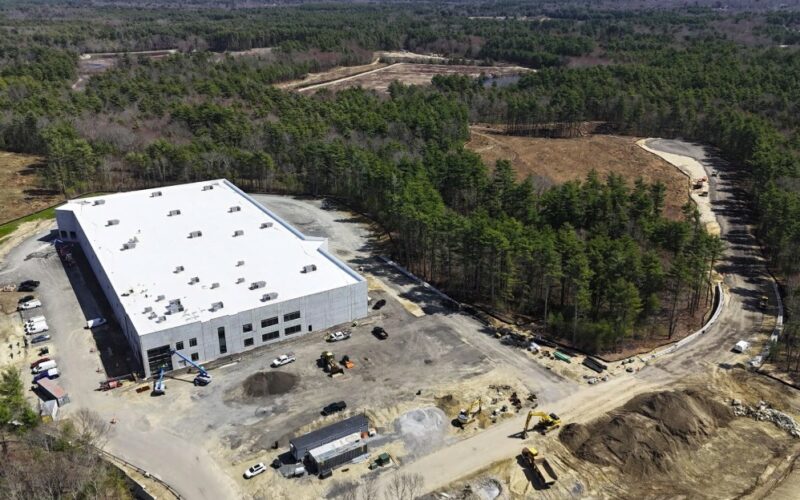
VMD Companies has closed an $11.6 million land sale to Indus at The Campus at Canopy Drive in Middleborough, Massachusetts, marking the second major transaction at the master-planned industrial park in less than a year. The latest closing follows VMD Companies’ $6.6 million sale to REXA, Inc. in September 2025, bringing the combined value of the two deals to $18.2 million and committing nearly 185,000 square feet of development at a site designed to support as much as 700,000 square feet overall. Strategically, the back-to-back transactions matter because they show that a shovel-ready industrial project can still attract occupiers and capital even as higher financing costs and construction inflation have made speculative development harder to underwrite. For Middleborough, the transactions also turn a long-discussed development vision into a more visible employment and tax-base expansion story.
Why does VMD Companies’ second Middleborough land deal matter beyond the headline sale price?
The importance of the Indus closing is not really the $11.6 million alone. Land deals can look impressive in isolation and still mean very little if the broader site lacks momentum, tenant quality, or a credible next phase. What gives this transaction weight is that it follows a prior $6.6 million deal to REXA, Inc. and creates a pattern rather than a one-off event. In industrial real estate, patterns are what lenders, tenants, and local governments care about. One deal can be luck. Two in quick succession starts to look like proof of concept.
That matters especially in the current industrial development environment, where occupiers remain interested in strategically located sites but financing discipline has become much tighter. VMD Companies appears to have benefited from doing the hard and unglamorous work early: assembling the parcels, securing entitlements, and presenting a site that tenants can actually move on. In a market where many projects stall between concept and execution, that preparation becomes a competitive advantage. Industrial parks do not win just because they exist on a map. They win because they remove friction.
The transactions also suggest that The Campus at Canopy Drive is beginning to shift from a development thesis into an operating industrial ecosystem. That is a subtle but important transition. Once multiple occupiers commit, the remaining parcels become easier to market, because prospective tenants are no longer evaluating empty land. They are evaluating a location where other companies have already placed real capital and long-term operating plans.

How is the Indus facility changing the industrial profile of The Campus at Canopy Drive?
For Indus, the plan is not a simple land banking exercise. VMD Companies is developing a 75,000 square foot corporate headquarters and operations facility, along with seven acres of industrial outdoor storage. That combination is notable because it adds a more operationally intensive use case to the campus rather than a passive warehouse footprint. Roadway rehabilitation and pavement preservation require equipment, vehicle movement, materials staging, and logistics coordination, which means the facility has the potential to function as a real employment and activity anchor.
The decision by Indus to consolidate its headquarters and field operations in Middleborough also indicates that the site is serving more than just regional spillover demand from Greater Boston. It is being positioned as a strategic operating base. That makes the development more valuable than a generic industrial park filled with interchangeable distribution boxes. Headquarters and operations facilities tend to create stronger local economic ties, stickier employment, and longer-term occupancy commitment than tenants simply seeking overflow space.
There is also a signaling effect. When a company relocates core operations rather than leasing satellite capacity, it is making a statement about confidence in the site’s accessibility, infrastructure, and future utility. For Canopy Drive, that helps build the narrative that this is a long-duration industrial node rather than a short-cycle speculative project.
Why are local tax incentives and public-private coordination central to this project’s success?
One of the clearest takeaways from the VMD Companies announcement is that municipal alignment was not peripheral to the project. It was central. The Town of Middleborough, led in part through support from Town Manager James McGrail and the Town Meeting process, extended Tax Increment Financing agreements to both Indus and REXA. That matters because industrial site selection is rarely just about geography. It is about the full stack of cost certainty, permitting clarity, local cooperation, and financial support.
Tax Increment Financing can be politically sensitive because critics sometimes treat it as a giveaway. But in competitive industrial development, it often functions as a tool for market realism. Companies choosing where to place facilities are comparing multiple sites, multiple municipalities, and multiple state-level incentive structures. If one town insists on purity while others offer predictable support, guess which town gets the jobs. Economic development is not a poetry contest. It is usually won by the places that understand underwriting.
In Middleborough’s case, the incentive framework appears to have been used to pull in occupiers that could deliver both direct jobs and broader corridor development. Between Indus and REXA, the two companies are expected to bring or support more than 145 jobs, with priority for qualified local hires. That suggests the town is not merely approving industrial space for tax ratables. It is using policy to shape a local employment base around manufacturing and operational uses in the West Grove Street corridor.
What does the REXA project reveal about the type of industrial tenants VMD Companies is attracting?
The REXA facility offers a useful clue to the broader positioning of The Campus at Canopy Drive. This is not a story about low-complexity warehouse absorption alone. REXA is building a 110,000 square foot manufacturing headquarters intended to consolidate engineering, design, and production under one roof. That makes the site more closely associated with advanced industrial and process-control activity than with simple logistics overflow.
The technical specifications of the REXA building also reinforce that point. With two-floor office space, wide bay spacing, significant clear heights, and manufacturing-oriented loading and operational design, the facility has been tailored around production workflow rather than generic occupancy. That is meaningful for VMD Companies because industrial developers increasingly need to show specialization. Generic space can still lease, but more valuable campuses often distinguish themselves by matching design and zoning flexibility to higher-value industrial use cases.
If Canopy Drive continues to attract companies like Indus and REXA, its identity could evolve into something more durable than a standard industrial subdivision. It could become a regional base for mixed industrial activity that blends manufacturing, operational headquarters, storage, and distribution. That mix is harder to replicate and potentially more resilient across economic cycles than pure warehouse concentration.
What happens next as VMD Companies moves toward speculative construction and future leasing?
The next test is not whether VMD Companies can close land deals. It is whether it can convert early momentum into the harder phase of industrial development: speculative execution. The company plans to break ground on Lot 1 in summer 2026, with approximately 240,000 square feet of shallow-bay industrial space across two speculative buildings designed for occupiers ranging from 20,000 to 120,000 square feet. Lot 3, a 12.1-acre parcel permitted for up to 107,000 square feet, remains available and will continue to be marketed by CBRE.
This is where the project becomes more strategically interesting. Land sales validate demand, but speculative buildings require conviction that future occupiers will materialize on a reasonable timeline. The reward is obvious. Spec space gives developers control over lease-up economics, product design, and long-term income generation. The risk is equally obvious. If capital costs remain elevated or tenant decisions slow, carrying vacant industrial product becomes far less comfortable.
Still, VMD Companies may have a credible setup for this phase. The project already has tenant validation, geographic advantages near the Interstate 495 interchange, and access to large labor and customer markets within Greater Boston and Providence. The range of permitted uses, including high-tech manufacturing, warehouse and distribution, research and development, and industrial outdoor storage, also widens the addressable tenant pool. In industrial real estate, flexibility is not glamorous, but it is bankable.
The bigger question is whether Canopy Drive can become known as a cluster rather than a collection of parcels. Cluster effects matter because they create reinforcing demand. Suppliers, service providers, employees, and neighboring tenants all become more comfortable with a location once critical mass begins to form. That is when an industrial park stops relying solely on developer selling and starts benefiting from market pull.
How should executives, investors, and local stakeholders read VMD Companies’ Canopy Drive strategy now?
The best way to interpret the latest transaction is as evidence that VMD Companies is trying to create value through staged de-risking rather than through a single headline development bet. First came land assembly and entitlements. Then came municipal coordination. Then anchor transactions. Next comes speculative buildout. It is a disciplined sequence, and that sequence matters in a market where capital is less forgiving of grand industrial plans that arrive before demand is proven.
For corporate occupiers, the site’s emerging profile offers a practical message: there is still opportunity in secondary and exurban industrial corridors if the infrastructure, incentives, and access routes line up. For developers, the lesson is that shovel-ready status still carries pricing power because it saves tenants time and uncertainty. For local governments, Middleborough’s approach shows that policy coordination can materially alter a project’s commercial viability without requiring reckless subsidy.
What happens next will determine whether Canopy Drive becomes a meaningful industrial address in southeastern Massachusetts or simply a well-executed local success. But the recent closings indicate that the project has moved beyond aspiration. VMD Companies is no longer selling only a future map of what could happen at Middleborough Industrial Park. It is now selling a campus where capital has already shown up, buildings are underway, and the next phase is about scale rather than credibility.
What are the key takeaways on what VMD Companies’ Canopy Drive expansion means for industrial real estate in Massachusetts?
- VMD Companies’ $11.6 million sale to Indus matters because it confirms repeat demand at Canopy Drive, not just isolated transaction activity.
- The combined $18.2 million in land closings with Indus and REXA signals that Middleborough is becoming a credible industrial destination rather than a speculative concept.
- Indus adds operational intensity to the site through headquarters, field operations, and outdoor storage, which strengthens the campus beyond standard warehouse use.
- REXA’s manufacturing headquarters raises the quality profile of the tenant base and suggests the site can support more advanced industrial users.
- Middleborough’s Tax Increment Financing strategy appears to have been a decisive tool in converting interest into signed commitments and local job creation.
- VMD Companies’ phased execution model reduces risk by stacking entitlements, incentives, tenant commitments, and future speculative development in sequence.
- The planned Lot 1 speculative buildings will be the next major proof point because speculative construction tests market depth, not just tenant-specific demand.
- Flexible zoning and strong highway access give The Campus at Canopy Drive a broader leasing universe across manufacturing, logistics, research, and storage uses.
- If additional tenants follow, Canopy Drive could develop cluster effects that improve leasing momentum and raise the strategic value of the remaining parcels.
- For Massachusetts industrial real estate, the project highlights how secondary locations can compete when site readiness, municipal support, and development discipline align.
Discover more from Business-News-Today.com
Subscribe to get the latest posts sent to your email.