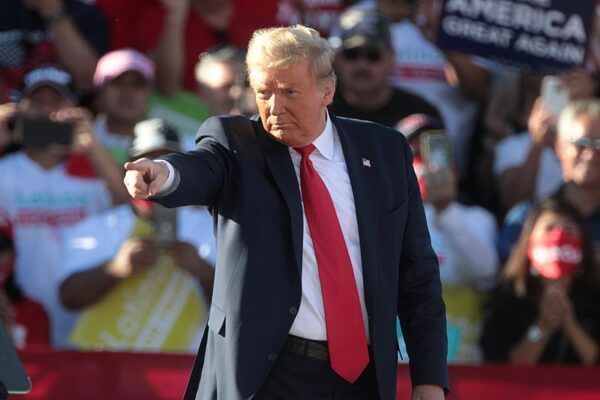

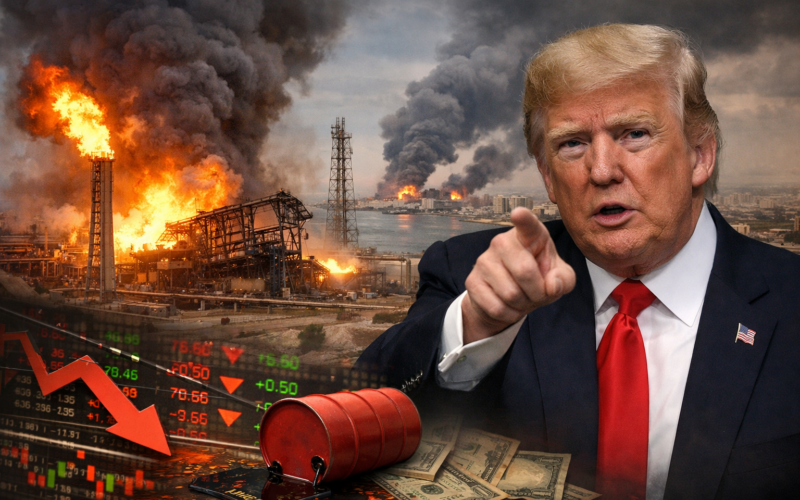
United States President Donald Trump has directed Israeli Prime Minister Benjamin Netanyahu to halt further strikes on Iranian energy infrastructure, after the Israeli Air Force bombed the South Pars Gas Field in Iran’s Bushehr province on Wednesday, March 18, 2026. The strike marked the first time Israel had targeted Iranian natural gas production facilities since the United States and Israel jointly launched Operation Epic Fury against Iran on February 28, 2026.
Trump issued his position through a post on the Truth Social platform, stating that Israel had acted unilaterally and that the United States had no prior knowledge of the attack. Trump described Israel as having “violently lashed out” at South Pars and confirmed that only a limited portion of the facility had been struck. He stated there would be no further Israeli strikes on the gas field. At the same time, Trump issued a direct threat to Iran: if Tehran continued striking Qatar’s liquefied natural gas facilities, the United States would strike the entirety of the South Pars Gas Field with force on a scale Iran had not previously experienced.
Trump’s denial of prior knowledge was disputed from multiple directions within hours of the post. United States and Israeli officials told journalists that the strike had been coordinated with and approved by the White House before it was executed. Axios reported, citing an unnamed United States defense official and two senior Israeli officials, that Trump and Netanyahu had discussed the strike in advance, with the intent of sending a deterrent message to Tehran over its continuing closure of the Strait of Hormuz to shipping from the United States, Israel, and their Western allies. The Wall Street Journal separately reported that Trump had supported the operation as a signal to Iran. Three Israeli officials told Reuters, speaking anonymously, that Israel was not caught off guard by Trump’s subsequent public distancing from the strike, describing the dynamic as consistent with a pattern that had emerged after an earlier Israeli attack on Iranian fuel depots in which Trump also initially denied advance knowledge while officials confirmed coordination.
In the Oval Office on Thursday, March 19, Trump appeared to partly acknowledge the sequence of events, telling reporters he had instructed Netanyahu not to carry out the strike. “I told him don’t do that,” Trump said. That statement stood alongside his earlier claim that the United States had no involvement, creating a dual public posture in which Trump sought simultaneously to distance Washington diplomatically from the operation while signalling continued strategic alignment with Israel and issuing an escalatory threat of his own toward Iran.
How did Operation Epic Fury escalate to include Iranian natural gas production sites in Bushehr province?
The United States and Israel launched Operation Epic Fury on February 28, 2026, initially targeting Iranian military facilities, nuclear sites, and senior leadership. Supreme Leader Ali Khamenei was killed in early strikes. In the weeks that followed, Iran’s Islamic Revolutionary Guard Corps closed the Strait of Hormuz to shipping from the United States, Israel, and their Western allies, halting transit through a waterway through which approximately one-fifth of the world’s oil supply normally flows. The closure sent oil prices sharply higher and triggered emergency responses from governments across Asia and Europe.
Prior to the South Pars strike, both American and Israeli planners had refrained from targeting Iranian oil and gas production infrastructure, treating such action as a potential trigger for catastrophic regional economic retaliation. Reporting from Axios dated March 10, 2026, had confirmed that the Trump administration had previously asked Israel not to strike Iranian energy facilities, with one source describing such action as a “doomsday option” to be held in reserve only if Iran first attacked Gulf oil facilities. The South Pars strike represented a departure from that established restraint and one that carried significant strategic risk given the interconnected energy infrastructure of the Persian Gulf region.
Why did Iran retaliate against Qatar, Saudi Arabia, and the United Arab Emirates after the South Pars strike?
The consequences of the South Pars strike materialized rapidly. Iran launched missile attacks on energy infrastructure across the Persian Gulf in retaliation. Iran struck Qatar’s Ras Laffan Industrial City, the world’s largest liquefied natural gas complex. QatarEnergy confirmed extensive damage to its Ras Laffan gas-to-liquid facility and halted all gas production. Iran targeted facilities in the United Arab Emirates, prompting suspension of operations at the Habshan gas facility and the Bab oilfield. Saudi Arabia intercepted missiles directed at Riyadh, with debris falling near a refinery south of the city. Iran also struck two Kuwaiti gas units and hit the SAMREF refinery in the Red Sea port city of Yanbu, where Saudi Arabia had been diverting oil exports westward to avoid the Strait of Hormuz closure. Overnight, Iran launched at least six waves of missiles at Israel, including cluster munitions, which Iranian forces had not previously deployed in the conflict.
Iran’s President Masoud Pezeshkian condemned the South Pars strike, warning of “uncontrollable consequences” that could affect the entire world. A senior Iranian security source told CNN that Tehran’s confrontation with the United States and Israel had expanded into a regional war and warned that the Strait of Hormuz “will not return to pre-war conditions.” Iranian Foreign Minister Abbas Araghchi warned Thursday that any nation assisting United States efforts to reopen the Strait of Hormuz would be complicit in what Tehran described as “war crimes,” directing that message at Japan during a call with Japanese Foreign Minister Toshimitsu Motegi.
What is the South Pars Gas Field and why does damage to it threaten Iranian energy supply and global markets?
South Pars is the world’s largest known natural gas reserve, with approximately 1,800 trillion cubic feet of reserves, shared between Iran and Qatar. Approximately 80 percent of all electricity generated in Iran is derived from natural gas, according to the International Energy Agency, based in Paris. Iran consumes approximately 94 percent of the natural gas it produces domestically, owing to sanctions and technical constraints that limit export capacity. While strikes on Iranian facilities were expected to have a limited direct effect on global gas supply given Iran’s high domestic consumption, Tehran’s retaliatory strikes on Gulf energy infrastructure posed the greater threat to world markets.
QatarEnergy said damage to its Ras Laffan facility could delay Qatar’s ability to supply global markets even after the conflict ends, with estimates that repairs may take three to five years. The damage at Ras Laffan also threatened global fertilizer production, given the facility’s role as a major source of feedstock for chemical manufacturing. Qatar had previously halted production earlier in the conflict due to separate strikes, and the renewed extensive damage further reduced the country’s capacity to fill any global supply gap created by the Strait of Hormuz closure.
How did the Israeli strike on South Pars and Iran’s Gulf retaliation affect oil prices and global financial markets?
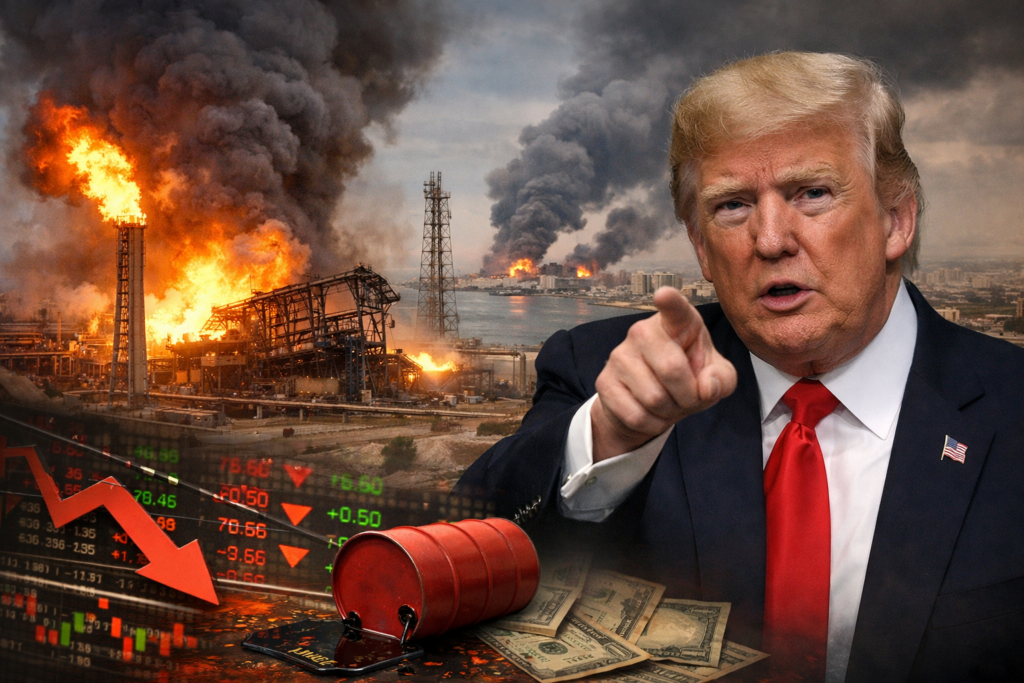
Global energy and financial markets reacted severely. Brent crude futures rose above $116 per barrel on Thursday, March 19, while United States crude futures climbed above $97 per barrel, according to Reuters. Natural gas prices across Europe increased by more than 30 percent. The average retail price for a gallon of regular gasoline in the United States reached $3.88, according to data from the American Automobile Association. Japan’s Nikkei stock index fell more than 3 percent, South Korean equities fell 2.8 percent, and European futures declined more than 1.5 percent. The World Trade Organization estimated that if oil and liquefied natural gas prices remained elevated throughout 2026 due to the conflict, global goods trade growth could slow to 1.4 percent for the year.
What did Netanyahu confirm about United States requests to halt Israeli strikes on Iranian energy infrastructure?
Prime Minister Netanyahu addressed the South Pars controversy at a press conference on Thursday, confirming that the United States had asked Israel to halt further strikes on Iranian energy infrastructure and that Israel was complying with that request. “President Trump asked us to hold off on future attacks, and we are,” Netanyahu said. Netanyahu claimed Israeli strikes had significantly degraded Iran’s military capabilities, asserting Tehran could no longer enrich uranium or manufacture ballistic missiles. He did not provide evidence to substantiate those claims. He framed the military campaign as aimed at eliminating Iran’s nuclear and ballistic missile programs before those capabilities could be moved deeper underground beyond the reach of aerial attack.
Director of National Intelligence Tulsi Gabbard told Congress on Wednesday that Iran’s new Supreme Leader, Mojtaba Khamenei, had been seriously injured in an Israeli strike. However, Gabbard also assessed that Iran’s governing structure appeared to remain intact, though “largely degraded.” Defense Secretary Pete Hegseth confirmed at a Thursday Pentagon briefing that the United States had struck more than 7,000 targets across Iran since the beginning of the conflict and said Thursday’s operations would constitute the “largest strike package yet.”
How are Gulf states, European governments, and the United Nations responding to the regional energy infrastructure crisis?
Regional responses were immediate. Qatar expelled Iranian military and security attaches from the Iranian Embassy in Doha, ordering them to leave within 24 hours. Saudi Arabia’s Foreign Minister Prince Faisal bin Farhan Al Saud said that “what little trust there was before with Iran has completely been shattered.” The United Arab Emirates described Iranian strikes on its territory as a “terrorist attack” representing a “dangerous escalation.” Arab League Secretary-General Ahmed Aboul Gheit condemned the Iranian strikes as a “dangerous escalation.” The United States State Department announced multi-billion-dollar arms sales to the United Arab Emirates, Kuwait, and Jordan, encompassing air and missile defense systems, aircraft, munitions, and drone-interception equipment.
French President Emmanuel Macron called for an immediate moratorium on strikes targeting civilian infrastructure, including energy and water facilities, following telephone calls with Trump and the Emir of Qatar. German Foreign Minister Johann Wadephul warned of a “crisis of the gravest order” if global supply chain disruption continued. The United Kingdom deployed a small contingent of military planners to join United States Central Command personnel to develop a plan to reopen the Strait of Hormuz. The United Kingdom, France, Germany, Italy, the Netherlands, and Japan issued a joint statement expressing readiness to contribute to efforts ensuring safe passage through the Strait of Hormuz and pledging to work with producing nations to stabilize energy markets.
United States President Trump pressed Japanese Prime Minister Sanae Takaichi, who visited the White House on Thursday, to send minesweepers to the Strait of Hormuz, noting that Japan sources more than 90 percent of its oil through the waterway. Takaichi said Japan and the United States had confirmed the importance of calming the situation and ensuring the safety of navigation in the Strait of Hormuz and the stable supply of energy.
The Pentagon is requesting an additional $200 billion from Congress to fund and resupply United States military operations related to the Iran conflict. The Washington Post reported the figure, citing a senior administration official. Defense Secretary Hegseth declined to directly confirm the number at his Thursday briefing but indicated it could change and said funding discussions with Congress were ongoing. Trump, when asked about the $200 billion figure, described it as “a small price to pay” to keep the military in its best condition, adding that funding was needed for reasons that extended beyond the Iran conflict.
United Nations Secretary-General Antonio Guterres called for “diplomacy to prevail over war” and issued what he described as two clear messages. He urged the United States and Israel to end a war he described as “risking to get out of control,” causing immense suffering on civilians with dramatic effects on the global economy. He called on Iran to stop attacking its neighbors, which “were never parties to the conflict.” The United Nations Security Council had condemned Iran’s attacks on neighboring states and ordered them to stop, alongside demands to reopen the Strait of Hormuz. Russia’s Foreign Ministry issued a fresh call for the “fastest possible cessation of hostilities,” attributing responsibility to what it described as “unprovoked aggression” by the United States and Israel, and stated that Russia, together with China and Turkey, was ready to assist in diplomatic efforts toward a settlement.
What does Israel’s South Pars strike and Trump’s energy warning mean for the Middle East conflict and global markets?
- Israel struck Iran’s South Pars Gas Field on Wednesday, March 18, 2026, in the first Israeli attack on Iranian natural gas production facilities since Operation Epic Fury began on February 28, 2026. United States President Trump subsequently confirmed on Truth Social that Israel would not attack the facility again, while simultaneously threatening that the United States itself would destroy the entire South Pars field if Iran continued targeting Qatar’s liquefied natural gas infrastructure.
- Multiple United States and Israeli officials confirmed the South Pars operation was coordinated with and approved by the White House in advance, directly contradicting Trump’s public claim of no prior knowledge. Israeli Prime Minister Netanyahu later confirmed at a press conference that the United States had asked Israel to halt future strikes on Iranian energy infrastructure and that Israel was complying.
- Iran retaliated by striking energy facilities across the Persian Gulf, hitting Qatar’s Ras Laffan Industrial City, targeting gas facilities in the United Arab Emirates, attacking two Kuwaiti gas units, and striking Saudi Arabia’s SAMREF refinery in Yanbu. Qatar halted all gas production, and QatarEnergy warned that repairs to the Ras Laffan facility could take three to five years.
- Global energy markets reacted sharply, with Brent crude briefly surpassing $116 per barrel and natural gas prices across Europe rising more than 30 percent. The Pentagon simultaneously submitted a request for an additional $200 billion in Congressional funding for war operations, with Defense Secretary Pete Hegseth declining to confirm the figure directly but indicating the amount could change.
- The United Kingdom, France, Germany, Italy, the Netherlands, and Japan issued a joint statement condemning Iranian attacks on commercial vessels and energy infrastructure across the Gulf and expressing readiness to contribute to efforts to ensure safe passage through the Strait of Hormuz. United Nations Secretary-General Antonio Guterres called on both sides to halt hostilities, warning that the conflict risked getting out of control with dramatic consequences for the global economy.
Discover more from Business-News-Today.com
Subscribe to get the latest posts sent to your email.