


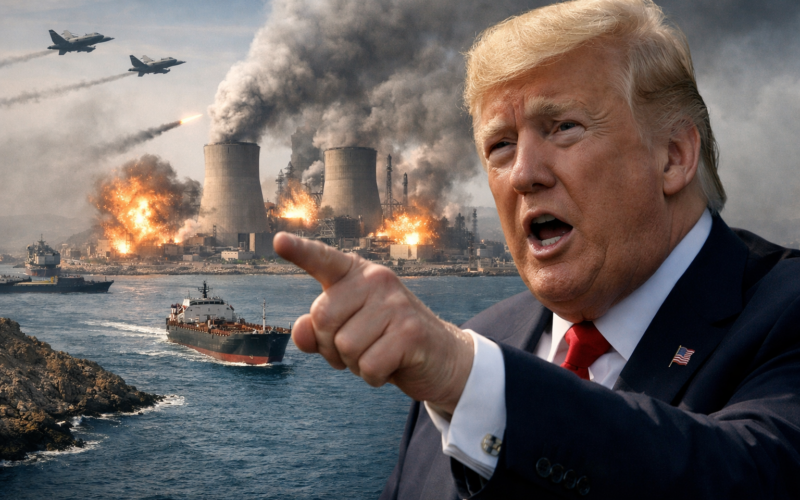
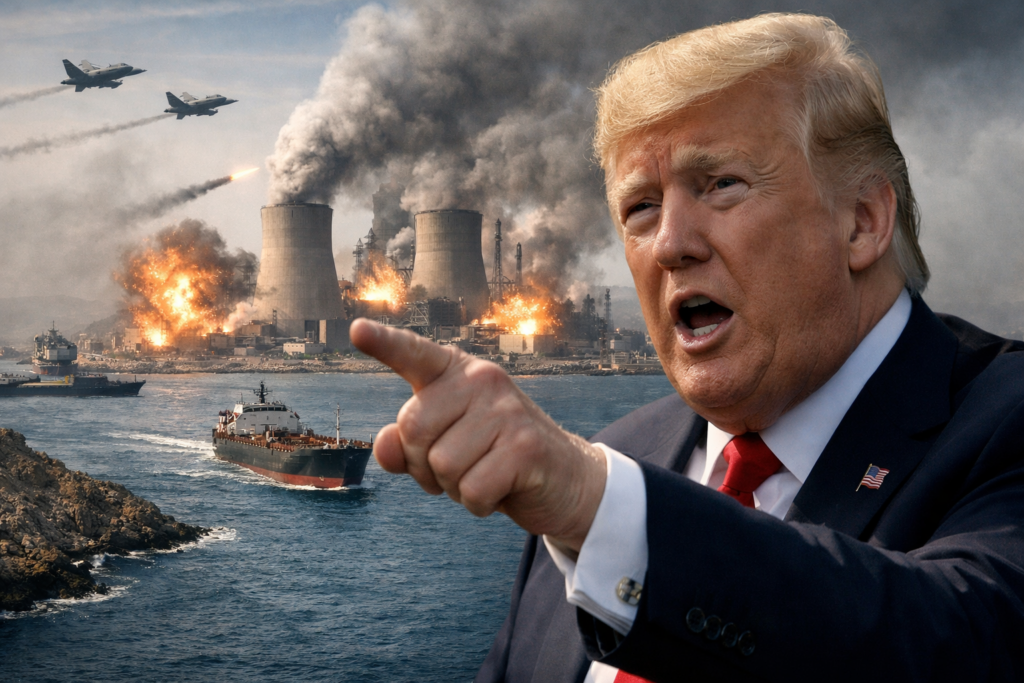
United States President Donald Trump issued a direct ultimatum to Iran on Saturday, March 22, 2026, threatening to strike and destroy Iranian power plants if Tehran does not fully reopen the Strait of Hormuz to commercial shipping within 48 hours. Trump delivered the warning in a post on his Truth Social platform, writing: “If Iran doesn’t FULLY OPEN, WITHOUT THREAT, the Strait of Hormuz, within 48 HOURS from this exact point in time, the United States of America will hit and obliterate their various POWER PLANTS, STARTING WITH THE BIGGEST ONE FIRST!” The president did not identify which Iranian facility he was referring to as the largest. The post came on the 22nd day of the United States and Israel’s military campaign against Iran, which was launched on February 28, 2026.
The ultimatum represented a significant escalation in United States rhetoric and came less than 24 hours after Trump had signalled a different policy direction. The comments marked a departure from Trump’s statement on Friday in which he said he was thinking about winding down the military operation and suggested the responsibility for policing the Strait of Hormuz would fall to the countries most dependent on shipping through the corridor. Trump’s rapidly shifting positions have left governments and financial markets attempting to interpret United States policy intent in real time.
Why the Strait of Hormuz remains the central pressure point in the United States and Iran conflict
The Strait of Hormuz is 21 miles wide at its narrowest point, forming a seaway passage between Iran and Oman. Its two unidirectional sea lanes facilitate the transit of around 20 million barrels of oil per day, representing roughly 20 percent of global seaborne oil trade, primarily from producers including Saudi Arabia, the United Arab Emirates, Iraq, and Qatar. In addition to crude oil, the strait serves as the primary export corridor for Qatari liquefied natural gas, making it a dual chokepoint for both oil and natural gas supply chains.
Brent crude oil prices surpassed 100 United States dollars per barrel on March 8, 2026 for the first time in four years, rising to 126 United States dollars per barrel at their peak. The closure of the Strait of Hormuz has been described as the largest disruption to the global energy supply since the 1970s energy crisis. Many oil producers including Iraq and Kuwait began curtailing their production in early March 2026 as local storage capacity filled up and export infrastructure became inaccessible. The Dallas Federal Reserve Bank has estimated that a closure of the Strait that removes close to 20 percent of global oil supplies from the market is expected to raise the average West Texas Intermediate price of oil to 98 United States dollars per barrel and lower global real gross domestic product growth by an annualised 2.9 percentage points.
How the United States military has sought to degrade Iran’s ability to control Strait of Hormuz shipping
Prior to Trump’s ultimatum, the head of United States Central Command, Admiral Brad Cooper, released a video update on day 22 of the combat mission stating that Iran’s ability to threaten the Strait of Hormuz had been degraded. Cooper said United States forces had dropped multiple 5,000-pound bombs on an underground Iranian coastal facility storing anti-ship cruise missiles, mobile missile launchers, and equipment used to monitor and target international shipping. Cooper stated that the strike also destroyed intelligence support sites and missile radar relays used to track ship movements, adding that United States forces would continue pursuing these targets.
Iran has maintained a selective interpretation of the waterway’s status. Tehran has said the Strait of Hormuz is open to all except the United States and its allies. Iranian Foreign Minister Abbas Araghchi stated last week that he had been approached by a number of countries seeking safe passage for their vessels and confirmed negotiations with Japan on facilitating the passage of Japanese ships were ongoing. The Islamic Revolutionary Guard Corps separately declared it would not allow a litre of oil linked to the United States, Israel, or their allies to pass through the strait, warning that any vessel linked to those parties would be considered a legitimate target.
The disconnect between the United States military’s stated assessment, Trump’s escalatory rhetoric, and Iran’s selective passage policy reflects the complex and contested nature of the Strait of Hormuz situation entering the fourth week of the conflict.
Iran strikes Israeli cities of Dimona and Arad as conflict enters a dangerous new phase
The escalation of Trump’s rhetoric on Saturday coincided with a series of significant battlefield developments. Late on Saturday, Iranian missiles struck the southern Israeli cities of Dimona and Arad, injuring dozens of people including children, in separate strikes. Israel’s secretive nuclear research centre is approximately 13 kilometres southeast of Dimona, and both cities lie near several military installations, including Nevatim Air Base, one of Israel’s largest. Israeli military spokesperson Brigadier General Effie Defrin acknowledged that air defences had not intercepted the strikes and that an investigation would follow.
Iran said the strike on Dimona was in retaliation for an earlier Israeli strike on the Natanz uranium enrichment facility, which is Iran’s main nuclear enrichment site and located approximately 135 miles southeast of Tehran. Iranian officials and the semi-official Tasnim news agency reported that no radioactive material was released following the Natanz strike. The United Nations nuclear watchdog has stated that the bulk of Iran’s estimated 970 pounds of enriched uranium is located beneath the rubble at its Isfahan facility, with a lesser amount at Natanz. The White House has stated that preventing Iran from ever acquiring nuclear weapons is a key objective of the war launched alongside Israel on February 28.
Iran’s ballistic missile strike on Diego Garcia reveals extended long-range capability threatening European capitals
Iran launched two ballistic missiles at the joint United States and United Kingdom military base at Diego Garcia in the Indian Ocean, with a range of approximately 4,000 kilometres. The Israeli military said it was the first time Iran had used long-range missiles since the start of the conflict. Israeli Chief of Staff Lieutenant General Eyal Zamir stated in a public statement on Saturday: “These missiles are not intended to strike Israel. Their range reaches European capitals. Berlin, Paris, and Rome are all within direct threat range.” Neither missile struck the base, according to a United States official.
The Diego Garcia launch carries significance beyond its immediate military result. Iran had publicly stated in February 2026 that it was not developing long-range missiles and had limited its ballistic missile range to below 2,000 kilometres. The March 20 strike toward Diego Garcia at approximately 4,000 kilometres directly contradicted those public assurances and raised assessments of Iran’s ballistic missile capability across Western defence establishments. The attack demonstrated a capability that goes beyond what Iran was known to have possessed at the time of the February public statements.
The United Kingdom’s Ministry of Defence condemned the strikes, with a spokesperson stating that Iran’s attacks, including the attempted strike on Diego Garcia and the closure of the Strait of Hormuz, represent a threat to British interests and British allies. The United Kingdom has allowed United States bombers to use the Diego Garcia base to strike Iranian targets, though it has not directly participated in offensive operations against Iran.
How 22 nations and the International Energy Agency have responded to the Strait of Hormuz closure and Iranian attacks
A coalition of 22 countries released a joint statement on Saturday condemning Iran’s actions in the strongest terms. The nations include Australia, Bahrain, Canada, Czechia, Denmark, Estonia, Finland, France, Germany, Italy, Japan, Latvia, Lithuania, the Netherlands, New Zealand, Norway, the Republic of Korea, Romania, Slovenia, Sweden, the United Arab Emirates, and the United Kingdom. The joint statement condemned Iran’s attacks against unarmed civilian shipping vessels, attacks on oil and gas infrastructure throughout the Gulf, and Iran’s effort to shut down traffic in the Strait of Hormuz. The nations called on Iran to cease immediately its threats, the laying of mines, drone and missile attacks, and other attempts to block the strait to commercial shipping, and to comply with United Nations Security Council Resolution 2817.
The International Energy Agency has sought to cushion global markets from the supply shock. The agency announced that all 32 of its member countries had unanimously agreed to release 400 million barrels of oil from their emergency reserves. International Energy Agency Executive Director Fatih Birol stated that while the reserve release represented a major action, the most important condition for a return to stable flows of oil and natural gas remained the resumption of transit through the Strait of Hormuz. The United States Energy Information Administration estimates that 400 million barrels of released reserves would cover roughly four days of global oil consumption at current rates.
The Trump administration separately lifted some sanctions to allow the sale of Iranian oil currently at sea, in an attempt to ease supply constraints. During the course of the war with Iran, retail gasoline prices in the United States have risen 93 cents per gallon, and the price of United States crude oil has increased more than 70 percent since the start of the year. Trump also waived the Jones Act for 60 days to ease domestic shipping regulations on oil.
Trump stated in a separate Truth Social post that Iran wants to make a deal, though he said he does not want one, arguing he had met his objectives weeks ahead of schedule and that the United States had dealt severe damage to Iran’s military capacity. Israel’s Defence Minister Israel Katz said the joint campaign would intensify significantly in the coming days, adding that Iran’s leadership would be among the targets. Israeli Chief of Staff Lieutenant General Eyal Zamir described the campaign as at roughly the halfway stage.
What this development means for Iran, the United States, Israel, and the global energy order
- United States President Donald Trump issued a 48-hour ultimatum to Iran on March 22, 2026, threatening to strike and obliterate Iranian power plants if Tehran does not fully reopen the Strait of Hormuz, a waterway through which approximately 20 percent of global oil and liquefied natural gas supplies normally transit.
- Iran’s military responded by threatening to target all United States energy infrastructure in the region if Iranian fuel and energy infrastructure is attacked, while Iranian ballistic missiles struck the Israeli cities of Dimona and Arad injuring more than 100 people, and an attempted strike on the joint United States and United Kingdom base at Diego Garcia in the Indian Ocean demonstrated an Iranian long-range ballistic missile capability that Iran had publicly denied possessing.
- United States Central Command reported that Iran’s ability to threaten shipping in the Strait of Hormuz had been degraded following strikes on an underground coastal facility storing anti-ship missiles and radar infrastructure, though Iran maintained the strait remains closed to vessels linked to the United States, Israel, and their allies.
- Brent crude oil prices have reached as high as 126 United States dollars per barrel since the start of the conflict, representing the largest disruption to the global energy supply since the 1970s energy crisis, with the International Energy Agency authorising an emergency release of 400 million barrels from member state reserves.
- A coalition of 22 nations, including France, Germany, Japan, the United Arab Emirates, and the United Kingdom, issued a joint statement condemning Iran’s attacks on civilian shipping and oil infrastructure and calling on Tehran to comply with United Nations Security Council Resolution 2817.
Discover more from Business-News-Today.com
Subscribe to get the latest posts sent to your email.