




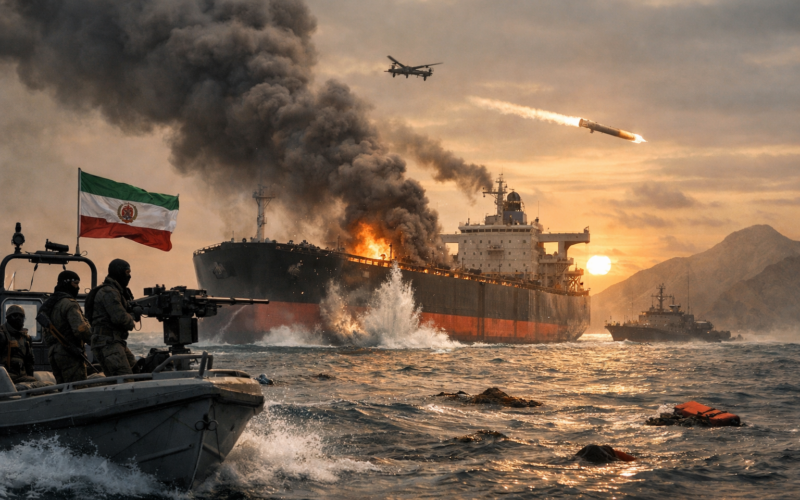
The leaders of the United Kingdom, France, Germany, Italy, the Netherlands, and Japan issued a joint statement on 19 March 2026 condemning attacks by Iran on unarmed commercial vessels in the Gulf, strikes on civilian infrastructure including oil and gas installations, and the de facto closure of the Strait of Hormuz by Iranian forces.
The six governments expressed deep concern about the escalating conflict and called on Iran to cease immediately all threats, the laying of mines, drone and missile attacks, and other attempts to obstruct the Strait of Hormuz to commercial shipping. The statement called explicitly on Iran to comply with United Nations Security Council Resolution 2817, adopted on 11 March 2026.
The six governments affirmed that freedom of navigation is a fundamental principle of international law, including under the United Nations Convention on the Law of the Sea. They emphasised that the consequences of Iran’s actions would be felt by people in all parts of the world, with the most vulnerable populations bearing the greatest burden.
Citing United Nations Security Council Resolution 2817, the statement characterised Iranian interference with international shipping and the disruption of global energy supply chains as a threat to international peace and security. In that context, the six governments called for an immediate and comprehensive moratorium on attacks on civilian infrastructure, including oil and gas installations.

Why did six nations issue a joint statement condemning Iran over Strait of Hormuz attacks on 19 March 2026
The joint statement by the six leaders on 19 March 2026 comes at a critical juncture in a conflict that has escalated sharply since late February. The current crisis originated on 28 February 2026 when the United States and Israel launched coordinated military strikes against Iran. Iranian forces responded by declaring the Strait of Hormuz closed to commercial shipping, with the Islamic Revolutionary Guard Corps formally announcing full control of the strait on 4 March 2026 and threatening and carrying out attacks on vessels attempting to transit.
As of 12 March 2026, Iran had made 21 confirmed attacks on merchant ships. Tanker traffic through the strait dropped by approximately 70 percent, and over 150 ships had anchored outside the waterway to avoid the risk of attack. According to the United Nations Trade and Development agency, ship traffic through the Strait of Hormuz dropped 97 percent from its pre-conflict levels amid the war.
How United Nations Security Council Resolution 2817 responded to Iranian attacks on Gulf states and shipping lanes
United Nations Security Council Resolution 2817 was adopted on 11 March 2026 and was presented by the Kingdom of Bahrain on behalf of the Gulf Cooperation Council member states. The resolution was co-sponsored by approximately 135 countries and was adopted with 13 votes in favour, with China and the Russian Federation abstaining. Resolution 2817 determined that Iran’s attacks constituted a breach of international law and demanded their immediate cessation. The text specified that any attempt to impede lawful transit passage or freedom of navigation through the Strait of Hormuz constitutes a threat to international peace and security. The resolution condemned Iran’s attacks against Bahrain, Kuwait, Oman, Qatar, Saudi Arabia, the United Arab Emirates, and Jordan, and demanded the immediate cessation of Iranian attacks against residential areas and civilian objects.
How the Strait of Hormuz closure in 2026 disrupted global oil markets and energy supply chains worldwide
The joint statement by the six governments reflects the severity of the economic and humanitarian impact of the Strait of Hormuz crisis. The strait is one of the most strategically important maritime chokepoints in the global economy. The waterway carries approximately 20 percent of global petroleum liquids consumption and serves as the primary export route for oil producers including Saudi Arabia, the United Arab Emirates, Kuwait, Iraq, and Iran. The International Energy Agency described the conflict as generating the largest supply disruption in the history of the global oil market, with only a trickle of supply passing through the Strait of Hormuz from its prior levels of approximately 20 million barrels per day.
The International Energy Agency’s oil market report noted that since the outbreak of the war, shipments through the Strait of Hormuz had plummeted to less than 10 percent of their pre-crisis flows, with an estimated 7.9 million barrels per day of crude and 9.9 million barrels per day of total liquids shut in across Gulf producers in March 2026. The price impact has been felt across global energy markets, with natural gas prices rising sharply in Europe and Asia and Brent crude trading well above $90 per barrel since the onset of the conflict.
The disruption has affected civilian populations far beyond the immediate conflict zone. The closure of the Strait of Hormuz has constrained energy supplies to economies across Asia, Europe, and beyond. Countries including India, Japan, China, and South Korea, which source large proportions of their energy needs from Gulf producers, face supply shortfalls that strategic petroleum reserves can only partially offset.
What the International Energy Agency strategic petroleum reserve release means for global oil prices in 2026
The six governments welcomed the decision by the International Energy Agency to authorise a coordinated release of strategic petroleum reserves. The International Energy Agency announced the largest-ever release of emergency oil stocks in the organisation’s history, with its 32 member countries agreeing to release a total of 400 million barrels from strategic reserves. The United States committed to releasing 172 million barrels from its Strategic Petroleum Reserve, representing 43 percent of the total International Energy Agency release and the largest single-country drawdown in the organisation’s 50-year history.
Despite the unprecedented scale of the reserve release, energy analysts and the International Energy Agency itself cautioned that the intervention addressed only a fraction of the supply deficit created by the effective closure of the Strait of Hormuz. The agency described the reserve release as a stop-gap measure and stated that a rapid reopening of the Strait of Hormuz and restoration of protection for Gulf energy infrastructure would be far more consequential for market stabilisation. The six governments stated they would take additional steps to stabilise energy markets, including working with certain oil-producing nations to increase output.
How allied nations are coordinating maritime escort operations to restore safe passage through the Strait of Hormuz
The six governments declared their readiness to contribute to appropriate efforts to ensure safe passage through the Strait of Hormuz and welcomed the commitment of nations engaged in preparatory planning toward that objective. This language reflects widening allied coordination on maritime escort and protection operations in the Persian Gulf region.
France and several partner states moved to establish a defensive escort mission for merchant ships under the framework of Operation Aspides, with France committing approximately twelve ships to the wider Middle East region and designating two frigates to escort commercial vessels through the strait. The United Kingdom, Germany, and Italy were working to support commercial shipping through the Strait of Hormuz as of 10 March 2026. The United States Navy has been directed to develop a plan for escorting merchant ships and tankers through the strait, and the United States separately provided political risk insurance to maritime trade in the region.
The six governments also stated they would work to provide support for the most affected nations through the United Nations and international financial institutions.
Why the Strait of Hormuz crisis in 2026 represents a threat to international peace, security, and global prosperity
The 19 March 2026 joint statement reflects the recognition by the United Kingdom, France, Germany, Italy, the Netherlands, and Japan that the Strait of Hormuz crisis has moved beyond a regional conflict into a challenge with direct consequences for international prosperity and stability. The six governments concluded their statement with a call on all states to respect international law and uphold the fundamental principles of international prosperity and security, noting that maritime security and freedom of navigation benefit all countries.
The crisis has placed significant strain on global energy infrastructure and exposed the degree to which civilian populations worldwide depend on the unimpeded transit of goods through critical maritime chokepoints. The joint statement, aligned with the mandate of United Nations Security Council Resolution 2817, represents an escalation of coordinated diplomatic pressure on Iran by major European and Asian economies alongside continued preparations for potential military escort operations.
What the six-nation Strait of Hormuz statement means for global security, energy markets, and the conflict
- The United Kingdom, France, Germany, Italy, the Netherlands, and Japan condemned Iranian attacks on unarmed commercial vessels, civilian infrastructure including oil and gas installations, and the de facto closure of the Strait of Hormuz, calling on Iran to comply immediately with United Nations Security Council Resolution 2817.
- United Nations Security Council Resolution 2817, adopted on 11 March 2026 with approximately 135 co-sponsors and 13 votes in favour, determined that Iranian interference with maritime navigation through the Strait of Hormuz constitutes a threat to international peace and security and demanded the immediate cessation of all Iranian attacks.
- The International Energy Agency authorised the largest emergency oil reserve release in its history, with 32 member countries committing to release 400 million barrels from strategic petroleum reserves, including 172 million barrels from the United States Strategic Petroleum Reserve, in response to the largest supply disruption in the global oil market’s recorded history.
- The six governments declared readiness to contribute to maritime escort operations to ensure safe passage through the Strait of Hormuz, reflecting widening allied coordination including France’s deployment under Operation Aspides and ongoing planning by the United Kingdom, Germany, Italy, and the United States.
- The six governments committed to additional steps to stabilise energy markets, including engagement with certain oil-producing nations to increase output and support for the most affected countries through the United Nations and international financial institutions.
Discover more from Business-News-Today.com
Subscribe to get the latest posts sent to your email.



