

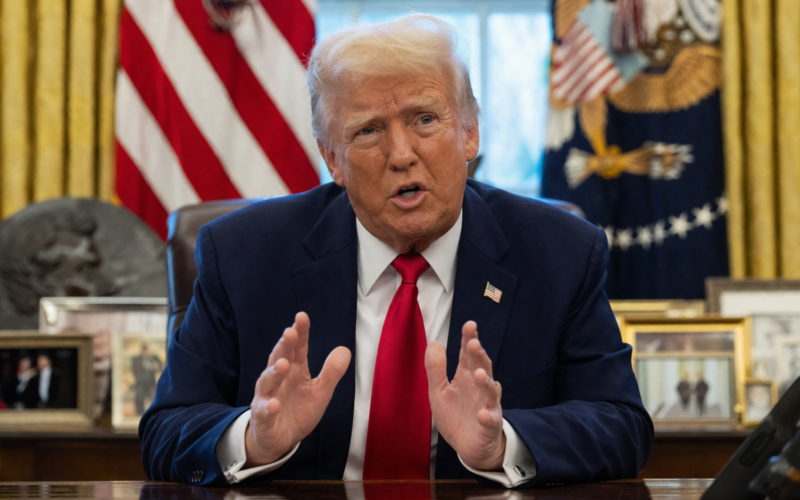
US President Donald Trump said on Friday that the top priority for upcoming talks with Iran in Islamabad was ensuring that Iran does not obtain a nuclear weapon, as Vice President JD Vance traveled to Pakistan to lead the United States delegation in negotiations scheduled to begin on Saturday. Trump also projected confidence about the diplomatic effort, saying the talks were going well and suggesting the issue would be resolved one way or the other, even as the ceasefire underpinning the talks remained fragile and major disputes over the Strait of Hormuz and Lebanon were still unresolved.
The immediate significance of Trump’s remarks is that they narrowed the public negotiating frame to the nuclear question even while the wider crisis has expanded into maritime security, regional proxy conflict, and the durability of a still-contested ceasefire. Reporting from ABC News said Trump identified “no nuclear weapon” as the top priority of the talks, while the Wall Street Journal’s live coverage summarized his comments as saying the prevention of an Iranian nuclear weapon was “99%” of the focus. At the same time, Reuters and Associated Press reporting showed that Washington is still trying to stabilize a ceasefire arrangement that has not fully reopened the Strait of Hormuz and has not ended parallel fighting involving Hezbollah in Lebanon.
Vance left for Islamabad after telling reporters that the United States was willing to negotiate in good faith if Iran was prepared to do the same, but he warned that the American team would not be receptive if Tehran tried to mislead it. ABC News reported that Vance said Trump had given the negotiating team clear guidelines, while the Associated Press said Vance described the talks as potentially positive but paired that optimism with a warning that Iran should not try to “play” the United States. Reuters separately confirmed that Vance will lead the American delegation at the talks.
The negotiations in Islamabad are taking place against the backdrop of a ceasefire that was never presented as a settled peace agreement. Reuters reported earlier this week that a Pakistan-mediated framework contemplated a two-stage process beginning with an immediate ceasefire and moving toward a broader settlement in 15 to 20 days, including Iranian commitments not to pursue nuclear weapons in exchange for sanctions relief and the release of frozen assets. That same Reuters report said the proposed arrangement envisioned in-person talks in Islamabad and was linked to efforts to reopen the Strait of Hormuz, underscoring that the nuclear file is only one part of a larger bargaining structure even if Washington is now emphasizing it above all else in public.
Why are the United States-Iran talks in Islamabad focused so heavily on the nuclear weapon issue right now?
Trump’s remarks suggest the White House wants to simplify a highly entangled regional crisis into a negotiable core demand that can be stated clearly to domestic and international audiences. The nuclear issue offers that clarity. It gives Washington a single, high-visibility benchmark for success while allowing the administration to argue that the talks are not merely about managing a ceasefire breach or restoring shipping routes, but about removing what it considers the central strategic threat. Reuters reported on April 8 that the White House had said Iran had indicated a willingness to turn over enriched uranium stockpiles, a development that would fit directly with Trump’s public emphasis on preventing a nuclear weapon. Reuters also cited the International Atomic Energy Agency as saying Iran had possessed 440.9 kilograms of uranium enriched to 60% before Israeli attacks, material that could become weapons-usable if enriched further.
That framing also reflects how unsettled the ceasefire still appears to be. Reuters reported on Friday that the Trump administration even considered a nationally televised address on the ceasefire, but advisers backed away because they did not think they had enough clarity on the details. The same report said the truce had halted United States and Israeli airstrikes on Iran, but had not ended the closure of the Strait of Hormuz or stopped the separate conflict involving Israel and Hezbollah in Lebanon. In other words, the nuclear objective may be the clearest point of leverage available to Washington in a situation where other components of the crisis remain contested, blurred, or beyond direct U.S.-Iran bilateral control.
How does JD Vance’s trip to Islamabad change the diplomatic and political weight of these Iran negotiations?
Vance’s personal role raises the political profile of the talks because the White House is sending the vice president, not a lower-level envoy, to lead the delegation. Associated Press reported that he is being joined by Trump’s special envoy Steve Witkoff and Jared Kushner, and that the trip represents a rare moment of direct, high-level United States engagement with the Iranian government. ABC News also reported that officials from the National Security Council, the State Department, and the Department of Defense were traveling in support of the negotiations. That broader institutional presence signals that the administration is treating the Islamabad meeting as a serious diplomatic test rather than a symbolic session.
Vance’s own messaging has also mattered because it combined openness with deterrence. Before departure, he said he expected positive discussions, but he also stressed that the United States would extend an open hand only if Iran negotiated in good faith. That combination closely mirrors Trump’s public posture, which has alternated between optimism and threat. Reuters reported that Trump had complained Iran was dishonoring the deal and said the only reason Iranian leaders were still alive was to negotiate. The effect is to make Vance’s mission look less like a reset in tone and more like an attempt to convert battlefield pressure and ceasefire ambiguity into a negotiated outcome under visible presidential terms.
What unresolved disputes over the Strait of Hormuz and Lebanon could still derail the Islamabad negotiations?
The biggest problem for the talks is that the two sides do not appear to agree on what the ceasefire actually covers or what must happen before negotiations can meaningfully advance. Reuters reported that the Strait of Hormuz remained shut on Friday and that the United States and Iran each described disputes around the waterway and around Hezbollah-related fighting in Lebanon as violations of the ceasefire on the eve of the talks. Associated Press reported that Iran’s parliament speaker Mohammad Bagher Qalibaf said a ceasefire in Lebanon and the release of blocked Iranian assets had to be fulfilled before negotiations begin. The same report said Israeli Prime Minister Benjamin Netanyahu and Trump maintained that the truce did not cover Lebanon.
That disagreement matters because it means the Islamabad meeting is not beginning from a stable diplomatic floor. The Strait of Hormuz has become both an economic and political pressure point. Associated Press reported that Iran’s effective closure of the waterway had already had major economic effects, including a rise in United States consumer prices, while Reuters described the disruption as the biggest-ever interruption to global energy supplies. Even if Trump has publicly downplayed that issue compared with the nuclear question, the maritime dispute remains deeply tied to whether a larger deal can survive beyond the first handshake.
Iran has also signaled its own terms for the talks. ABC News reported that Iran’s Deputy Foreign Minister Majid Takht-Ravanchi said Tehran’s proposed 10-point plan would form the basis for negotiations and that Iran did not want a ceasefire that would let an adversary rearm and conduct further attacks. Reuters had earlier reported that Pakistani mediation efforts involved a broader package that included sanctions relief, frozen assets, and a regional framework for the Strait of Hormuz. Those details suggest the talks are not simply about whether Iran says yes or no to a nuclear constraint. They are also about sequencing, guarantees, and whether either side believes the other will honor the next phase of any agreement.
What do Trump’s latest remarks reveal about the United States strategy before the Iran talks begin?
Trump’s latest comments reveal an administration trying to present diplomacy and coercion as complementary rather than contradictory. He projected confidence, said the talks were going well, and indicated the issue would be finished off in one way or another. At the same time, multiple reports said he had warned of renewed military action if negotiations failed. Reuters reported that analysts see a deep trust deficit between the two sides, shaped in part by Trump’s withdrawal from the 2018 nuclear deal during his first term and by the more recent war with Iran. That means the public insistence on a nuclear red line is not just a negotiating demand. It is also an attempt to define what success would look like if the administration needs to justify either a deal or a return to force.
There is also a messaging discipline to how the White House is approaching the moment. Reuters reported that advisers resisted a nationally televised presidential address because the ceasefire’s terms were still too unclear. Instead, the administration appears to be leaning on shorter, sharper public statements that keep the policy message simple: Iran cannot get a nuclear weapon, diplomacy remains possible, but military pressure has not been taken off the table. That may help the White House manage public expectations before the talks begin, but it does not remove the structural problems around trust, verification, and the unresolved regional disputes that sit just beyond the nuclear file.
Key takeaways on what this development means for the countries, institutions, and global context involved
- President Donald Trump has publicly defined the main purpose of the Islamabad talks as preventing Iran from obtaining a nuclear weapon, narrowing the United States negotiating message even as the broader crisis still includes the Strait of Hormuz and Lebanon.
- Vice President JD Vance is leading the United States delegation with support from senior White House, diplomatic, and defense officials, showing that Washington is treating the Islamabad meeting as a high-level negotiating effort.
- The ceasefire that created space for the talks remains fragile, with Reuters reporting continued disputes over the Strait of Hormuz and continuing conflict involving Hezbollah in Lebanon.
- Pakistan-mediated proposals reported by Reuters link any broader settlement to nuclear commitments, sanctions relief, frozen assets, and maritime arrangements, meaning the talks are larger than a single-issue discussion even if the United States is foregrounding the nuclear question.
- The success of the talks will depend not only on nuclear terms but also on whether Washington and Tehran can bridge conflicting understandings of the ceasefire and restore enough trust for a broader agreement to hold.
Discover more from Business-News-Today.com
Subscribe to get the latest posts sent to your email.