


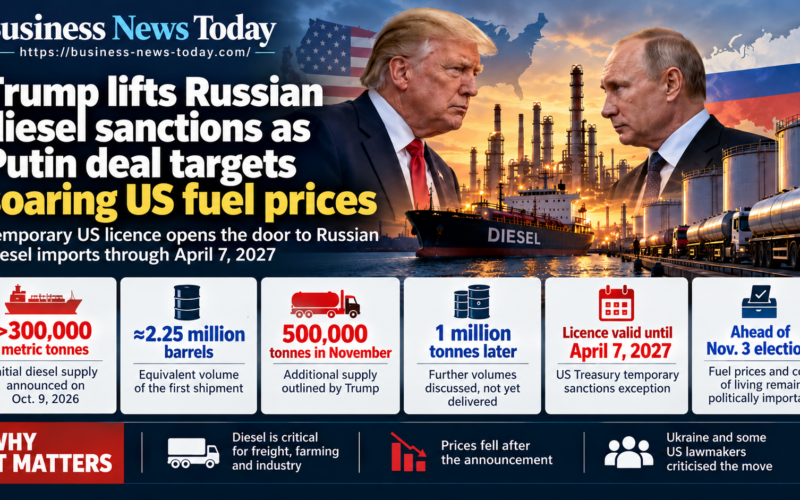
United States President Donald Trump announced an agreement with Russian President Vladimir Putin on October 9, 2026, under which Russia would supply more than 300,000 metric tonnes of diesel to American and international markets as Washington temporarily relaxed sanctions on Russian fuel. The agreement represents a significant reversal in United States energy policy at a time when diesel prices have risen sharply, creating financial pressure on transportation companies, farmers and households ahead of the November 3 congressional elections.
The United States Treasury Department issued a licence allowing Russian diesel imports through April 7, 2027, creating a temporary exception to restrictions imposed on Russian oil interests because of Moscow’s war in Ukraine. Trump said Russia would deliver an initial shipment exceeding 300,000 tonnes, followed by additional volumes, although the timing and scale of subsequent deliveries depend partly on Russian refinery conditions.
Ukrainian President Volodymyr Zelenskyy criticised the decision, arguing that additional fuel revenue could support Russia’s military operations. Several American lawmakers also questioned the sanctions relaxation, while energy analysts warned that the announced supply volumes might provide only limited relief to a market experiencing broader structural shortages.
Why did Donald Trump reach an agreement with Vladimir Putin to supply Russian diesel?
The agreement followed growing concern about the price of diesel, a fuel essential to freight transportation, agriculture, construction and several industrial sectors. Diesel prices have increased sharply amid geopolitical disruptions involving Iran, constrained refinery availability and uncertainty over international petroleum supplies.
Rising diesel costs can affect consumer prices indirectly because trucks transport a substantial proportion of goods across the United States. Farmers also depend on diesel for agricultural machinery, while heating-oil markets are closely connected with middle-distillate fuel supplies.
Trump has made lower energy prices a central element of his economic policy. The Russian agreement therefore addresses an immediate domestic concern while creating a potentially difficult contradiction with the sanctions framework maintained in response to Russia’s invasion of Ukraine.
The administration has defended its energy strategy as an attempt to increase fuel availability. However, the announcement establishes a supply arrangement and temporary sanctions relief, not proof that Russian shipments will produce sustained reductions in American retail diesel prices.
How much Russian diesel will enter the United States under the October agreement?
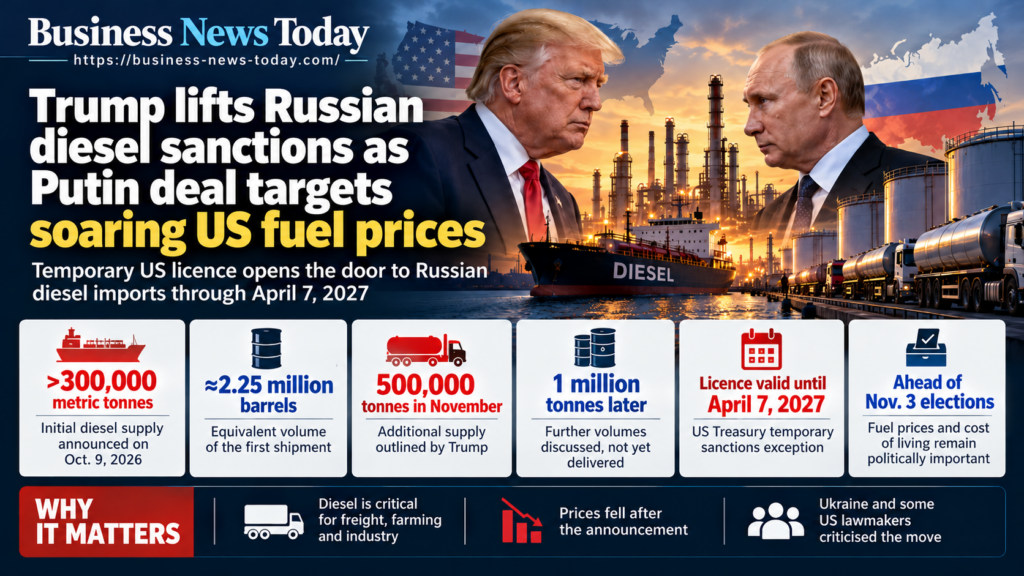
Trump announced that Russia had agreed to make more than 300,000 metric tonnes of diesel available immediately, equivalent to approximately 2.25 million barrels. He also described additional supplies of 500,000 tonnes in November and another 1 million tonnes afterward, with further volumes potentially dependent on the condition of Russian refineries.
The initial shipment is meaningful but relatively small compared with the scale of the United States fuel market. American diesel exports alone have recently averaged approximately 1.5 million barrels per day, illustrating the volume of fuel moving through the country’s broader petroleum system.
Additional Russian diesel could ease pressure in specific markets or provide temporary supply flexibility. However, the total effect will depend on delivery schedules, refinery demand, distribution arrangements and whether the fuel displaces other supplies or increases the amount available to consumers.
The announced future volumes should be treated as commitments or expectations rather than completed deliveries. Physical shipments, customs data and subsequent government disclosures will provide more reliable evidence of how much fuel actually reaches the market.
Why did the United States Treasury Department temporarily relax sanctions on Russian fuel?
Washington imposed sanctions on Russian energy interests as part of its response to the war in Ukraine, seeking to restrict Moscow’s ability to obtain revenue from international petroleum trade. The October licence creates a specific exception allowing Russian diesel imports for a defined period rather than removing every restriction affecting Russian energy companies.
This distinction is important because sanctions can operate through multiple legal mechanisms, including restrictions on designated entities, financial transactions and particular forms of trade. Allowing a specific category of fuel imports does not automatically eliminate those other restrictions.
The temporary authorisation creates an unusual policy intersection between domestic inflation concerns and foreign-policy objectives. Russian diesel may offer short-term supply relief, but permitting additional sales also creates opportunities for Russian exporters to generate revenue.
Whether the United States later expands, extends or reverses the exemption will depend on market conditions and the administration’s broader policy decisions. The April 7, 2027 authorisation deadline provides a defined point at which the arrangement may require reconsideration.
Why has Ukraine criticised the Trump-Putin diesel agreement?
Ukraine opposes measures that could increase Russian export earnings while the war continues. Zelenskyy argued that relaxing restrictions on Russian fuel undermines international efforts to constrain Moscow’s financial resources and creates an incentive for Russia to continue the conflict.
The criticism comes at a sensitive diplomatic moment because Ukrainian officials have been pursuing discussions in Washington about potential routes toward ending the war. The diesel arrangement demonstrates that American energy policy and sanctions policy may not always move in the same direction.
Some United States lawmakers have expressed similar concerns, including Republican Representative Don Bacon, who argued that Russia should face additional economic pressure rather than receive sanctions relief. Those objections reflect a disagreement over whether immediate domestic fuel costs justify modifying measures intended to constrain Russia.
The financial consequences for Moscow will depend on the realised value of shipments and the commercial terms. The agreement could generate revenue, but a precise estimate of the amount ultimately received by Russian entities cannot be established from the announced volumes alone.
Can Russian diesel imports meaningfully reduce fuel prices in the United States?
Diesel prices declined following the announcement, indicating that traders considered the possibility of additional supply relevant to the market. However, an immediate price reaction is not the same as a sustained reduction in fuel costs.
Diesel markets are affected by crude oil prices, refinery capacity, inventories, seasonal demand and international trade flows. Additional imports can help address shortages, but relatively modest quantities may be insufficient to overcome persistent constraints.
Some energy analysts have questioned whether the agreement is large enough to materially alter long-term price trends. Others have characterised the arrangement as one additional supply source that could help a tight market without resolving the underlying imbalance.
The most reliable test will be whether wholesale price reductions persist and eventually reach consumers. Distribution costs, regional supply conditions and retail pricing can delay or limit the effect of a temporary import arrangement.
What does the Russian diesel agreement mean for the November 2026 US midterm elections?
The agreement arrives less than a month before elections for Congress, when the cost of living is a prominent issue in American politics. Higher fuel costs affect household budgets directly through transportation and indirectly through the prices charged for goods and services.
Trump’s administration has sought to demonstrate that it is taking action to address those pressures. Opposition lawmakers have instead questioned the foreign-policy consequences of relaxing sanctions on a country continuing military operations against Ukraine.
The political arguments should be distinguished from measurable economic outcomes. A government announcement may influence public debate, but the extent to which diesel prices change will depend on actual market developments rather than the agreement’s political presentation.
The November 3 elections provide the immediate political context, while the Treasury licence extends into April 2027. That difference in timing means the arrangement’s economic and diplomatic consequences may continue well beyond election day.
What happens next under the US-Russia diesel supply agreement?
The next important developments will be confirmation of physical shipments, details of the companies authorised to participate and evidence of the agreement’s impact on diesel inventories. The market will also assess whether Russian refineries can provide the additional volumes described by Trump.
American officials may face further questions about how the fuel arrangement fits with sanctions on Russia and diplomatic support for Ukraine. The administration’s decisions on any subsequent exemptions could determine whether the current arrangement remains temporary or develops into a broader change in energy policy.
The October 9 agreement offers a possible short-term response to elevated fuel prices while reopening a difficult question about sanctions effectiveness. Its significance will ultimately depend on the volume of diesel delivered, the commercial impact on fuel markets and whether the temporary authorisation produces wider changes in United States policy toward Russia.
What are the key takeaways from Donald Trump’s Russian diesel agreement?
– President Donald Trump announced on October 9, 2026, that Russia had agreed to supply more than 300,000 metric tonnes of diesel to American and international markets.
– The United States Treasury Department issued temporary authorisation allowing Russian diesel imports through April 7, 2027.
– Trump outlined additional potential supplies, including 500,000 tonnes in November and another 1 million tonnes afterward, although those shipments had not been completed at announcement.
– The arrangement represents a specific relaxation of sanctions affecting Russian fuel rather than a complete removal of all United States energy sanctions on Russia.
– Ukrainian President Volodymyr Zelenskyy and some American lawmakers criticised the decision because additional Russian fuel revenue could benefit Moscow while its war in Ukraine continues.
– Diesel prices declined following the announcement, but energy analysts questioned whether the available volumes would produce sustained relief.
– The agreement arrives ahead of the November 3 congressional elections, with high fuel prices and household living costs central to the domestic economic debate.
Discover more from Business-News-Today.com
Subscribe to get the latest posts sent to your email.