



How could U.S. involvement shift the dynamics between Israel and Iran and what historical context shapes this choice?
President Donald Trump’s off-camera remarks to ABC News have reignited global attention around the escalating Israel–Iran conflict and the potential for U.S. military involvement. Speaking to a U.S. official in a private conversation later relayed to ABC News, Trump said that while the United States was not involved in the Israeli strikes on Iranian territory, “it’s possible we could get involved.” The comment, delivered amid a region-wide military escalation, hints at a critical shift in Washington’s posture.
Historically, the U.S. has maintained an unambiguous military and diplomatic alliance with Israel, extending support since the 1950s and actively intervening in previous Middle East confrontations. However, Trump’s tone was notably restrained compared to past U.S. interventions, reflecting a blend of strategic ambiguity and geopolitical caution. While his statement did not confirm any operational planning, it served as a deliberate signal that American engagement remains an option on the table.
What has changed on the ground in the latest military escalation between Israel and Iran?
The current crisis accelerated after Israeli forces launched a multi-wave airstrike campaign on Iranian military and nuclear infrastructure on June 12, resulting in the destruction of key radar, missile defense, and nuclear centrifuge facilities near cities including Natanz and Isfahan. Iranian media reported high-ranking Revolutionary Guard casualties, while Israeli officials suggested that the strikes were “preemptive defensive operations” in response to recent drone launches into northern Israel.
Iran retaliated the following day by firing over 100 missiles and drones into Israel. Tel Aviv, Haifa, and Be’er Sheva were among the urban centers targeted. While Israel’s Iron Dome defense system intercepted many incoming threats, several reached civilian areas, resulting in multiple casualties and widespread infrastructure damage. Israeli defense officials claimed they had achieved temporary “air superiority” over Iranian skies, though both nations continue to mobilize further assets.
How have U.S. officials and political figures responded to Trump’s comments on potential U.S. intervention?
Trump’s remarks have drawn mixed reactions across U.S. political and military circles. Secretary of State Marco Rubio stated that there was “no U.S. military involvement at this time,” underscoring that current deployments are defensive in nature. Pentagon officials reiterated that American forces remain in a heightened state of alert to protect bases and personnel in the region but have not engaged offensively.
Several Republican lawmakers, including Senator Lindsey Graham, publicly backed the idea of U.S. involvement if Iranian missile strikes expand or if American assets are attacked. On the other hand, influential conservative commentators such as Tucker Carlson cautioned against entanglement, warning that the United States should not act as Israel’s “air force” in the conflict.
National Security Adviser John Ratcliffe, in a statement to press late Sunday, noted that intelligence channels between Washington and Tel Aviv remain open, but emphasized that the administration “is prioritizing containment and deterrence, not escalation.”
What are the geopolitical and institutional factors influencing U.S. policy and Trump’s openness to Russian mediation?
President Trump’s openness to Russian President Vladimir Putin playing a mediating role has raised eyebrows across diplomatic communities. In the interview, Trump revealed that Putin called him on Saturday and offered to serve as a conflict mediator. Trump described the conversation as “long and constructive,” noting that Putin “wants this resolved” and had proposed a structured peace mechanism.
This development comes amid strained but functional communication channels between Washington and Moscow. Though Russia remains under broad U.S. sanctions, its growing ties with Iran and longstanding interest in regional balance make it a potentially influential player. Trump’s gesture may also reflect his administration’s broader skepticism toward traditional multilateral institutions like the United Nations, favoring state-to-state diplomacy.
Institutionally, the Trump administration had reinstated “maximum pressure” sanctions on Iran earlier in 2025, targeting oil exports, banking access, and missile procurement. At the same time, Israeli officials reportedly coordinated with U.S. counterparts before launching the June 12 strikes. While Trump emphasized that the United States was not involved in the strikes themselves, his prior knowledge suggests strategic coordination or tacit approval.
What is the global reaction to the Israel–Iran clash and U.S. positioning?
Reactions from world capitals have been swift but cautious. The United Nations Secretary-General issued an urgent call for restraint, warning that the current trajectory could lead to a broader regional war with global consequences. France, Germany, and the United Kingdom each reaffirmed Israel’s right to self-defense while urging immediate de-escalation and the return to diplomacy.
Russia, meanwhile, has publicly supported the idea of mediation, with Foreign Minister Sergey Lavrov saying Moscow is “willing to facilitate bilateral talks under neutral terms.” China has echoed similar sentiments, framing the crisis as a failure of “Western unilateralism” while positioning itself as a stabilizing voice.
On the economic front, oil prices jumped nearly 7 percent following Iran’s retaliation, reflecting investor anxiety over Middle East supply routes. Global stock markets saw volatility spikes, and safe-haven assets like gold rallied, signaling broader concern about potential U.S. military engagement.
Could Washington realistically join the conflict and under what conditions?
The Trump administration has indicated that U.S. military engagement would only be triggered if American forces or infrastructure were directly targeted by Iranian aggression. On his Truth Social account, Trump warned that “any attack on U.S. assets will be met with overwhelming force,” a statement interpreted by analysts as a red line rather than an active war posture.
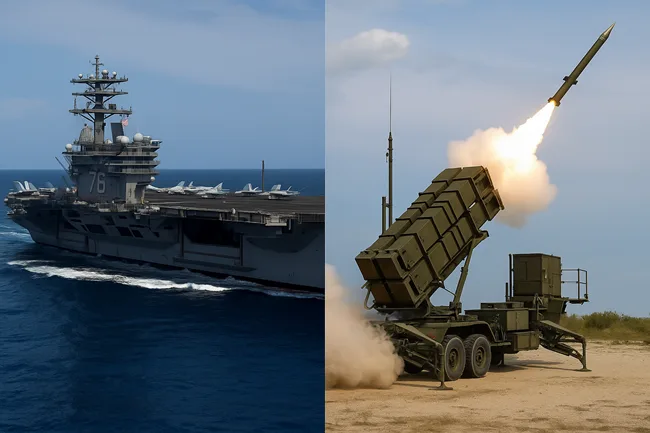
Nonetheless, the president’s phrasing—”it’s possible we could get involved”—has left room for contingency-based escalation. Defense Department insiders suggest that while combat units are not on the move, several carrier strike groups remain within rapid deployment range, and aerial reconnaissance missions over Iraq and the Gulf have increased in frequency.
Can diplomacy still prevail amid rising militancy and shifting alliances?
Despite the deteriorating military environment, the Trump administration maintains that diplomacy remains viable. Trump insisted in the interview that Iran “wants to talk” and that “they continue to talk,” downplaying the cancellation of nuclear talks scheduled to resume in Oman on June 15. Administration officials confirmed that indirect communication channels with Tehran remain open, facilitated by Swiss and Omani envoys.
Trump also suggested that the military escalations might paradoxically push both sides closer to a deal. “Something like this had to happen,” he said. “They want to talk, and they will be talking.” The belief that pressure could speed up diplomacy reflects a central tenet of Trump’s foreign policy—aggressive posturing backed by personal diplomacy.
If Putin’s mediation proposal is accepted, it could mark a turning point in the conflict. While Western allies remain wary of Moscow’s intentions, Russian leverage over Iranian arms suppliers and strategic interests may offer a unique opportunity for backchannel breakthroughs.
What does this moment reveal about Trump’s evolving foreign policy doctrine?
President Trump’s handling of the Israel–Iran conflict offers a window into his evolving foreign policy strategy. His administration’s stance blends assertive military posturing with a willingness to entertain unconventional diplomatic avenues, including those involving traditional adversaries. This duality—signaling overwhelming force while keeping diplomatic doors open—is emblematic of Trump’s broader approach during his current term.
Unlike traditional Republican hawks, Trump has resisted large-scale overseas interventions unless provoked. At the same time, he remains firmly aligned with Israel’s security goals and has repeatedly reaffirmed its right to act unilaterally. The Israel–Iran conflict may test whether Trump can maintain this balancing act as tensions continue to rise.
Discover more from Business-News-Today.com
Subscribe to get the latest posts sent to your email.


