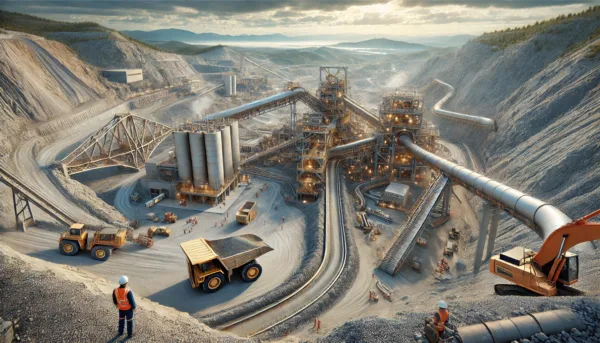

Troilus Mining Corp. has secured a credit-approved commitment for US$850 million in project debt from KfW IPEX-Bank and Société Générale, marking a major financing milestone for its planned Troilus Gold-Copper Project in Québec. The commitment represents the largest confirmed portion so far of an anticipated US$1.1 billion debt package that could move the development-stage miner significantly closer to a final investment decision and construction.
The remaining US$250 million is expected to come from Export Development Canada, although that proposed contribution still requires final approval. If completed as planned, the financing package would provide Troilus Mining with substantial debt capacity toward development of a large-scale project currently designed as a 50,000-tonne-per-day open-pit operation with an approximately 26-year mine life.
The commitment follows extensive technical, financial, environmental and social due diligence by the lenders, moving the project beyond an earlier financing mandate into credit-approved underwriting commitments. Troilus Mining is now working toward definitive loan documentation, remaining export-credit approvals, a final investment decision and financial close while continuing permitting, detailed engineering and procurement activities.
The development comes shortly after an updated technical report substantially strengthened the project’s economic profile under higher long-term commodity-price assumptions. At its base-case assumptions, Troilus Mining estimates an after-tax net present value of approximately US$3.2 billion, a 22% internal rate of return and roughly US$6.9 billion of cumulative after-tax cash flow, giving investors a clearer framework for evaluating whether the financing package can support construction of one of Canada’s larger undeveloped gold-copper projects.
Why Troilus Mining’s US$850 million debt commitment is a significant project milestone
The US$850 million commitment has been provided by KfW IPEX-Bank and Société Générale through senior secured project-finance facilities. Troilus Mining said the commitment represents a substantial advancement from its earlier financing mandate because a large portion of the contemplated debt package has now received lender credit approval rather than remaining at the preliminary structuring stage.
Chief Executive Officer Justin Reid indicated that the credit approvals represent one of the company’s most important financing milestones so far and reflect the technical and economic work undertaken on the project. He said Troilus Mining’s focus now shifts toward completing the broader financing package and reaching financial close while permitting, engineering and procurement continue in parallel.
That distinction is important for development-stage mining companies because obtaining project financing is often one of the largest obstacles between a technically viable mineral resource and an operating mine. Large-scale mines require enormous upfront capital commitments before meaningful operating cash flow begins, leaving developers dependent on combinations of debt, equity, offtake arrangements and strategic financing.
The proposed Troilus structure is intended to provide relatively long-duration financing aligned with the construction and operating profile of the project. The facilities are expected to include a repayment grace period of as much as three years during construction, followed by a sculpted repayment schedule over a notional 10-year period based on projected project cash flows.
Final pricing and other detailed terms have not yet been disclosed and will depend on definitive financing documents. The current commitment also remains subject to conditions including commitments covering the full US$1.1 billion facility, export-credit agency approvals, completion of due diligence, regulatory approvals and execution of final documentation.
Export Development Canada could take total planned Troilus project debt to US$1.1 billion
Export Development Canada remains one of the three mandated lead arrangers alongside KfW IPEX-Bank and Société Générale. Its proposed US$250 million participation is still moving through the approval process, and receiving that approval would lift total credit-approved debt commitments to the full anticipated US$1.1 billion.
The involvement of export-credit institutions could be strategically important because the Troilus Gold-Copper Project is expected to produce both gold and copper concentrate over a multi-decade operating life. Troilus Mining has positioned the development as a potential contributor to Canadian mineral exports while also building supply relationships with European markets.
European interest is also visible elsewhere in the project’s commercial development. Troilus Mining has previously negotiated preliminary long-term offtake arrangements involving Aurubis AG and Boliden Commercial AB, with those discussions covering a meaningful portion of expected future copper-gold concentrate production.
Those relationships help explain why European export-credit support can fit naturally within the financing structure. Project lenders are not simply evaluating a mineral deposit; they are assessing whether the planned mine has viable customers, reliable infrastructure, predictable production economics and sufficient projected cash flow to service debt over many years.
Troilus Mining is working with project-finance adviser Auramet International Inc. as it negotiates definitive facility agreements and satisfies the remaining financing conditions. The immediate objective is to assemble enough certainty around debt, approvals and construction readiness to support a final investment decision.
Updated Troilus economics show a US$3.2 billion valuation under base-case assumptions
The financing announcement comes only weeks after Troilus Mining published an updated technical report incorporating substantially more advanced engineering and updated project-cost assumptions. The report estimates an approximately 26-year mine life built around an open-pit operation processing about 50,000 tonnes of material per day.
Under long-term assumptions of US$3,600 per ounce for gold, US$5 per pound for copper and US$50 per ounce for silver, Troilus Mining estimates an after-tax net present value at a 5% discount rate of approximately US$3.2 billion. The same scenario produces an estimated after-tax internal rate of return of 22%, a payback period of approximately 3.6 years and cumulative after-tax cash flow of around US$6.9 billion.
The mine plan calls for life-of-mine payable production of approximately 5.63 million ounces of gold, 472 million pounds of copper and 10.88 million ounces of silver. Average annual payable gold production during the first 21 years is projected at approximately 251,000 ounces, giving the development meaningful exposure to both precious and industrial metals.
Those economics have improved substantially from the company’s 2024 feasibility study, although much of the increase reflects significantly higher commodity-price assumptions as well as subsequent engineering work. The 2024 study used a substantially lower long-term gold assumption and estimated a smaller after-tax net present value, meaning investors should distinguish improvements in project definition from improvements caused by the assumed commodity-price environment.
That sensitivity remains one of the central considerations for the investment case. Strong gold and copper prices can dramatically improve projected project returns, while weaker-than-assumed pricing during construction or operation could reduce cash generation and potentially affect debt-service capacity.
Construction readiness is advancing, but Troilus still has several hurdles to clear
Troilus Mining has already moved from basic engineering into detailed engineering, procurement and construction-readiness work. The company has been advancing equipment specifications, vendor selection, three-dimensional modelling, site infrastructure planning and construction sequencing as it prepares the project for a potential development decision.
The current development schedule anticipates construction beginning in 2027, provided financing and regulatory approvals are secured. First ore is targeted for September 2029, followed by commercial production around March 2030, although those dates remain subject to the typical execution risks associated with a project of this scale.
Troilus Mining has also secured a 70-megawatt hydroelectric power allocation and received support through Québec’s Filon mining initiative. These steps strengthen the infrastructure and government-support framework surrounding the project, but they do not eliminate the need to complete environmental and regulatory processes before construction can move fully ahead.
Financing itself is similarly not complete. The US$850 million commitment is credit approved, but the funds are not equivalent to cash already available for unrestricted construction spending because definitive agreements, remaining commitments and other conditions must still be satisfied.
That distinction makes the announcement meaningful without making it the final financing event. Troilus Mining has moved substantially closer to becoming a funded developer, but financial close and the final investment decision remain the milestones that would more clearly establish whether construction can proceed on the current timetable.
Troilus Mining shares fall despite financing progress as investors weigh execution risk
Troilus Mining shares closed at approximately C$2.01 on the Toronto Stock Exchange, down about 6.9% from the previous close of C$2.16 despite the financing announcement. The stock traded between roughly C$2.01 and C$2.10 during the session, showing that the credit-approved commitment did not generate an immediate positive market reaction.
The decline should not necessarily be interpreted as investors viewing the US$850 million commitment negatively. Troilus Mining shares had already experienced considerable volatility during September, including several daily moves of more than 5%, while the stock recently traded as high as approximately C$2.47 during the broader one-month period.
Investor caution may instead reflect the remaining gap between securing financing commitments and operating a profitable mine. Troilus Mining still needs to complete the full debt package, obtain remaining approvals, reach financial close, manage construction costs and ultimately bring a large open-pit operation into production on schedule.
The debt package also addresses only one component of the broader project-funding equation. Investors will continue watching how Troilus Mining finances any remaining capital requirements and whether additional equity issuance could create dilution for existing shareholders.
At the same time, securing US$850 million of credit-approved underwriting from major international lenders represents a meaningful validation of the project’s technical and financial work. The commitment materially reduces one of the largest uncertainties surrounding the development, even though Monday’s stock performance indicates that the market is still assigning substantial weight to the execution risks ahead.
What the US$850 million financing could mean for the Troilus Gold-Copper Project
The financing milestone brings Troilus Mining closer to the point at which the investment story shifts from exploration and engineering toward construction execution. With engineering more advanced, procurement underway and a large portion of the anticipated debt financing now credit approved, the company has addressed several of the structural requirements needed before committing billions of dollars to development.
The next major catalysts are relatively clear. Final approval of Export Development Canada’s proposed US$250 million participation would complete the targeted US$1.1 billion debt package at the credit-approval level, while definitive documentation and financial close would convert those commitments into a more concrete construction-funding framework.
For investors, the project’s economics provide substantial potential upside under Troilus Mining’s current commodity-price assumptions, but they also create sensitivity to gold and copper prices, construction costs and execution. A project with an estimated 26-year life can generate significant long-term cash flow if developed successfully, yet delays or cost escalation during the construction phase can materially change returns.
The US$850 million commitment therefore represents an important de-risking event rather than the end of the development process. Troilus Mining has demonstrated that major lenders are prepared to underwrite a substantial portion of the project, while the next stage will determine whether that financing can be converted into a fully funded construction decision and ultimately a producing gold-copper mine.
Key takeaways from Troilus Mining’s US$850 million gold-copper project financing
- Troilus Mining secured a US$850 million credit-approved debt commitment from KfW IPEX-Bank and Société Générale.
- The commitment forms the largest portion of a planned US$1.1 billion project debt package.
- Export Development Canada is considering an additional US$250 million contribution that still requires final approval.
- The proposed debt facilities include up to three years of repayment relief during construction.
- Troilus Mining estimates an after-tax project net present value of approximately US$3.2 billion under its base-case assumptions.
- The planned operation has an approximately 26-year mine life and a 50,000-tonne-per-day processing design.
- Construction could begin in 2027, with commercial production targeted for 2030 if financing and approvals are completed.
- Troilus Mining shares fell about 6.9% despite the financing milestone, highlighting continued investor caution.
- Financial close, permitting, construction costs and potential shareholder dilution remain important risks to monitor.
- Completing the US$1.1 billion financing package could significantly reduce one of the project’s largest remaining development uncertainties.
Discover more from Business-News-Today.com
Subscribe to get the latest posts sent to your email.