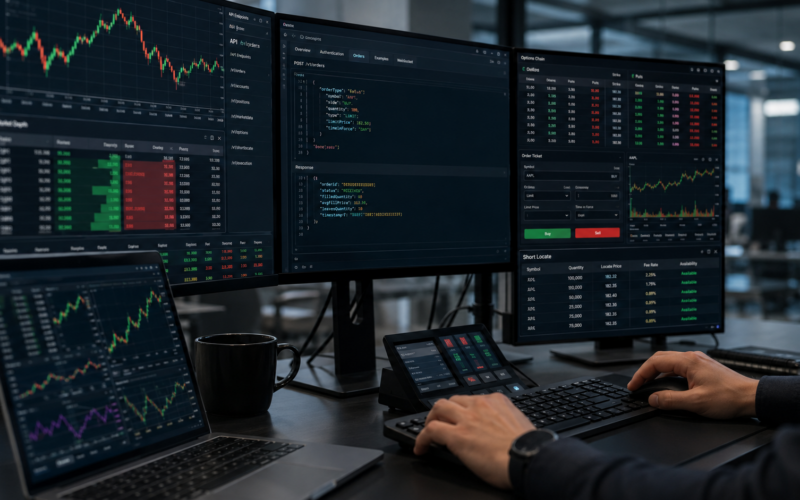
TradeZero has launched TradeZero Developer, an execution-first application programming interface that gives eligible account holders programmatic access to equity orders, options orders, real-time account data, and short locate workflows. The move positions TradeZero more directly inside the technology stack of active self-directed traders who already use custom signals, trading dashboards, and semi-automated execution tools. Instead of asking traders to move between external models and a broker interface, TradeZero Developer allows those workflows to connect directly with TradeZero’s order management, routing, account, and locate infrastructure. For a brokerage built around active traders and short-selling functionality, the launch turns a core trading workflow into a programmable layer rather than a screen-based feature.
Why is TradeZero launching a developer API for active equity and options traders now?
TradeZero Developer lands at a moment when the active trading market is becoming less about isolated platforms and more about workflow integration. Traders increasingly build their own infrastructure around alerts, signals, scanners, spreadsheet models, custom dashboards, and scripting environments. In that world, the broker that wins is not always the one with the prettiest interface. It is the broker that can sit cleanly inside the trader’s existing decision loop.
That is the real strategic meaning of TradeZero Developer. The API is not being positioned as a replacement for TradeZero’s front-end trading platforms. It is being positioned as a bridge between trader-built systems and TradeZero’s execution stack. The company says the API supports market, limit, stop, and advanced order types for equities, along with single-leg options order placement, modification, and cancellation.
For active traders, the timing also matters because brokerage competition is moving closer to execution quality, workflow speed, and specialist functionality. Basic commission-free trading has been commoditised. Many retail brokers now compete on user interface, social features, options access, or market education. TradeZero is taking a different route by leaning into a more technical user base: traders who know what they want to trade, know how they want to monitor risk, and increasingly want their broker to expose the plumbing.
There is also a market-structure subtext. If active trading participation continues to broaden, programmable execution could become more relevant beyond professional and semi-professional users. More traders may attempt higher-frequency discretionary or rule-based trading workflows, and brokers with programmable access could benefit if those traders graduate from point-and-click execution to structured trading systems.

How does TradeZero Developer change the short locate workflow for active short sellers?
The short locate component is the most distinctive part of the announcement because it connects directly to one of TradeZero’s better-known market niches. Many brokers can offer stock and options order entry through a platform. Fewer make short locate discovery, quoting, reservation, inventory management, sell-back credit, and audit history programmable as a core workflow.
That matters because short selling is not only an execution problem. It is also an inventory, timing, cost, and compliance problem. A trader looking to short a hard-to-borrow security may need to check availability, compare locate economics, reserve inventory, monitor whether the trade thesis still exists, and decide whether unused locates should be sold back. When that workflow remains manual, it creates friction precisely at the point where speed and discipline matter most.
TradeZero Developer attempts to reduce that friction by allowing short sellers to manage the locate process through code. That does not make short selling risk-free, of course. The market will not suddenly become kinder because a trader has an API key. However, it does mean that traders can build more structured systems around locate availability, execution timing, and unused inventory management.
For TradeZero, making locates programmable also deepens differentiation. Active short sellers are a valuable but demanding customer segment. They care about access to hard-to-borrow names, timing, transparency, and the economics of unused locates. By exposing locate workflows through code, TradeZero is effectively turning a specialist brokerage capability into infrastructure. That could make the platform stickier for traders whose short-selling process already depends on repeatable rules, watchlists, and real-time inventory checks.
What does execution-first API access signal about the future of retail trading platforms?
TradeZero’s launch reflects a broader shift in retail brokerage technology: the platform is becoming less of a destination and more of a programmable service layer. Traditional broker interfaces still matter, especially for discretionary traders. However, the more sophisticated end of the retail market is increasingly using multiple tools at once, including charting software, screeners, news feeds, spreadsheets, alerts, scripts, and external analytics engines.
An execution-first API gives a broker a place inside that ecosystem. TradeZero says orders submitted through TradeZero Developer follow the same order management, risk validation, and routing processes as orders placed through its own platforms. That detail is important because it suggests the API is not a separate execution island. It is a technical access route into the same underlying brokerage infrastructure.
The competitive implication is that active-trader brokers may increasingly need to support two types of customer experience at once. One is the polished front-end experience for traders who want a complete platform. The other is infrastructure access for traders who already have their own front end. Brokers that only focus on interface design risk losing advanced users to platforms that let them build around the broker rather than inside the broker.
There is also a risk layer. Programmatic access can increase speed, but it can also increase the consequences of flawed logic, poor safeguards, and over-automation. TradeZero Developer gives traders access to balances, positions, buying power, and open orders, which should help them build pre-trade and post-trade checks into their workflows. That kind of account-state visibility is crucial because an API that can place orders without reliable account context would be more dangerous than useful.
Why does no additional API access fee matter for TradeZero’s competitive positioning?
TradeZero’s decision not to charge an additional fee for API access is strategically important because it reduces adoption friction. API access often appeals to a narrower group than standard platform access. If the broker adds a separate fee, it forces users to justify the cost before they have proven the workflow. By making TradeZero Developer available without an additional access fee, TradeZero is effectively encouraging experimentation among technically capable active traders.
That matters because developer ecosystems are built through usage, not announcements. Traders need to test authentication, account queries, paper trading, order placement, cancellation workflows, locate requests, and error handling before they trust an API with live execution. TradeZero says users can enable the add-on through the Client Portal, sign the API Trading Agreement, generate credentials, and begin building.
The paper trading environment is also important because it gives traders a safer place to test strategies before requesting live access. That is not just a convenience feature. It is a risk-management requirement for any trader attempting to connect custom logic to real order execution. A strategy that looks tidy in a spreadsheet can behave very differently once it starts interacting with balances, positions, order states, and changing market prices.
The default rate limit of 200 authenticated requests per minute per account also frames the product as active-trader infrastructure rather than institutional high-frequency trading infrastructure. That rate may be enough for many custom dashboards, signal-driven execution tools, account polling, and locate workflows. It is not the same as giving users a direct path to ultra-high-frequency strategies. That distinction matters for risk management, compliance, and product positioning.
For TradeZero, the no-fee approach can act as a customer acquisition and retention tool. Traders who invest time building around an API are less likely to switch brokers casually, especially if the workflows involve short locates, position monitoring, and options execution. The stickiness is not just emotional loyalty. It is technical integration, and technical integration can be a very effective moat when the customer is sophisticated enough to care.
What risks could limit TradeZero Developer’s adoption among active retail traders?
The main adoption risk is that the addressable audience is narrower than the marketing opportunity sounds. Many active traders want fast tools, but not every active trader wants to write code, manage credentials, handle API responses, or design fail-safes. TradeZero Developer will resonate most with traders who already operate with structured workflows or who can work with developers. That makes the API strategically useful, but not necessarily mass-market.
The second risk is execution discipline. Programmatic trading can amplify both good and bad decision-making. A well-designed system can reduce missed trades, improve consistency, and enforce account-state checks. A poorly designed one can send unintended orders, trade stale signals, or respond incorrectly to changing market conditions. TradeZero can provide the infrastructure, but traders remain responsible for how their own systems behave.
The third risk sits around short-selling workflows themselves. Short locates are operationally complex because availability, pricing, reservation, usage, and sell-back economics can shift quickly. Traders must design around confirmation delays, audit history, and inventory changes rather than assume every request instantly becomes executable inventory. The more sophisticated the workflow, the more important logging, monitoring, and fallback procedures become.
There is also a segmentation risk. TradeZero says API access is for personal trading use only and traders seeking to build multi-user platforms should contact TradeZero directly about Broker API arrangements. That boundary is sensible, but it also limits how far independent developers can commercialise tools built directly on TradeZero Developer without moving into a different arrangement. In other words, this launch is aimed at trader infrastructure first, not an open marketplace of third-party trading products.
How could TradeZero Developer influence broker competition in active trading infrastructure?
TradeZero Developer could push competitors to treat APIs as a front-line product rather than a technical afterthought. For years, many retail brokers have focused on lowering commissions, simplifying options access, improving mobile apps, and adding education. The next competitive layer may be programmability. Active traders increasingly want the freedom to connect their own models and screens to execution, while still relying on a regulated broker’s order management and risk controls.
The short locate angle makes TradeZero’s move more pointed. If a broker’s only programmable function is basic order entry, it may struggle to stand out. If the programmable layer includes a specialised workflow such as hard-to-borrow locate management, the broker is not just offering access. It is exposing a differentiated capability in a way that power users can operationalise.
The larger industry implication is that active retail trading is slowly borrowing infrastructure expectations from professional trading without fully becoming institutional trading. Retail traders are not all hedge funds in hoodies, thankfully for everyone’s compliance department. However, the top end of the retail market increasingly expects professional-style tooling, better account visibility, programmable workflows, and more control over execution logic.
For TradeZero, the success of TradeZero Developer will likely depend on documentation quality, uptime, paper trading reliability, community adoption, and how well the API handles edge cases during fast markets. The launch gives TradeZero a sharper technology story, but the hard part begins after credentials are generated. In trading infrastructure, the demo sells the dream. The logs decide whether users stay.
Key takeaways on what TradeZero Developer means for active traders, broker APIs and short-selling infrastructure
- TradeZero Developer turns TradeZero’s active-trader offering into a more programmable execution layer rather than only a platform-based trading experience.
- The most strategically important feature is the Short Locate API, because it exposes a specialised TradeZero workflow through code.
- No additional API access fee lowers the barrier for traders who want to test custom execution, account monitoring, and locate workflows.
- The paper trading environment is important because traders need to validate logic before connecting custom tools to live execution.
- TradeZero’s API strategy fits a broader shift in retail brokerage from interface-led competition to infrastructure-led competition.
- The product is likely to appeal most to technically capable active traders, systematic discretionary traders, and short sellers with repeatable workflows.
- Programmable locate workflows mean traders still need robust monitoring, logging, and confirmation logic rather than assuming instant execution certainty.
- The launch could increase customer stickiness because traders who build around broker infrastructure face higher switching costs.
- The personal-use limitation keeps the product focused on individual trading workflows, while multi-user platforms remain a separate Broker API opportunity.
- TradeZero’s challenge will be to prove reliability, documentation depth, and operational resilience when users move from testing to live trading.
Discover more from Business-News-Today.com
Subscribe to get the latest posts sent to your email.