




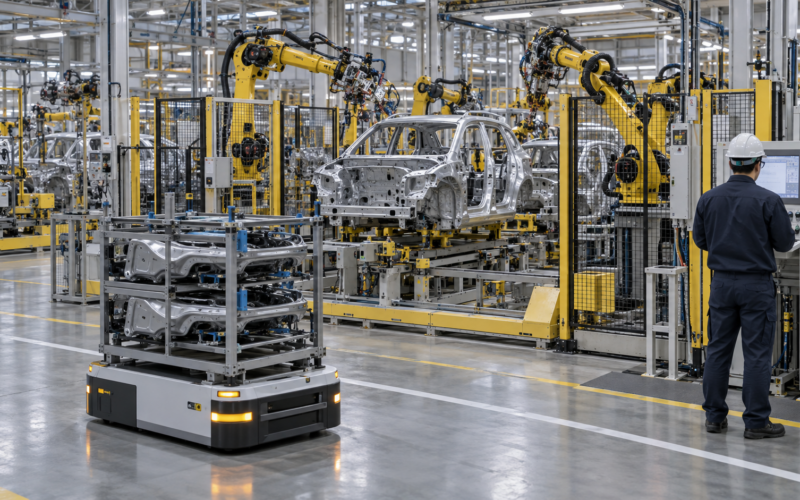
Toyota Motor Corporation (Tokyo: 7203; NYSE: TM) estimates that modernising factories across Toyota, group companies and key suppliers through automation could require approximately ¥1 trillion, or $6.4 billion, annually from 2028. The world’s largest automaker told investors that roughly 400,000 robots could ultimately be required, including replacements for existing equipment and additional humanoid and conventional robots used across manufacturing, logistics and human-machine collaboration. Toyota has not committed to spending exactly ¥1 trillion every year or specified how many years investment at that level would continue, making the figure an estimate of potential industrial requirements rather than formal capital-expenditure guidance.
The scale nevertheless makes the automation strategy financially significant. Toyota generated ¥50.68 trillion of fiscal 2026 sales revenue but operating income fell 21.5% to ¥3.77 trillion, meaning the company is considering unusually large manufacturing investments while profitability is already under pressure from costs and changing industry economics. Global consolidated vehicle sales rose 2.5% to approximately 9.6 million units during the fiscal year.
Why could Toyota need around 400,000 robots across its manufacturing ecosystem?
Toyota’s manufacturing system is enormous and extends well beyond factories carrying the Toyota name. Group companies and major suppliers produce engines, transmissions, electronics, body components, batteries and thousands of other parts feeding assembly plants around the world, creating an industrial network in which labour availability and equipment age can become significant constraints.
The 400,000 estimate includes both replacement equipment and new installations. Toyota is considering conventional industrial robots, automated logistics equipment and future systems designed to work alongside human employees, while humanoid robots could eventually perform tasks historically difficult to automate because they occur in spaces and processes designed around people.
Japan’s ageing population increases the urgency. Automotive manufacturing requires large numbers of skilled workers, and labour scarcity can eventually limit production even when customer demand remains strong. Automation therefore becomes partly a capacity-preservation strategy rather than merely a way to cut payroll.
Ageing machinery creates another requirement. Replacing old manufacturing equipment provides an opportunity to install systems that are more connected, easier to monitor and capable of generating data that can improve maintenance and quality control.

How large is ¥1 trillion compared with Toyota’s earnings?
Toyota’s fiscal 2026 operating income of ¥3.77 trillion means an annual ecosystem-wide automation requirement of ¥1 trillion would be economically substantial, although the two figures should not be compared as though Toyota alone were writing the entire cheque. The estimate covers Toyota, affiliated companies and major suppliers, so capital spending would be distributed across the manufacturing network.
Even with that qualification, the figure demonstrates the cost of maintaining industrial competitiveness as automotive manufacturing becomes more automated. Vehicle manufacturers already need to fund electric powertrains, batteries, software-defined architectures, advanced driver-assistance systems and new manufacturing capacity. Robotics adds another major investment category.
Toyota has historically benefited from exceptionally disciplined manufacturing and continuous improvement through its Toyota Production System. The new challenge is translating those principles into factories containing far more autonomous equipment without creating excessive complexity or reducing flexibility.
Robots can lower variable labour costs, but expensive automation becomes a fixed cost that only produces attractive returns when equipment remains highly utilised. Toyota consequently needs to avoid automating processes merely because technology exists.
Why could robotics become a business opportunity beyond Toyota’s own factories?
Bernstein analysts cited by Reuters argued that Toyota’s growing robotics focus could encourage investors to recognise opportunities extending beyond automobile manufacturing. Toyota possesses decades of experience designing manufacturing equipment and has long experimented with robotics, mobility devices and automated production systems.
If the company develops systems that work effectively inside its own operations, some technology could eventually become useful across logistics, industrial automation or adjacent mobility applications. Toyota has not announced a major independent robotics revenue target, however, so that possibility remains strategic optionality rather than a forecast business line.
The automotive industry itself could provide enough demand to justify enormous investment. Hyundai Motor Group plans to deploy humanoid robots from Boston Dynamics at its Georgia manufacturing operation beginning in 2028, demonstrating that Toyota is not alone in viewing humanoid technology as an industrial tool rather than a science-fiction demonstration.
Tesla and numerous Chinese manufacturers are pursuing related technologies, while specialist automation companies are developing robots capable of warehouse, assembly and inspection tasks. Competition could therefore determine whether automakers develop proprietary systems or increasingly purchase common robotic platforms from outside suppliers.
Could automation help Toyota manage its shift toward more hybrids and electric vehicles?
Toyota is planning a larger hybrid production mix as demand for vehicles combining combustion engines with electric powertrains remains strong. Earlier projections shared with suppliers indicated Toyota could produce approximately 6.7 million hybrid and plug-in hybrid vehicles in 2028, potentially representing around 60% of total output. Toyota said those figures were planning assumptions rather than formal sales commitments.
Higher automation could help factories accommodate multiple propulsion systems without requiring completely separate manufacturing footprints. Flexible robotic cells can theoretically adapt to different models and components faster than dedicated fixed equipment if production systems are designed appropriately.
That flexibility matters because the automotive transition is proving less linear than manufacturers expected several years ago. Battery-electric demand, hybrid adoption and regional regulations are moving at different speeds, forcing Toyota and rivals to maintain multiple technologies simultaneously.
Automation consequently needs to support flexibility rather than lock factories into a single forecast of future demand.
What are the biggest execution risks in Toyota’s robotics strategy?
The first is return on investment. Spending billions of dollars on robotics makes financial sense only if the resulting productivity, quality, capacity or labour savings exceed the cost of equipment, software and maintenance.
The second is reliability. Vehicle factories operate at enormous volumes, and one failed automated process can disrupt downstream production across an entire plant. Robots therefore need industrial uptime and serviceability, not merely impressive demonstrations.
Human integration adds another issue. Toyota is explicitly considering collaboration between people and robots, making workplace design, safety systems and employee training essential parts of the automation programme. The highest-value outcome may involve machines taking repetitive or physically demanding work while humans continue managing judgement-intensive tasks.
The company must also coordinate suppliers whose financial resources differ substantially. Toyota can finance multi-billion-dollar programmes more easily than smaller component manufacturers, creating a risk that automation proceeds unevenly across the supply chain.
What does Toyota’s stock performance suggest about investor expectations?
Toyota shares were modestly weaker in Tokyo around the September 18 automation report, with Reuters-linked market data showing the stock approximately 0.3% lower. The move is too small to describe as a clear judgement on the potential ¥1 trillion programme, particularly because the figure had been discussed with investors earlier in September rather than appearing as completely unexpected guidance.
The bigger investor question concerns profitability. Toyota increased fiscal 2026 revenue by 5.5% while operating income fell more than 20%, demonstrating why productivity improvement matters even when vehicle demand remains substantial.
A ¥1 trillion annual automation requirement sounds like another cost burden. If deployed effectively, however, it could also become part of the solution to Toyota’s longer-term cost problem.
The relevant milestone is therefore not the number of robots purchased. It is whether more automated Toyota factories ultimately produce more vehicles, with greater flexibility and fewer labour constraints, at sustainably better returns on invested capital.
Discover more from Business-News-Today.com
Subscribe to get the latest posts sent to your email.


