



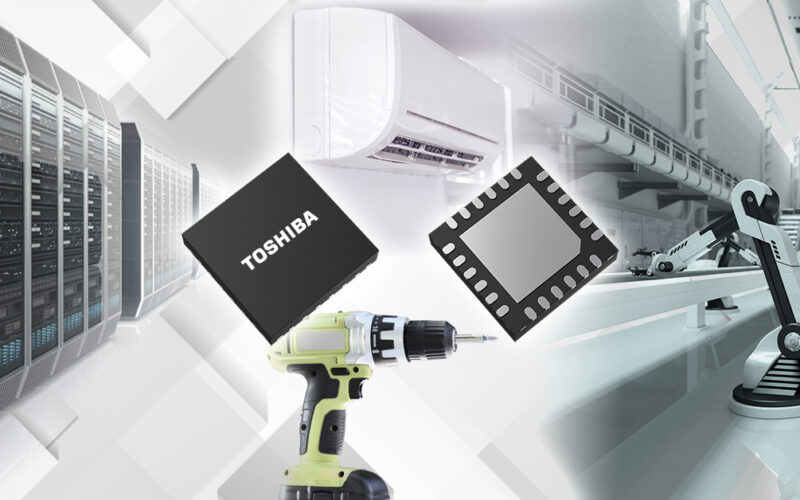
Toshiba Electronic Devices & Storage Corporation has started shipping the TCKE1401NM, an 80V-rated electronic fuse designed to protect 24V, 48V and 54V power lines while occupying a 4.0mm by 4.0mm package, positioning the device for servers, network equipment, factory automation systems, robots and other space-constrained electronics. The August 19 launch matters because the migration toward 48V architectures is allowing equipment designers to deliver more power without proportionally increasing current, but it also raises the voltage tolerance and fault-management requirements imposed on protection circuitry. Toshiba is therefore competing on a combination of voltage headroom, integrated protection and board-area efficiency rather than simply trying to maximise current capacity. The commercial question is whether that smaller footprint is valuable enough to win design slots in industrial and computing systems where competing eFuses can offer substantially lower resistance and higher current handling.
The TCKE1401NM operates across an input-voltage range of 4.7V to 75V and carries an 80V maximum input-voltage rating, giving designers headroom above nominal 48V and 54V rails. Toshiba specifies typical on-resistance of 44.5 milliohms and packages the device in a VQFN24D enclosure measuring about 4.0mm by 4.0mm and no more than 0.9mm thick. The company said shipments began with the announcement, moving the device directly from product introduction into commercial availability rather than presenting it as a future roadmap component.
Why are 48V power architectures increasing the need for more sophisticated electronic protection?
The shift toward 48V distribution is fundamentally about moving more power efficiently through constrained electrical systems. At a given power level, increasing voltage reduces the current required, which can reduce conductor losses, cable requirements and some of the thermal challenges associated with high-current distribution. That attraction has made higher-voltage architectures increasingly relevant across servers and networking systems, while 48V supplies are also appearing in industrial automation and communications applications that historically relied heavily on lower-voltage rails. Analog Devices, for example, has described 24V direct current as the traditional standard for much industrial control equipment while noting that Power over Ethernet has encouraged development around 48V supplies.
Higher voltage, however, changes the protection problem rather than eliminating it. Industrial systems still have to handle short circuits, excessive current, reverse connections, abnormal voltages and thermal events, while components sitting on a 48V or 54V rail require enough voltage tolerance to survive operating excursions. Toshiba says the new TCKE1401NM integrates overcurrent protection, overvoltage shutdown, reverse-current blocking, reverse-polarity protection and thermal shutdown functionality around this higher-voltage operating environment.
That integration is strategically important because a conventional fuse addresses only part of the failure chain. A physical fuse can interrupt excessive current, but an electronic fuse can detect several different fault conditions, communicate system status and control how the circuit recovers. As equipment becomes more compact and more electronically managed, protection itself is increasingly becoming an active power-management function rather than a disposable component placed in series with the load.
What does Toshiba’s TCKE1401NM actually add beyond a conventional fuse?
Toshiba has made programmability a central part of the product. The TCKE1401NM can limit output current following an overcurrent event and shut down output when an overvoltage condition is detected, while external resistors allow designers to configure the operating thresholds. The device also supports true reverse-current blocking and protection against reversed input connections using external MOSFETs, extending the fault-protection architecture beyond the integrated switch alone.
Monitoring functions make the device more relevant to managed industrial systems. A FLAG output can notify another circuit when an abnormal condition occurs, a power-good output communicates whether the voltage has reached the required state, and an output-current monitor gives the surrounding system visibility into load behaviour. Thermal shutdown provides another layer of protection by switching off the device during excessive temperature conditions, including those associated with unexpected shorts or abnormal heat generation.
Recovery can also be configured for different equipment requirements. Auto-retry mode allows the eFuse to attempt automatic recovery after a fault, while latch-off mode keeps the output disabled until an external signal triggers recovery. That distinction can matter in industrial environments because the appropriate response to a transient disturbance may be very different from the response required after a potentially persistent wiring or load fault.
The protection response is relatively fast. Toshiba specifies a typical fast-trip response time of 3 microseconds at 48V under defined test conditions, with the fast-trip comparator set at approximately twice the programmed current limit. Depending on the external current-limit resistor, Toshiba’s specification table shows typical current-limit settings ranging from about 0.82A to 6.43A.

How important is the 4mm package when industrial electronics already have competing 80V eFuses?
The package may be the clearest differentiator. Toshiba describes the 4.0mm by 4.0mm VQFN24D as an industry-leading small package among 80V-rated eFuse integrated circuits based on its August 2026 survey, a claim that should therefore be understood specifically as Toshiba’s competitive assessment rather than an independently established market ranking.
A useful comparison illustrates both the attraction and the limits of Toshiba’s approach. Texas Instruments sells the TPS1685, a 9V-to-80V integrated hot-swap eFuse packaged at 6mm by 5mm, or roughly 30 square millimetres, compared with about 16 square millimetres for Toshiba’s new device. On package area alone, Toshiba’s footprint is approximately 47% smaller.
That calculation does not mean the products are performance equivalents. Texas Instruments specifies typical on-resistance of just 3.5 milliohms and current limits of up to 20A for the TPS1685, compared with Toshiba’s 44.5 milliohm typical resistance and lower-current operating profile. Texas Instruments also supports parallel operation for high-power systems and has demonstrated two-device configurations around 48V and 2kW power-path protection.
The comparison therefore reveals Toshiba’s likely design strategy more clearly than a simple specification contest would. TCKE1401NM appears aimed at designers who need 80V-class tolerance and sophisticated protection in very little board area, rather than systems that demand the lowest possible conduction loss or extremely high current from a single device.
That distinction matters because there is no single 48V market. An artificial-intelligence server power path carrying kilowatts presents a very different electrical problem from a control board inside a robot, industrial printer, network appliance or factory automation module. Toshiba’s commercial opportunity is likely strongest where physical footprint and protection integration are more valuable than maximum current density.
Could the TCKE1401NM benefit from the broader shift toward higher-density servers and industrial automation?
Toshiba has identified servers and network equipment alongside factory automation equipment, robots, multifunction printers, power tools and home appliances as potential applications. That breadth is useful commercially because it gives the product exposure to several different equipment cycles rather than tying demand to one end market.
Servers are particularly interesting because 48V power distribution has become more prominent as computing power requirements rise. Texas Instruments has explicitly connected its own 48V eFuse development to high-performance computing and artificial-intelligence infrastructure, where processors and accelerators have pushed power-density requirements higher and increased the need for scalable fault protection.
Toshiba’s product should not automatically be interpreted as a direct attack on the highest-power artificial-intelligence server input stages, however. Its current capability and resistance profile make that conclusion too broad. The more credible opportunity is that the same architectural movement toward higher-voltage distribution creates additional 48V sub-systems, network boards, controls and peripheral equipment that also require compact protection.
Industrial automation creates a second route to adoption. Robots, controllers, communications modules and distributed equipment increasingly combine higher power density with limited physical space, while unplanned downtime can make protection and fault diagnostics commercially important beyond the component’s purchase price. A semiconductor fuse capable of detecting and reporting faults can therefore contribute to system-level reliability in ways that are difficult to capture by comparing fuse costs alone.
Where does Toshiba still face trade-offs between compact size, current capability and power efficiency?
The most visible trade-off is conduction resistance. At 44.5 milliohms typical, the TCKE1401NM cannot match the extremely low resistance of higher-current devices such as Texas Instruments’ 3.5 milliohm TPS1685, although the two components target different combinations of current, size and system functionality.
That matters because resistance produces both voltage drop and heat as current increases. Toshiba’s design therefore makes the most sense when the current envelope remains compatible with its thermal and efficiency characteristics and where the board-space savings justify the chosen protection architecture. Equipment designers will ultimately evaluate the complete system rather than one headline specification, including external MOSFET requirements, fault thresholds, thermal performance, transient behaviour, qualification, availability and cost.
There is also a broader competitive challenge. Electronic fuse functionality is becoming part of a larger power-management battle that includes Texas Instruments and other analogue and power-semiconductor suppliers offering hot-swap controllers, eFuses, protection switches and increasingly intelligent power-path devices. Texas Instruments, for example, now markets 80V eFuses with current monitoring, fault reporting, power-good signalling and, in newer devices, digital telemetry aimed specifically at data-centre power management.
Toshiba therefore needs more than a small package to build a durable position. The TCKE1401NM has to convert its compactness into simpler board layouts, acceptable thermal performance and system-level cost advantages that matter to original equipment manufacturers.
What will determine whether Toshiba’s compact 80V eFuse becomes meaningful beyond the product launch?
The immediate improvement is clear. Toshiba now has an 80V eFuse capable of protecting nominal 48V and 54V systems while integrating multiple fault-management functions into a 16-square-millimetre package, and commercial shipments have already begun. The product expands Toshiba’s ability to participate in the gradual movement toward higher-voltage power distribution across industrial and computing equipment.
What remains unresolved is design adoption. Semiconductor launches create strategic opportunity, but revenue depends on engineers qualifying the component into products that may remain in production for years. The most meaningful proof points would therefore be broader adoption across Toshiba’s named target applications, expansion of the surrounding high-voltage eFuse family and evidence that customers value the footprint advantage enough to accept the device’s particular resistance and current characteristics.
The larger industry direction is favourable to the concept. As power density rises, circuit protection increasingly has to become smaller, faster and more programmable without creating an efficiency penalty large enough to undermine the move toward higher-voltage distribution in the first place. Toshiba’s TCKE1401NM addresses the first three requirements convincingly on paper; the commercial test is whether that package-level advantage translates into enough real-world design wins to make compact 80V protection a meaningful product category for the company.
Key takeaways on Toshiba TCKE1401NM, 48V eFuse protection and industrial power design
- Toshiba Electronic Devices & Storage Corporation began shipping the TCKE1401NM 80V eFuse on August 19, 2026.
- The device supports an operating input range of 4.7V to 75V and is intended for 24V, 48V and 54V systems.
- Toshiba packages the eFuse in a 4.0mm by 4.0mm VQFN24D enclosure, targeting space-constrained power-protection designs.
- Protection functions include overcurrent limiting, overvoltage shutdown, reverse-current blocking, reverse-polarity protection and thermal shutdown.
- FLAG, power-good and current-monitor outputs add system-level visibility that conventional physical fuses cannot provide alone.
- Toshiba specifies typical on-resistance of 44.5 milliohms and configurable current-limit settings extending to about 6.43A under the disclosed test conditions.
- Compared purely on package area with the 6mm by 5mm Texas Instruments TPS1685, Toshiba’s device occupies about 47% less space, although the competing components have materially different electrical capabilities.
- Texas Instruments’ TPS1685 demonstrates that the 80V eFuse market also includes substantially higher-current products, meaning Toshiba is competing more on compact integration than maximum power handling.
- Servers, networking, factory automation and robotics could all benefit from the broader migration toward 48V distribution and more sophisticated fault protection.
- The next meaningful test will be customer adoption and whether Toshiba expands the compact high-voltage eFuse family around the TCKE1401NM.
Discover more from Business-News-Today.com
Subscribe to get the latest posts sent to your email.