
Titagarh Rail Systems Limited (NSE: TITAGARH, BSE: 532966) has reported a mixed Q4 and FY26 performance, with consolidated profit returning in the March quarter even as revenue remained under pressure from freight rail supply constraints. The company’s FY26 investor presentation shows a standalone order book of around Rs 14,240 crore including wholly owned subsidiaries, and a broader order visibility of around Rs 27,540 crore after including its prorated share in joint ventures. The immediate investment debate is no longer whether Titagarh Rail Systems Limited has demand visibility, but whether it can convert that order pipeline into predictable execution, cash flow and margin expansion in FY27. The stock traded around Rs 801 to Rs 802 after the results, below its 52-week high of Rs 973.80 but still well above its 52-week low of Rs 568.70, reflecting a market that is interested but not yet fully convinced.
Why are Titagarh Rail Systems Q4 FY26 results being read as an execution story rather than a simple profit recovery?
Titagarh Rail Systems Limited’s Q4 FY26 numbers tell two stories at once. On the surface, the company swung back to consolidated profit in the March quarter, with reported consolidated net profit of about Rs 54 crore compared with a loss in the year-earlier quarter that was affected by an exceptional item. Revenue, however, declined year-on-year to about Rs 875 crore, while EBITDA softened despite margin improvement. That combination explains why the stock reaction was cautious rather than celebratory. A profit recovery is useful, but investors in manufacturing and infrastructure-linked companies tend to reward execution consistency more than one quarter of accounting improvement.
The larger FY26 picture is more revealing. Standalone revenue declined to Rs 3,143.58 crore in FY26 from Rs 3,747.38 crore in FY25, mainly because the Freight Rail Systems business was hit by wheelset and West Asia-related supply constraints. Freight Rail Systems revenue fell to Rs 2,604.25 crore from Rs 3,491.83 crore, reducing its contribution to 82.84 percent of revenue from 93.18 percent a year earlier. That is a meaningful shift because freight wagons have historically been the company’s core volume engine. When that engine stutters, the market quickly starts asking whether order book strength can actually translate into quarterly revenue.
The more constructive part of the story came from Passenger Rail Systems. Passenger Rail Systems revenue rose to Rs 539.33 crore in FY26 from Rs 255.55 crore in FY25, crossing the company’s own highest-ever marker for the segment. Passenger Rail Systems EBIT margin also improved to 14.27 percent from 8.27 percent in FY25 and 3.02 percent in FY24. This matters because the passenger rail business is not just a volume add-on. It is a strategic pivot toward metro coaches, Vande Bharat trainsets, propulsion systems and long-cycle rail infrastructure demand. The catch is that passenger rail needs disciplined ramp-up, working capital control and manufacturing reliability. Rail investors love operating leverage, but only after the factory floor proves it can keep pace.
How does Titagarh Rail Systems’ Rs 27,540 crore order book change the FY27 growth outlook?
Titagarh Rail Systems Limited’s order book is the strongest part of the current equity story. The company reported around Rs 13,740 crore of core order book, split between roughly Rs 3,115 crore in Freight Rail Systems and Rs 10,625 crore in Passenger Rail Systems. Including Titagarh Naval Systems Limited, the standalone order book including wholly owned subsidiaries rises to around Rs 14,240 crore. After adding the company’s prorated share of joint venture order books, including the forged wheel manufacturing joint venture with Ramkrishna Forgings Limited and the Vande Bharat annual maintenance contract joint venture with Bharat Heavy Electricals Limited, total order visibility rises to around Rs 27,540 crore.
That number is strategically important because it gives Titagarh Rail Systems Limited multi-year visibility across three linked areas: freight rolling stock, passenger mobility and rail component localisation. Passenger Rail Systems now accounts for more than three-fourths of the core order book, which signals a structural change in the company’s revenue mix. The market is likely to read this as a move from a wagon-led manufacturer toward a broader rail systems platform. That is a better long-term story, but it also raises the execution bar. Metro coaches, Vande Bharat trainsets, propulsion systems and long-term maintenance obligations are more complex than standard wagon delivery cycles.
The FY27 outlook therefore hinges on conversion speed. Titagarh Rail Systems Limited has indicated that the pending Freight Rail Systems order book of around 6,500 wagons is scheduled for delivery in FY27, while the Passenger Rail Systems business is targeting at least 200 coaches in FY27 after supplying 64 coaches in FY26. That is a sizeable step-up. If achieved, FY27 could show a cleaner recovery in revenue and operating leverage. If delayed, the order book may start looking less like certainty and more like a very impressive to-do list, which is not exactly what impatient markets frame and hang on the wall.
Why is Passenger Rail Systems becoming the most important swing factor for Titagarh Rail Systems investors?
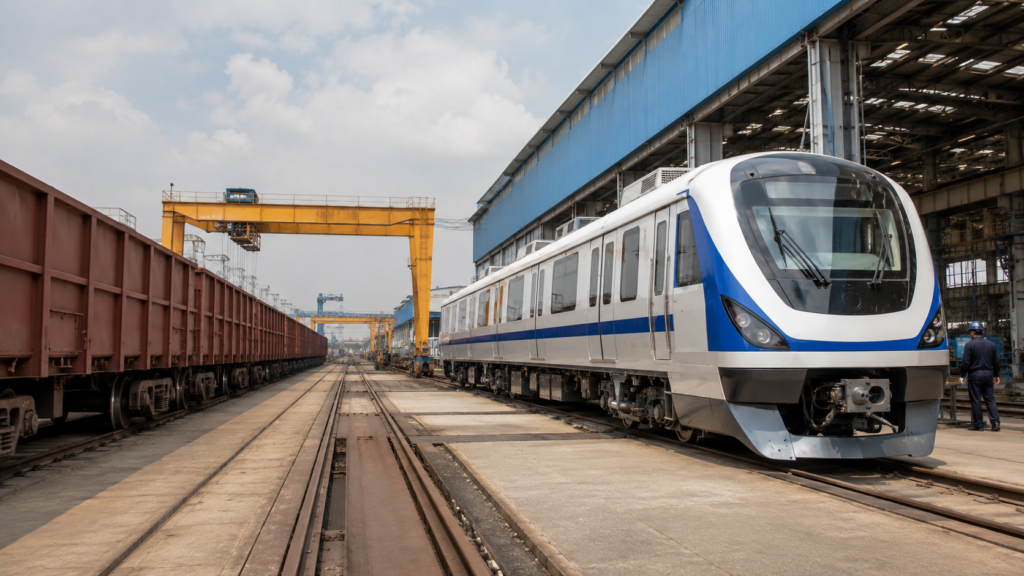
Passenger Rail Systems is emerging as the strategic swing factor because it offers a route to higher-value manufacturing and better segment margins. Titagarh Rail Systems Limited disclosed that its Passenger Rail Systems order book includes 519 metro coaches, 1,280 Vande Bharat coaches, 71 propulsion sets and 571 traction motors, excluding options. The company has also acquired about 40 acres at Uttarpara to expand manufacturing capacity and build a fully integrated facility with a 1.6 kilometre test track. That investment signals intent to move deeper into integrated passenger rail manufacturing rather than remain dependent on less complex assembly work.
The agreement with ABB for train control and management systems for 25 kV driverless metro applications and localisation of converters and traction motors is also important. It helps Titagarh Rail Systems Limited broaden its technical portfolio in metro traction systems, a market where localisation, reliability and qualification history matter. The company has already delivered its first indigenously manufactured stainless steel metro coach to Gujarat Metro and secured approval for an indigenously developed propulsion system for EMU trains from RDSO through a combined system test. These milestones are useful because they support the case that Titagarh Rail Systems Limited is building engineering depth, not merely riding public capex headlines.
The risk is that passenger rail ramp-up is unforgiving. Higher-value systems bring longer qualification cycles, stricter delivery conditions and customer scrutiny. The target of at least 200 passenger coaches in FY27, compared with 64 in FY26 and 12 in FY25, is ambitious enough to materially change the revenue mix. It is also ambitious enough to create disappointment if supply chain, testing, vendor localisation or customer acceptance timelines stretch. For investors, the key FY27 question is whether Passenger Rail Systems can scale without dragging working capital or exposing manufacturing bottlenecks.
What does the freight rail slowdown reveal about supply chain risk in Titagarh Rail Systems’ core business?
The freight rail slowdown is a reminder that order visibility does not automatically equal revenue recognition. Titagarh Rail Systems Limited dispatched 7,019 wagons in FY26, with the company attributing the weaker freight performance to wheelset and West Asia-related supply chain constraints. The company has set an FY27 target of 650 to 700 wagons per month, with potential to scale up to 1,000 wagons per month once new Indian Railways tenders are awarded. That guidance suggests management expects a recovery, but the gap between target and delivery will now become a quarterly scorecard item.
There are signs of strategic mitigation. The foundry upgrade, including resin-based moulding capacity expansion to 50,000 metric tonnes per annum, is designed to support full wagon output through backward integration. The forged wheel joint venture with Ramkrishna Forgings Limited is also central to the localisation story. That joint venture is expected to produce 228,000 forged wheels per annum, with commercial operations expected to begin in Q2 FY27 after hot trials and sample submissions. If the wheel project executes well, it could reduce dependence on constrained external supply chains over time.
However, the benefits will not be instant. Supply chain resilience takes time to show up in margins and delivery schedules. The FY26 experience shows that even a strong demand environment can be disrupted by component availability. For Titagarh Rail Systems Limited, the investment case now depends on whether backward integration can move from strategic promise to practical throughput. Investors will likely watch wagon dispatch cadence, wheel availability, inventory normalisation and Freight Rail Systems EBIT margins before assigning a stronger multiple to the recovery.
Why do cash flow, working capital and promoter warrants matter after Titagarh Rail Systems’ FY26 numbers?
The cash flow picture improved meaningfully in FY26, which is important for a company entering a capital-intensive execution phase. Titagarh Rail Systems Limited reported cash flow from operations of Rs 311.28 crore in FY26, compared with negative operating cash flow of Rs 101.15 crore in FY25. Cash generated from operations improved to Rs 380.42 crore, while year-end cash and cash equivalents rose to Rs 151.78 crore from Rs 17.36 crore. Net debt stood at Rs 93 crore, which suggests the balance sheet remains manageable despite capex and working capital demands.
The concern is working capital. Net working capital days rose to around 107 days from around 84 days, driven by mismatched inventory linked to supply chain constraints. That matters because rising inventory can quietly absorb cash even when reported profit looks acceptable. For rail systems companies, especially those ramping up passenger coaches, propulsion systems and wagon deliveries at the same time, working capital discipline can decide whether growth is self-funded or increasingly dependent on external capital. The market will not mind capex if it translates into throughput. It will be less forgiving if inventory builds faster than execution.
The Rs 200 crore promoter warrant issue at Rs 947 per share also deserves attention. Titagarh Rail Systems Limited has received 25 percent of the amount, or Rs 50 crore, with the balance due within 18 months. Since the warrant price is above the recent market price, the structure can be read as a confidence signal, but it also creates a visible conversion benchmark. Alongside the recommended Rs 1 per share dividend, the company appears to be balancing growth investment, shareholder signalling and capital reinforcement. That is sensible, but FY27 will decide whether the capital structure remains comfortably ahead of execution needs.
How does the Titagarh Naval Systems expansion add optionality beyond core rail manufacturing?
Titagarh Rail Systems Limited has hived off its shipbuilding and maritime business into Titagarh Naval Systems Limited, a wholly owned subsidiary, effective January 1, 2026. The subsidiary is setting up a brownfield shipyard at Falta with planned capex of around Rs 600 crore and has secured Rs 169 crore under the Shipbuilding Financial Assistance Scheme for the Falta expansion. The company has indicated that the project is ready with detailed project report, approvals and site preparation completed, with launch planned for June 2026.
This gives Titagarh Rail Systems Limited optionality in defence-linked and maritime manufacturing, but the market may treat it cautiously until orders and execution visibility improve. The company is exploring opportunities in small vessels, passenger ferries, craft, hovercraft for the Indian Coast Guard, tugs and vessels up to 120 metres. It is also seeking to upgrade from Category D to Category C shipyard status for Indian Navy opportunities. Strategically, this aligns with India’s broader push for domestic defence and maritime manufacturing. Financially, however, shipbuilding can be lumpy, capital-intensive and certification-heavy.
The maritime vertical should therefore be read as a medium-term option rather than a near-term earnings driver. If Titagarh Naval Systems Limited secures export or government-linked orders and manages capex discipline, it could diversify revenue beyond rail cycles. If the ramp-up is slower, the business could absorb management bandwidth and capital without immediate returns. For now, rail execution remains the main course. Shipbuilding is the spicy side dish, promising, but not something investors should overeat before the kitchen proves consistency.
Why did Titagarh Rail Systems stock react cautiously despite the Q4 FY26 profit recovery?
Titagarh Rail Systems Limited shares traded around Rs 801.40 to Rs 801.45 after the Q4 FY26 results, down roughly 2.7 percent to 3 percent in the session. The stock remains below its 52-week high of Rs 973.80 and around 41 percent above its 52-week low of Rs 568.70. One data source showed the stock down 3.68 percent over one week, while another showed a 4.3 percent gain over one month, indicating that the market is still oscillating between order book optimism and near-term execution caution.
That reaction makes sense. The Q4 profit recovery removes the noise from the prior year’s exceptional loss, but it does not fully answer the revenue decline, freight constraints or working capital questions. The stock already carries expectations linked to India’s rail capex cycle, metro expansion, Vande Bharat localisation and rolling stock demand. When expectations are high, the market usually wants clean revenue growth, not just strategic runway. A large order book helps, but quarterly execution is what keeps valuation pressure contained.
A neutral reading suggests Titagarh Rail Systems Limited remains a strong thematic beneficiary of India’s rail manufacturing cycle, but FY27 must validate the story. The stock’s current position below its 52-week high gives room for recovery if passenger coaches scale, freight dispatches normalise and cash flow remains positive. The risk is that any further supply chain disruption, passenger rail ramp delay or working capital stretch could keep investors cautious. For now, the stock is less a simple turnaround bet and more an execution-linked infrastructure manufacturing story.
Key takeaways on what Titagarh Rail Systems Q4 FY26 means for investors, competitors and India’s rail manufacturing sector
- Titagarh Rail Systems Limited has significant order visibility, with around Rs 14,240 crore of standalone order book including wholly owned subsidiaries and around Rs 27,540 crore including its share in joint ventures.
- The FY26 revenue decline shows that supply chain constraints can still disrupt execution even when rail demand remains structurally strong.
- Passenger Rail Systems is becoming the company’s most important growth lever, with revenue more than doubling and EBIT margin improving sharply in FY26.
- The FY27 target of at least 200 passenger coaches will be a major test of manufacturing scale, vendor readiness and customer acceptance timelines.
- Freight Rail Systems needs a clean recovery in wagon dispatches after FY26 was affected by wheelset and West Asia-related constraints.
- The Ramkrishna Titagarh Rail Wheels Limited joint venture could reduce long-term supply chain dependence if commercial operations begin as planned in Q2 FY27.
- Cash flow improved materially in FY26, but higher working capital days show that inventory mismatch remains a key watchpoint.
- The Titagarh Naval Systems Limited expansion creates diversification optionality, but maritime manufacturing will need order conversion and capex discipline before investors assign it major value.
- The stock reaction after Q4 FY26 suggests investors are not dismissing the long-term story, but they want proof that the order book can become predictable revenue.
- FY27 is likely to be judged less on headline announcements and more on quarterly delivery cadence, operating margins, working capital discipline and passenger rail execution.
Discover more from Business-News-Today.com
Subscribe to get the latest posts sent to your email.