




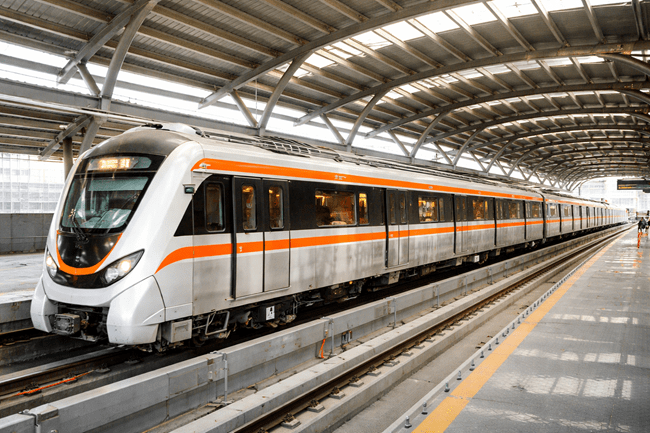
Titagarh Rail Systems Limited (NSE: TITAGARH) has delivered the first driverless metro trainset for Ahmedabad Metro Phase 2, reinforcing its role as a domestic leader in urban rail manufacturing and a strategic partner in India’s mass transit expansion. The rollout highlights the company’s growing capabilities in automated train systems, stainless steel design, and indigenous manufacturing, aligned with the “Make in India” vision.
How does the Ahmedabad Metro rollout reinforce Titagarh’s position in the Indian urban transit supply chain?
The delivery of the first driverless trainset to the Gujarat Metro Rail Corporation marks a high-visibility milestone in Titagarh Rail Systems Limited’s evolution from a domestic rolling stock supplier into a player shaping India’s automated metro future. With over 70–75% localized value content, the project represents not just a contract execution, but an industrial signaling moment for India’s push toward self-reliant transit infrastructure manufacturing.
The trainset was manufactured at Titagarh’s Passenger Rail Systems facility in Uttarpara, West Bengal, and ceremonially handed over in the presence of Gujarat Chief Minister Bhupendrabhai Patel. The event drew further weight from the attendance of key state advisors and the managing director of Gujarat Metro, signalling the political and institutional priority being placed on urban transit infrastructure in western India.
Notably, this rollout supports the expansion of the Ahmedabad Metro Phase 2 network, covering a 28.26 km elevated corridor with 22 stations. It includes the Yellow Line, connecting Narendra Modi Stadium to Mahatma Mandir in Gandhinagar, and the Violet Line extension to GIFT City. The route holds economic significance by linking high-footfall civic zones with financial and administrative clusters.
What technologies and design principles are embedded in the Ahmedabad trainsets?
Titagarh’s metro trainsets for Ahmedabad incorporate stainless steel car bodies that balance durability, lightweight build, and corrosion resistance—features critical for India’s diverse climate zones and high daily rider volumes. The use of stainless steel also enhances energy efficiency, aligning with sustainability goals for next-generation public transport.
The standout innovation, however, is the adoption of a modern Train Control and Management System (TCMS), which enables driverless operation. This move positions Titagarh among the few Indian players capable of delivering automated metro systems—an area previously dominated by multinational OEMs such as Alstom, Siemens, and CRRC.
Ergonomics and accessibility have also been considered. The design features spaces for Persons with Reduced Mobility (PRM), platform-level boarding, and a visual theme inspired by Garba dance, tying local cultural identity into transit branding—a growing trend in metro rail aesthetics.
The passenger experience elements, such as custom ceiling motifs and vibrant interior themes, reinforce how metro systems are now competing not just on function, but also on visual and emotional resonance in urban landscapes.
What strategic intent is signaled by Titagarh’s broader rollout and future capability plans?
Beyond the Ahmedabad trainset, Titagarh Rail Systems is making a longer-term bid to position itself as India’s go-to supplier for both conventional and high-speed rail programs. During the plant tour, the Chief Minister of Gujarat was shown the company’s ongoing work on the Vande Bharat trainsets, further solidifying Titagarh’s embedded role in multiple national rail projects.
Vice Chairman and Managing Director Umesh Chowdhary emphasized the company’s expansion trajectory, highlighting future ambitions to manufacture high-speed trains domestically. These comments suggest that Titagarh is not merely executing orders but is actively building platform capabilities that span multiple propulsion technologies and operational formats—from metro to semi-high-speed to eventually full high-speed rail.
If realized, this strategic move could open the company to participation in India’s longer-term bullet train ambitions, where technology partnerships, licensing deals, and capital expenditures could significantly reshape Titagarh’s balance sheet and shareholder value.
How does Titagarh’s local content strategy align with India’s manufacturing priorities?
The company’s claim of achieving 70–75% local content by value resonates strongly with government-led initiatives such as Atmanirbhar Bharat and the Production Linked Incentive (PLI) schemes. This high degree of indigenization also gives Titagarh a pricing edge in domestic tenders and may shield it from import-driven cost volatility—a key differentiator as currency fluctuations and supply chain realignments persist globally.
Moreover, the strategic location of the Uttarpara facility in West Bengal provides access to both eastern and central logistics corridors, reducing turnaround time for pan-India deployment. This plant, being already configured for large-scale coach assembly and automation integration, offers Titagarh the scale advantage needed to execute multi-city metro rail contracts concurrently.
The long-term implication here is clear: any upcoming metro expansions in cities such as Pune, Indore, and Bhopal may find Titagarh a more natural and economically efficient partner than multinational competitors with heavier import dependency.
What broader message does this send to institutional stakeholders and OEM competitors?
The presence of Gujarat’s top leadership at the handover ceremony was more than ceremonial. It signals a growing willingness among Indian states to visibly support domestic industrial champions and to place confidence in homegrown OEMs for sophisticated, safety-critical infrastructure.
This also puts institutional pressure on competitors—particularly foreign suppliers operating under joint ventures or technology-transfer agreements—to localize faster or risk being crowded out of high-volume, politically prioritized public transport projects.
The event also indirectly challenges Indian Railways’ own internal production units to justify their capital intensity and throughput as private players like Titagarh demonstrate faster innovation cycles and increasing automation capacity without legacy constraints.
For institutional investors tracking infrastructure and manufacturing plays, Titagarh Rail Systems Limited now warrants consideration as more than a rolling stock fabricator. It is evolving into a systems integrator and transit OEM with deep political capital, operational maturity, and an addressable market expanding across both public and private mobility projects.
Key takeaways: What this rollout signals for Titagarh, metro expansion, and India’s transit supply chain
- Titagarh Rail Systems Limited has delivered the first driverless metro trainset for Ahmedabad Metro Phase 2, built with 70–75% localized content.
- The rollout supports a key 28.26 km elevated corridor connecting Gandhinagar and Ahmedabad, including the GIFT City extension.
- Trainsets feature stainless steel car bodies, advanced TCMS for driverless operations, and interiors styled around Gujarat’s cultural themes.
- Gujarat’s Chief Minister endorsed Titagarh’s role in realizing the Make in India vision for high-tech urban infrastructure.
- The company is already executing Vande Bharat coach production and aims to enter high-speed train manufacturing, reflecting aggressive capability expansion.
- High localization improves Titagarh’s competitiveness in future metro and intercity rail tenders amid India’s PLI-driven procurement shifts.
- The rollout strengthens Titagarh’s standing against foreign OEMs and Indian Railways’ own manufacturing units by demonstrating quality, scale, and speed.
- For long-term investors and state governments, Titagarh’s trajectory positions it as a pivotal player in India’s urban and intercity mobility ecosystem.
Discover more from Business-News-Today.com
Subscribe to get the latest posts sent to your email.